February 14, 2006
Everything You Didn't Want to Know About St. Valentine and Didn't Care to Ask
From the Catholic Encyclopedia:
At least three different Saint Valentines, all of them martyrs, are mentioned in the early martyrologies under date of 14 February. One is described as a priest at Rome, another as bishop of Interamna (modern Terni), and these two seem both to have suffered in the second half of the third century and to have been buried on the Flaminian Way, but at different distances from the city. In William of Malmesbury's time what was known to the ancients as the Flaminian Gate of Rome and is now the Porta del Popolo, was called the Gate of St. Valentine. The name seems to have been taken from a small church dedicated to the saint which was in the immediate neighborhood. Of both these St. Valentines some sort of Acta are preserved but they are of relatively late date and of no historical value. Of the third Saint Valentine, who suffered in Africa with a number of companions, nothing further is known.
From a Carmelite community in Ireland:
The Roman Martyrology commemorates two martyrs named Valentine (or Valentinus) on February 14 which seems to indicate that both were beheaded on the Flaminian Way, one at Rome the other at Terni which is some 60 miles from Rome. Valentine of Rome was a priest who is said to have died about 269 during the persecution of Claudius the Goth (or Claudius II Gothicus). The other Valentine was allegedly Bishop of Terni, and his death is attested to in the Martyrology of St Jerome. Whether there were actually one or two Valentines is disputed. One possibility is that is two cults – one based in Rome, the other in Terni – may have sprung up to the same martyr but that in the mists of time his true identity became confused. . . .Under the rule of Emperor Claudius II, Rome was involved in many bloody and unpopular campaigns. Claudius the Cruel was having a difficult time getting soldiers to join his military leagues. He believed that the reason was that roman men did not want to leave their loves or families. As a result, Claudius cancelled all marriages and engagements in Rome. Claudius had also ordered all Romans to worship the state religion’s idols, and he had made it a crime punishable by death to associate with Christians. But Valentinus was dedicated to the ideals of Christ, and not even the threat of death could keep him from practicing his beliefs. Valentine and Saint Marius aided the Christian martyrs and secretly married couples, and for this kind deed Valentine was apprehended and dragged before the Prefect of Rome, who condemned him to be beaten to death with clubs and to have his head cut off. He suffered martyrdom on the 14th day of February, in either 269 or 270.
This is one legend surrounding Valentine’s martyrdom. The second is that during the last weeks of his life a remarkable thing happened. One day a jailer for the Emperor of Rome knocked at Valentine’s door clutching his blind daughter in his arms. He had learned of Valentine’s medical and spiritual healing abilities, and appealed to Valentine to treat his daughter’s blindness. She had been blind since birth. Valentine knew that her condition would be difficult to treat but he gave the man his word he would do his best. The little girl was examined, given an ointment for her eyes and a series of re-visits were scheduled.
Seeing that he was a man of learning, the jailer asked whether his daughter, Julia, might also be brought to Valentine for lessons. Julia was a pretty young girl with a quick mind. Valentine read stories of Rome’s history to her. He described the world of nature to her. He taught her arithmetic and told her about God. She saw the world through his eyes, trusted in his wisdom, and found comfort in his quiet strength.
One day she asked if God really existed and Valentine assured her that He did. She went on to tell him how she prayed morning and night that she might be able to see and Valentine told her that whatever happened would be God’s will and would be for the best. They sat and prayed together for a while.
Several weeks passed and the girl’s sight was not restored. Yet the man and his daughter never wavered in their faith and returned each week. Then one day, Valentine received a visit from the Roman soldiers who arrested him and who now destroyed his medicines and admonished him for his religious beliefs. When the little girl’s father learned of his arrest and imprisonment, he wanted to intervene but there was nothing he could do.
On the eve of his death, Valentine wrote a last note to Julia - knowing his execution was imminent. Valentine asked the jailer for a paper, pen and ink. He quickly jotted a farewell note and handed it to the jailer to give to his blind daughter. He urged her to stay close to God, and he signed it “From Your Valentine.” His sentence was carried out the next day, February 14, 269 A.D., near a gate that was later named Porta Valentini (now Porta del Popolo) in his memory.
When the jailer went home, he was greeted by his little girl. The little girl opened the note and discovered a yellow crocus inside. The message said, “From your Valentine.” As the little girl looked down upon the crocus that spilled into her palm she saw brilliant colours for the first time in her life! The girl’s eyesight had been restored.
He was buried at what is now the Church of Praxedes in Rome, near the cemetery of St Hippolytus. It is said that Julia herself planted a pink-blossomed almond tree near his grave. Today, the almond tree remains a symbol of abiding love and friendship. . . .
Compiled from various sources including The New Catholic Encyclopaedia (New York: McGraw Hill. 1967), Butler’s Lives of the Fathers, Martyrs and other principal Saints, and from the Encyclopaedia Britannica (London. 1962).
From the same community, come the following liturgical texts:
Entrance AntiphonHere is a true martyr who shed his blood for Christ.
His judges could not shake him by their menaces,
and so he won through to the Kingdom of Heaven.Opening Prayer
All powerful, ever living God,
You gave St Valentine the courage to witness to the Gospel of Christ, even to the point of giving his life for it. By his prayers help us to endure all suffering for love of you and to seek you with all our hearts, for you alone are the source of life.
Grant this through our Lord Jesus Christ, your Son . . . .First Reading
A reading from the letter of St James.
James 1:2-4, 12You will always have your trials, but when they come, try to treat them as a happy privilege; you understand that your faith is only put to the test to make you patient but patience too is to have its practical results so that you will become more fully developed, complete, with nothing missing. . . . Happy the man who stands firm when trials come. He has proved himself and will win the prize of life, the crown that the Lord has promised to those who love him.
This is the word of the Lord.
Gospel
A reading from the holy Gospel according to John.
John 12:24-26As the Father has loved me, so I have loved you. Remain in my love. If you keep my commandments you will remain in my love, just as I have kept my Father’s commandments and remain in his love. I have told you this so that my own joy may be in you and your joy be complete. This is my commandment: Love one another as I have loved you. A man can have no greater love than to lay down his life for his friends. You are my friends, if you do what I command you. I shall not call you servants anymore, because a servant does not know his master’s business; I call you friends, because I have made known to you everything I have learned from my Father. You did not choose me, no, I chose you; and I commissioned you to go out and to bear fruit, fruit that will last; and then the Father will give you anything you ask him in my name. What I command you, is to love one another.
This is the Gospel of the Lord.
Prayers of the Faithful
Lord, as we come to praise and worship you as Lord of our lives on this, the feast of St Valentine, help us to imitate his love for you and for each other. We ask you to listen and to grant our prayers:
We pray for all who have entered the Sacrament of Marriage: that they may be strengthened through prayer and the sacraments; that they may be a witness to the world of the joy of their lives together. Lord, . . .
For those who have recently become engaged: we thank God for them and pray for them that the Lord will help them in practical ways as they prepare for their lives together and that they will be blessed with good health and material blessings. Lord, . . .
We hear of many for whom marriage has broken down or where sickness or sadness seems to be their lot: Lord, you have promised we are never on our own, be with those who suffer and grant them your healing in their painful situation. Lord, . . .
We pray that the ideals of Christian Marriage may always be preserved: those ideals which value friendship, life, mutual help and love. May our homes be as that of the Holy Family – open to God and neighbour. Lord, . . .
Finally, let us pray that, like the seed that falls to the ground and dies, we may die daily to our own selfishness so that the true wheat of love may grow in our lives for others to see and take heart. Lord, . . .
Let us pray,
Lord, home is where love is meant to be and where you tell us you are present. Help us to make that presence real in our homes and communities by banishing evil and installing instead your grace. We make this prayer through Christ, our Lord.
Blessing of Rings
Lord,
X bless these rings.
Grant that those who wear them
may always be faithful to each other.
May they do your will
and live in peace with you in mutual love.
We ask this through Christ, our Lord.Prayer over the gifts
God of love,
pour out your blessing on our gifts
and make us strong in faith,
the faith which St Valentine professed by the shedding of his blood.
We ask this through Christ, our Lord.
Prayer after CommunionLord, we are renewed by the mystery of the Eucharist.
By imitating the fidelity of St Valentine,
and by our patience,
may we come to share the eternal life you have promised.
We ask this in the name of Jesus, the Lord.
January 30, 2006
Our Fathers Among the Saints, the Three Hierarchs Basil, Gregory and John
Troparion of the Three Great Hierarchs Tone 1
Let all who love their words come together and honour with hymns/ the three luminaries of the light-creating Trinity:/ Basil the Great, Gregory the Theologian,/ and renowned John of golden speech,/ who have enlightened the world with the rays of their divine doctrines,/ and are mellifluous rivers of wisdom/ who have watered all creation with streams of divine knowledge;/ they ever intercede with the Trinity for us.
Kontakion of the Three Great Hierarchs Tone 2
Thou hast taken the sacred and divinely inspired heralds,/ the crown of Thy teachers, O Lord,/ for the enjoyment of Thy blessings and for repose./ For Thou hast accepted their sufferings and labours above every burnt offering,/ O Thou Who alone dost glorify Thy Saints.
From the OCA website:
During the eleventh century, disputes raged in Constantinople about which of the three hierarchs was the greatest. Some preferred St Basil (January 1), others honored St Gregory the Theologian (January 25), while a third group exalted St John Chrysostom (November 13).Dissension among Christians increased. Some called themselves Basilians, others referred to themselves as Gregorians, and others as Johnites.
By the will of God, the three hierarchs appeared to St John the Bishop of Euchaita (June 14) in the year 1084, and said that they were equal before God. "There are no divisions among us, and no opposition to one another."
They ordered that the disputes should stop, and that their common commemoration should be celebrated on a single day. Bishop John chose January 30 for their joint Feast, thus ending the controversy and restoring peace.
January 28, 2006
Our Father Among the Saints, Ephraim the Syrian

Troparion of St Ephraim Tone 8
By a flood of tears you made the desert fertile,/ And your longing for God brought forth fruits in abundance./ By the radiance of miracles you illumined the whole universe./ O our holy father Ephraim, pray to Christ our God to save our souls!
Kontakion of St Ephraim Tone 2
O Ephraim, as a lover of silence/ thou didst ever forsee the hour of reckoning and bitterly lament;/and by thy words thou wast indeed a teacher, O righteous one./ Wherefore, O father of all the world,/ thou dost rouse the slothful to repentance.
The Saint Ephrem the Syrian Library
An article on St. Ephrem's prayer by Protopresbyter Alexander Schmemann
From the OCA website:
Saint Ephraim the Syrian, a teacher of repentance, was born at the beginning of the fourth century in the city of Nisibis (Mesopotamia) into the family of impoverished toilers of the soil. His parents raised their son in piety, but from his childhood he was known for his quick temper and impetuous character. He often had fights, acted thoughtlessly, and even doubted God's Providence. He finally recovered his senses by the grace of God, and embarked on the path of repentance and salvation.Once, he was unjustly accused of stealing a sheep and was thrown into prison. He heard a voice in a dream calling him to repent and correct his life. After this, he was acquitted of the charges and set free.
The young man ran off to the mountains to join the hermits. This form of Christian asceticism had been introduced by a disciple of St. Anthony the Great, the Egyptian desert dweller Eugenios.
St. James of Nisibis (January 13) was a noted ascetic, a preacher of Christianity and denouncer of the Arians. St. Ephraim became one of his disciples. Under the direction of the holy hierarch, St. Ephraim attained Christian meekness, humility, submission to God's will, and the strength to undergo various temptations without complaint.
St. James transformed the wayward youth into a humble and conrite monk. Realizing the great worth of his disciple, he made use of his talents. He trusted him to preach sermons, to instruct children in school, and he took Ephraim with him to the First Ecumenical Council at Nicea (in the year 325). St. Ephraim was in obedience to St. James for fourteen years, until the bishop's death in 338.
After the capture of Nisibis by the Persians in 363, St. Ephraim went to a monastery near the city of Edessa. Here he saw many great ascetics, passing their lives in prayer and psalmody. Their caves were solitary shelters, and they fed themselves with a certain plant.
He became especially close to the ascetic Julian (October 18), who was of one mind with him. St. Ephraim combined asceticism with a ceaseless study of the Word of God, taking from it both solace and wisdom for his soul. The Lord gave him a gift of teaching, and people began to come to him, wanting to hear his counsel, which produced compunction in the soul, since he began with self-accusation. Both verbally and in writing, St. Ephraim instructed everyone in repentance, faith and piety, and he denounced the Arian heresy, which at that time was causing great turmoil. Pagans who heard the preaching of the saint were converted to Christianity.
He also wrote the first Syriac commentary on the Pentateuch (i.e. "Five Books") of Moses. He wrote many prayers and hymns, thereby enriching the Church's liturgical services. Famous prayers of St. Ephraim are to the Most Holy Trinity, to the Son of God, and to the Most Holy Theotokos. He composed hymns for the Twelve Great Feasts of the Lord (the Nativity of Christ, the Baptism, the Resurrection), and funeral hymns. St. Ephraim's Prayer of Repentance, "O Lord and Master of my life...", is recited during Great Lent, and it summons Christians to spiritual renewal.
From ancient times the Church has valued the works of St. Ephraim. His works were read publicly in certain churches after the Holy Scripture, as St. Jerome tells us. At present, the Church Typikon prescribes certain of his instructions to be read on the days of Lent. Among the prophets, St. David is the preeminent psalmodist; among the Fathers of the Church, St. Ephraim the Syrian is the preeminent man of prayer. His spiritual experience made him a guide for monastics and a help to the pastors of Edessa. St. Ephraim wrote in Syriac, but his works were very early translated into Greek and Armenian. Translations into Latin and Slavonic were made from the Greek text.
In many of St. Ephraim's works we catch glimpses of the life of the Syrian ascetics, which was centered on prayer and working in various obediences for the common good of the brethren. The outlook of all the Syrian ascetics was the same. The monks believed that the goal of their efforts was communion with God and the acquisition of divine grace. For them, the present life was a time of tears, fasting and toil.
"If the Son of God is within you, then His Kingdom is also within you. Thus, the Kingdom of God is within you, a sinner. Enter into yourself, search diligently and without toil you shall find it. Outside of you is death, and the door to it is sin. Enter into yourself, dwell within your heart, for God is there."
Constant spiritual sobriety, the developing of good within man's soul gives him the possibility to take upon himself a task like blessedness, and a self-constraint like sanctity. The requital is presupposed in the earthly life of man, it is an undertaking of spiritual perfection by degrees. Whoever grows himself wings upon the earth, says St. Ephraim, is one who soars up into the heights; whoever purifies his mind here below, there glimpses the Glory of God. In whatever measure each one loves God, he is, by God's love,satiated to fullness according to that measure. Man, cleansing himself and attaining the grace of the Holy Spirit while still here on earth, has a foretaste of the Kingdom of Heaven. To attain to life eternal, in the teachings of St. Ephraim, does not mean to pass over from one realm of being into another, but rather to discover "the heavenly," spiritual condition of being. Eternal life is not bestown on man through God's one-sided efforts, but rather, it constantly grows like a seed within him by his efforts, toils and struggles.
The pledge within us of "theosis" (or "deification") is the Baptism of Christ, and the main force that drives the Christian life is repentance. St. Ephraim was a great teacher of repentance. The forgiveness of sins in the Mystery of Repentance, according to his teaching, is not an external exoneration, not a forgetting of the sins, but rather their complete undoing, their annihilation. The tears of repentance wash away and burn away the sin. Moreover, they (i.e. the tears) enliven, they transfigure sinful nature, they give the strength "to walk in the way of the the Lord's commandments," encouraging hope in God. In the fiery font of repentance, the saint wrote, "you sail yourself across, O sinner, you resurrect yourself from the dead."
St. Ephraim, accounting himself as the least and worst of all, went to Egypt at the end of his life to see the efforts of the great ascetics. He was accepted there as a welcome guest and received great solace from conversing with them. On his return journey he visited at Caesarea in Cappadocia with St. Basil the Great (January 1), who wanted to ordain him a priest, but he considered himself unworthy of the priesthood. At the insistence of St. Basil, he consented only to be ordained as a deacon, in which rank he remained until his death. Later on, St. Basil invited St. Ephraim to accept a bishop's throne, but the saint feigned madness in order to avoid this honor, humbly regarding himself as unworthy of it.
After his return to his own Edessa wilderness, St. Ephraim hoped to spend the rest of his life in solitude, but divine Providence again summoned him to serve his neighbor. The inhabitants of Edessa were suffering from a devastating famine. By the influence of his word, the saint persuaded the wealthy to render aid to those in need. From the offerings of believers he built a poor-house for the poor and sick. St. Ephraim then withdrew to a cave near Edessa, where he remained to the end of his days.
January 25, 2006
Our Father Among the Saints, Gregory of Nazianzus, Archbishop of Constantinople, the Theologian

Troparion of St Gregory the Theologian Tone 1
The shepherd's pipe of thy theology/ conquered the philosophers' trumpets;/ for since thou didst search out the depths of the Spirit,/ beauty of speech was added to thee./ Intercede with Christ our God that our souls may be saved,/ O Father Gregory.
Kontakion of St Gregory the Theologian Tone 3
With thy theologian's speech thou didst dispel the philosopher's cobwebs,/ O glorious Gregory;/ and thou dost adorn the robe of Orthodoxy woven for the Church from on high./ Wearing this, she cries out with us thy children:/ Rejoice, O Father, most excellent mind of theology.
From the Prolog:
Gregory was born in Nazianzus of a Greek father and a Christian mother. Before his baptism, he studied in Athens along with Basil the Great and Julian the Apostate. Gregory often prophesied that Julian would become an apostate and a persecutor of the Church which actually happened. Gregory was especially influenced greatly by his good mother Nonna. When he completed his studies, Gregory was baptized. St. Basil consecrated him as bishop of Sasima, and Emperor Theodosius the Great summoned him to fill the vacant archepiscopal throne of Constantinople. He wrote numerous works of which his most famous are those concerning theology for which he is called The Theologian. Especially known because of its depth is his work: Homilies on The Holy Trinity. Gregory wrote against the heretic Macedonius who erroneously taught that the Holy Spirit is a creation of God and, Gregory also wrote against Appolinarius who erroneously taught that Christ did not have a human soul but that His divinity was in lieu of His soul. Additionally Gregory wrote against Emperor Julian the Apostate, his one-time colleague in school. In 381 A.D., when a debate began regarding his election as archbishop, he withdrew on his own and issued a statement: "Those, who deprive us of our archepiscopal throne cannot deprive us of God." After that, he left Constantinople and went to Nazianzus and there lived a life of solitude and prayer, writing worthwhile books. Even though he was in poor health throughout his entire life, nevertheless, Gregory lived to be eighty years old. His relics were later transferred to Rome. A reliquary containing his head reposes in the Cathedral Church of the Assumption in Moscow. He was, and remains, a great and wonderful light of the Orthodox Church as much by his meekness and purity of character as well as for the unsurpassable depth of his mind. He died in the Lord in the year 390 A.D.
First Theological Oration (XXVII): Against the Eunomians (excerpts from this oration are posted on my companion blog: here, here, here, here, and here)
Second Theological Oration (XXVIII)
Third Theological Oration (XXIX): The First on the Son (this is also posted on my companion blog)
Fourth Theological Oration (XXX): The Second on the Son
Fifth Theological Oration (XXXII): On the Holy Spirit
From the OCA website:
Saint Gregory the Theologian, Archbishop of Constantinople, a great Father and teacher of the Church, was born into a Christian family of eminent lineage in the year 329, at Arianzos (not far from the city of Cappadocian Nazianzos). His father, also named Gregory (January 1), was Bishop of Nazianzus. The son is the St. Gregory Nazianzus encountered in Patristic theology. His pious mother, St. Nonna (August 5), prayed to God for a son, vowing to dedicate him to the Lord. Her prayer was answered, and she named her child Gregory.When the child learned to read, his mother presented him with the Holy Scripture. St. Gregory received a complete and extensive education: after working at home with his uncle St. Amphilochios, an experienced teacher of rhetoric, he then studied in the schools of Nazianzos, Caesarea in Cappadocia, and Alexandria. Then the saint decided to go to Athens to complete his education.
On the way from Alexandria to Greece, a terrible storm raged for many days. St. Gregory, who was just a catechumen at that time, feared that he would perish in the sea before being cleansed in the waters of Baptism. St. Gregory lay in the ship's stern for twenty days, beseeching the merciful God for salvation. He vowed to dedicate himself to God, and was saved when he invoked the name of the Lord.
St. Gregory spent six years in Athens studying rhetoric, poetry, geometry, and astronomy. His teachers were the reknowned pagan rhetoricians Gymorias and Proeresias. St. Basil, the future Archbishop of Caesarea (January 1) also studied in Athens with St. Gregory. They were such close friends that they seemed to be one soul in two bodies. Julian, the future emperor (361-363) and apostate from the Christian Faith, was studying philosophy in Athens at the same time.
Upon completing his education, St. Gregory remained for a certain while at Athens as a teacher of rhetoric. He was also familiar with pagan philosophy and literature.
In 358 St. Gregory quietly left Athens and returned to his parents at Nazianzus. At thirty-three years of age, he received Baptism from his father, who had been appointed Bishop of Nazianzus. Against his will, St. Gregory was ordained to the holy priesthood by his father. However, when the elder Gregory wished to make him a bishop, he fled to join his friend Basil in Pontus. St. Basil had organized a monastery in Pontus and had written to Gregory inviting him to come.
St. Gregory remained with St. Basil for several years. When his brother St. Caesarius (March 9) died, he returned home to help his father administer his diocese. The local church was also in turmoil because of the Arian heresy. St. Gregory had the difficult task of reconciling the bishop with his flock, who condemned their pastor for signing an ambiguous interpretation of the dogmas of the faith.
St. Gregory convinced his father of the pernicious nature of Arianism, and strengthened him in Orthodoxy. At this time, Bishop Anthimos, who pretended to be Orthodox but was really a heretic, became Metropolitan of Tyana. St. Basil had been consecrated as the Archbishop of Caesarea, Cappadocia. Anthimos wished to separate from St. Basil and to divide the province of Cappadocia.
St. Basil the Great made St. Gregory bishop of the city of Sasima, a small town between Caesarea and Tyana. However, St. Gregory remained at Nazianzos in order to assist his dying father, and he guided the flock of this city for a while after the death of his father in 374.
Upon the death of Patriarch Valentus of Constantinople in the year 378, a council of bishops invited St. Gregory to help the Constantinople Church, which at this time was ravaged by heretics. Obtaining the consent of St. Basil the Great, St. Gregory came to Constantinople to combat heresy. In the year 379 he began to serve and preach in a small church called "Anastasis" ("Resurrection"). Like David fighting the Philistines with a sling, St. Gregory battled against impossible odds to defeat false doctrine.
Heretics were in the majority in the capital, Arians, Macedonians, and Appolinarians. The more he preached, the more did the number of heretics decrease, and the number of the Orthodox increased. On the night of Pascha (April 21, 379) when St. Gregory was baptizing catechumens, a mob of armed heretics burst into the church and cast stones at the Orthodox, killing one bishop and wounding St. Gregory. But the fortitude and mildness of the saint were his armor, and his words converted many to the Orthodox Church.
St. Gregory's literary works (orations, letters, poems) show him as a worthy preacher of the truth of Christ. He had a literary gift, and the saint sought to offer his talent to God the Word: "I offer this gift to my God, I dedicate this gift to Him. Only this remains to me as my treasure. I gave up everything else at the command of the Spirit. I gave all that I had to obtain the pearl of great price. Only in words do I master it, as a servant of the Word. I would never intentionally wish to disdain this wealth. I esteem it, I set value by it, I am comforted by it more than others are comforted by all the treasures of the world. It is the companion of all my life, a good counselor and converser; a guide on the way to Heaven and a fervent co-ascetic." In order to preach the Word of God properly, the saint carefully prepared and revised his works.
In five sermons, or "Theological Orations," St. Gregory first of all defines the characteristics of a theologian, and who may theologize. Only those who are experienced can properly reason about God, those who are successful at contemplation and, most importantly, who are pure in soul and body, and utterly selfless. To reason about God properly is possible only for one who enters into it with fervor and reverence.
Explaining that God has concealed His Essence from mankind, St. Gregory demonstrates that it is impossible for those in the flesh to view mental objects without a mixture of the corporeal. Talking about God in a positive sense is possible only when we become free from the external impressions of things and from their effects, when our guide, the mind, does not adhere to impure transitory images. Answering the Eunomians, who would presume to grasp God's Essence through logical speculation, the saint declared that man perceives God when the mind and reason become godlike and divine, i.e. when the image ascends to its Archetype. (Or. 28:17). Furthermore, the example of the Old Testament patriarchs and prophets and also the Apostles has demonstrated, that the Essence of God is incomprehensible for mortal man. St. Gregory cited the futile sophistry of Eunomios: "God begat the Son either through His will, or contrary to will. If He begat contrary to will, then He underwent constraint. If by His will, then the Son is the Son of His intent."
Confuting such reasoning, St. Gregory points out the harm it does to man: "You yourself, who speak so thoughtlessly, were you begotten voluntarily or involuntarily by your father? If involuntarily, then your father was under the sway of some tyrant. Who? You can hardly say it was nature, for nature is tolerant of chastity. If it was voluntarily, then by a few syllables you deprive yourself of your father, for thus you are shown to be the son of Will, and not of your father" (Or. 29:6).
St. Gregory then turns to Holy Scripture, with particular attention examining a place where it points out the Divine Nature of the Son of God. St. Gregory's interpretations of Holy Scripture are devoted to revealing that the divine power of the Savior was actualized even when He assumed an impaired human nature for the salvation of mankind.
The first of St. Gregory's Five Theological Orations is devoted to arguments against the Eunomians for their blasphemy of the Holy Spirit. Closely examining everything that is said in the Gospel about the Third Person of the Most Holy Trinity, the saint refutes the heresy of Eunomios, which rejected the divinity of the Holy Spirit. He comes to two fundamental conclusions. First, in reading Holy Scripture, it is necessary to reject blind literalism and to try and understand its spiritual sense. Second, in the Old Testament the Holy Spirit operated in a hidden way. "Now the Spirit Himself dwells among us and makes the manifestation of Himself more certain. It was not safe, as long as they did not acknowledge the divinity of the Father, to proclaim openly that of the Son; and as long as the divinity of the Son was not accepted, they could not, to express it somewhat boldly, impose on us the burden of the Holy Spirit" (Or. 31:26).
The divinity of the Holy Spirit is a sublime subject. "Look at these facts: Christ is born, the Holy Spirit is His Forerunner. Christ is baptized, the Spirit bears witness to this... Christ works miracles, the Spirit accompanies them. Christ ascends, the Spirit takes His place. What great things are there in the idea of God which are not in His power? What titles appertaining to God do not apply also to Him, except for Unbegotten and Begotten? I tremble when I think of such an abundance of titles, and how many Names they blaspheme, those who revolt against the Spirit!" (Or. 31:29).
The Orations of St. Gregory are not limited only to this topic. He also wrote Panegyrics on Saints, Festal Orations, two invectives against Julian the Apostate, "two pillars, on which the impiety of Julian is indelibly written for posterity," and various orations on other topics. In all, forty-five of St. Gregory's orations have been preserved.
The letters of the saint compare favorably with his best theological works. All of them are clear, yet concise. In his poems as in all things, St. Gregory focused on Christ. "If the lengthy tracts of the heretics are new Psalters at variance with David, and the pretty verses they honor are like a third testament, then we also shall sing Psalms, and begin to write much and compose poetic meters," said the saint. Of his poetic gift the saint wrote: "I am an organ of the Lord, and sweetly... do I glorify the King, all atremble before Him."
The fame of the Orthodox preacher spread through East and West. But the saint lived in the capital as though he still lived in the wilderness: "his food was food of the wilderness; his clothing was whatever necessary. He made visitations without pretense, and though in proximity of the court, he sought nothing from the court."
The saint received a shock when he was ill. One whom he considered as his friend, the philosopher Maximos, was consecrated at Constantinople in St. Gregory's place. Struck by the ingratitude of Maximos, the saint decided to resign the cathedra, but his faithful flock restrained him from it. The people threw the usurper out of the city. On November 24, 380 the holy emperor Theodosius arrived in the capital and, in enforcing his decree against the heretics, the main church was returned to the Orthodox, with St. Gregory making a solemn entrance. An attempt on the life of St. Gregory was planned, but instead the assassin appeared before the saint with tears of repentance.
At the Second Ecumenical Council in 381, St. Gregory was chosen as Patriarch of Constantinople. After the death of Patriarch Meletios of Antioch, St. Gregory presided at the Council. Hoping to reconcile the West with the East, he offered to recognize Paulinus as Patriarch of Antioch.
Those who had acted against St. Gregory on behalf of Maximos, particularly Egyptian and Macedonian bishops, arrived late for the Council. They did not want to acknowledge the saint as Patriarch of Constantinople, since he was elected in their absence.
St. Gregory decided to resign his office for the sake of peace in the Church: "Let me be as the Prophet Jonah! I was responsible for the storm, but I would sacrifice myself for the salvation of the ship. Seize me and throw me... I was not happy when I ascended the throne, and gladly would I descend it."
After telling the emperor of his desire to quit the capital, St. Gregory appeared again at the Council to deliver a farewell address (Or. 42) asking to be allowed to depart in peace.
Upon his return to his native region, St. Gregory turned his attention to the incursion of Appolinarian heretics into the flock of Nazianzus, and he established the pious Eulalios there as bishop, while he himself withdrew into the solitude of Arianzos so dear to his heart. The saint, zealous for the truth of Christ continued to affirm Orthodoxy through his letters and poems, while remaining in the wilderness. He died on January 25, 389, and is honored with the title "Theologian," also given to the holy Apostle and Evangelist John.
In his works St. Gregory, like that other Theologian St. John, directs everything toward the Pre-eternal Word. St. John of Damascus (December 4), in the first part of his book AN EXACT EXPOSITION OF THE ORTHODOX FAITH, followed the lead of St. Gregory the Theologian.
St. Gregory was buried at Nazianzos. In the year 950, his holy relics were transferred to Constantinople into the church of the Holy Apostles. Later on, a portion of his relics was transferred to Rome.
In appearance, the saint was of medium height and somewhat pale. He had thick eyebrows, and a short beard. His contemporaries already called the archpastor a saint. The Orthodox Church, honors St. Gregory as a second Theologian and insightful writer on the Holy Trinity.
"O glorious Father Gregory, Your knowledge has overcome the pride of false wisdom. The church is clothed with your teaching as a robe of righteousness. We your children celebrate your memory crying out: Rejoice, O father of unsurpassable wisdom!" [Kontakion].
January 24, 2006
Our Mother Among the Saints, Xenia of St. Petersburg, Fool for Christ
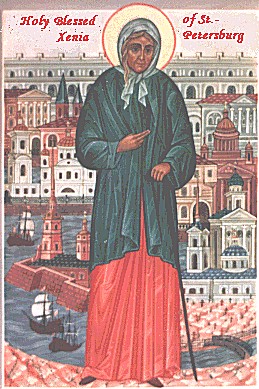
Troparion of St Xenia of St Petersburg Tone 8
Christ the Lord has shown forth in thee a new mediatress and intercessor for our race;/ thou didst will to endure evil in thy life and didst lovingly serve both God and man./ We zealously run to thee in misfortune and sorrow,/ we hope in thee and cry from our hearts:/ Put not our hope to shame, O blessed Xenia.
Another Troparion of St Xenia of St Petersburg Tone 5
Having lived as a stranger in the world, O Xenia,/ thou didst outwit the deviser of evil/ by thy pretended foolishness./ Thou didst receive from God/ grace to foresee and foretell things to come./ Now thou hast been translated from earth/ and art numbered with the choirs of Angels.
Kontakion of St Xenia of St Petersburg Tone 4
Thou didst give thy wealth to the poor, O Xenia,/ and accept poverty out of love for Christ;/ and having lived in a manner rivalling the Angels/ thou wast counted worthy/ of glory on high.
January 21, 2006
Our Father Among the Saints, Maximos the Confessor

Troparion of St Maximos the Confessor Tone 3
Through thee the Spirit poured forth/ streams of teaching for the Church;/ thou didst expound God the Word's self emptying,/ and shine forth in thy struggles as a true Confessor of the Faith;/ holy Father Maximos, pray to Christ our God to grant us His great mercy.
Kontakion of St Maximos the Confessor Tone 8
O faithful, let us acclaim the lover of the Trinity,/ great Maximos who taught the God-inspired Faith,/ that Christ is to be glorified in two natures, wills and energies:/ and let us cry to him: Rejoice, O herald of the Faith.
From the Prolog
Maximus was a Constantinopolian by birth and, at first, a high-ranking courtier at the court of Emperor Heraclius and, after that, a monk and abbot of a monastery not too far from the capitol. He was the greatest defender of Orthodoxy against the so-called Monothelite heresy which proceeded from the heresy of Eutyches. That is to say: As Eutyches claimed that there is only one nature in Christ [Monophysitism], so the Monothelites claimed that there is only one will in Christ [Monothelitism]. Maximus opposed that claim and found himself as an opponent of the emperor and the patriarch. Maximus did not frighten easily but endured to the end in proving that there were two wills as well as two natures in Christ. Because of his efforts, a council was held in Carthage and another in Rome. Both councils anathematized the teachings of the Monothelites. The suffering of Maximus for Orthodoxy cannot be described: he was tortured by princes, deceived by prelates, spat upon by the masses of the people, beaten by soldiers, exiled, imprisoned, until finally, with a severed tongue and hand, he was condemned to exile for life in the land of Skhemaris [near Batum on the Black Sea] where he spent three years in prison and gave up his soul to God in the year 666 A.D.
St. Maximos the Confessor: Selections from the Chapters on Knowledge
Maximos Confessor: Selections from the Mystagogy
St Maximos the Confessor: On Deification
From OCA website:
Saint Maximus the Confessor was born in Constantinople around 580 and raised in a pious Christian family. He received an excellent education, studying philosophy, grammar, and rhetoric. He was well-read in the authors of antiquity and he also mastered philosophy and theology. When St. Maximus entered into government service, he became first secretary (asekretis) and chief counselor to the emperor Heraklios (611-641), who was impressed by his knowledge and virtuous life.St. Maximus soon realized that the emperor and many others had been corrupted by the Monothelite heresy, which was spreading rapidly through the East. He resigned from his duties at court, and went to the Chrysopolis monastery (at Skutari on the opposite shore of the Bosphorus), where he received monastic tonsure. Because of his humility and wisdom, he soon won the love of the brethren and was chosen igumen of the monastery after a few years. Even in this position, he remained a simple monk.
In 638, the emperor Heraklios and Patriarch Sergius tried to minimize the importance of differences in belief, and they issued an edict, the "Ekthesis" ("Ekthesis tes pisteos" or "Exposition of Faith), which decreed that everyone must accept the teaching of one will in the two natures of the Savior. In defending Orthodoxy against the "Ekthesis," St. Maximus spoke to people in various occupations and positions, and these conversations were successful. Not only the clergy and the bishops, but also the people and the secular officials felt some sort of invisible attraction to him, as we read in his Life.
When St. Maximus saw what turmoil this heresy caused in Constantinople and in the East, he decided to leave his monstery and seek refuge in the West, where Monothelitism had been completely rejected. On the way, he visited the bishops of Africa, strengthening them in Orthodoxy, and encouraging them not to be deceived by the cunning arguments of the heretics.
The Fourth Ecumenical Council had condemned the Monophysite heresy, which falsely taught that in the Lord Jesus Christ there was only one nature (the divine). Influenced by this erroneous opinion, the Monothelite heretics said that in Christ there was only one divine will ("thelema") and only one divine energy ("energia"). Adherents of Monothelitism sought to return by another path to the repudiated Monophysite heresy. Monothelitism found numerous adherents in Armenia, Syria, Egypt. The heresy, fanned also by nationalistic animosities, became a serious threat to Church unity in the East. The struggle of Orthodoxy with heresy was particularly difficult because in the year 630, three of the patriarchal thrones in the Orthodox East were occupied by Monothelites: Constantinople by Sergios, Antioch by Athanasios, and Alexandria by Cyrus.
St. Maximus traveled from Alexandria to Crete, where he began his preaching activity. He clashed there with a bishop, who adhered to the heretical opinions of Severus and Nestorius. The saint spent six years in Alexandria and the surrounding area.
Patriarch Sergios died at the end of 638, and the emperor Heraklios also died in 641. The imperial throne was eventually occupied by his grandson Constans II (642-668), an open adherent of the Monothelite heresy. The assaults of the heretics against Orthodoxy intensified. St. Maximus went to Carthage and he preached there for about five years. When the Monothelite Pyrrhus, the successor of Patriarch Sergius, arrived there after fleeing from Constantinople because of court intrigues, he and St. Maximus spent many hours in debate. As a result, Pyrrhus publicly acknowledged his error, and was permitted to retain the title of "Patriarch." He even wrote a book confessing the Orthodox Faith. St. Maximus and Pyrrhus traveled to Rome to visit Pope Theodore, who received Pyrrhus as the Patriarch of Constantinople.
In the year 647 St. Maximus returned to Africa. There, at a council of bishops Monotheletism was condemned as a heresy. In 648, a new edict was issued, commissioned by Constans and compiled by Patriarch Paul of Constantinople: the "Typos" ("Typos tes pisteos" or "Pattern of the Faith"), which forbade any further disputes about one will or two wills in the Lord Jesus Christ. St. Maximus then asked St. Martin the Confessor (April 14), the successor of Pope Theodore, to examine the question of Monothelitism at a Church Council. The Lateran Council was convened in October of 649. One hundred and fifty Western bishops and thirty-seven representatives from the Orthodox East were present, among them St. Maximus the Confessor. The Council condemned Monothelitism, and the Typos. The false teachings of Patriarchs Sergius, Paul and Pyrrhus of Constantinople, were also anathematized.
When Constans II received the decisions of the Council, he gave orders to arrest both Pope Martin and St. Maximus. The emperor's order was fulfilled only in the year 654.St. Maximus was accused of treason and locked up in prison. In 656 he was sent to Thrace, and was later brought back to a Constantinople prison.
The saint and two of his disciples were subjected to the cruelest torments. Each one's tongue was cut out, and his right hand was cut off. Then they were exiled to Skemarum in Scythia, enduring many sufferings and difficulties on the journey.
After three years, the Lord revaled to St. Maximus the time of his death (August 13, 662). Three candles appeared over the grave of St. Maximus and burned miraculously. This was a sign that St. Maximus was a beacon of Orthodoxy during his lifetime, and continues to shine forth as an example of virtue for all. Many healings occurred at his tomb.
In the Greek Prologue, August 13 commemorates the Transfer of the Relics of St. Maximus to Constantinople, but it could also be the date of the saint's death. It may be that his memory is celebrated on January 21 because August 13 is the Leavetaking of the Feast of the Transfiguration of the Lord.
St. Maximus has left to the Church a great theological legacy. His exegetical works contain explanations of difficult passages of Holy Scripture, and include a Commentary on the Lord's Prayer and on Psalm 59, various "scholia" or "marginalia" (commentaries written in the margin of manuscripts), on treatises of the Hieromartyr Dionysios the Areopagite (October 3) and St. Gregory the Theologian (January 25). Among the exegetical works of St. Maximus are his explanation of divine services, entitled "Mystagogia" ("Introduction Concerning the Mystery").
The dogmatic works of St. Maximus include the Exposition of his dispute with Pyrrhus, and several tracts and letters to various people. In them are contained explanations of the Orthodox teaching on the Divine Essence and the Persons of the Holy Trinity, on the Incarnation of the Word of God, and on "theosis" ("deification") of human nature.
"Nothing in theosis is the product of human nature," St. Maximus writes in a letter to his friend Thalassios, "for nature cannot comprehend God. It is only the mercy of God that has the capacity to endow theosis unto the existing... In theosis man (the image of God) becomes likened to God, he rejoices in all the plenitude that does not belong to him by nature, because the grace of the Spirit triumphs within him, and because God acts in him" (Letter 22).
St. Maximus also wrote anthropological works (i.e. concerning man). He deliberates on the nature of the soul and its conscious existence after death. Among his moral compositions, especially important is his "Chapters on Love." St. Maximus the Confessor also wrote three hymns in the finest traditions of church hymnography, following the example of St. Gregory the Theologian.
The theology of St. Maximus the Confessor, based on the spiritual experience of the knowledge of the great Desert Fathers, and utilizing the skilled art of dialectics worked out by pre-Christian philosophy, was continued and developed in the works of St. Symeon the New Theologian (March 12), and St. Gregory Palamas (November 14).
January 19, 2006
Our Father Among the Saints, Mark Evgenikes, Archbishop of Ephesus

Troparion of St Mark of Ephesus Tone 3
Holy Mark, in thee the Church has found a zealot/ by thy confession of the sacred Faith;/ for thou didst champion the Fathers' doctrine/ and cast down the pride of boastful darkness./ Pray to Christ our God for those who honour thee,/ that we may be granted the forgiveness of sins.
Kontakion of St Mark of Ephesus Tone 3
As one clad in invincible armour,/ thou didst cast down the pride of the Western rebellion;/ thou didst become an instrument of the Comforter/ and shine forth as Orthodoxy's defender./ Therefore we cry to thee: Rejoice, O Mark, boast of the Orthodox.
From the OCA website:
Saint Mark Eugenikos, Archbishop of Ephesus, was a stalwart defender of Orthodoxy at the Council of Florence. He would not agree to a union with Rome which was based on theological compromise and political expediency (the Byzantine Emperor was seeking military assistance from the West against the Moslems who were drawing ever closer to Constantinople). St. Mark countered the arguments of his opponents, drawing from the well of pure theology, and the teachings of the holy Fathers. When the members of his own delegation tried to pressure him into accepting the Union he replied, "There can be no compromise in matters of the Orthodox Faith."Although the Orthodox delegation signed the Tomos of Union, St. Mark was the only one who refused to do so. When he returned from Florence, St. Mark urged the inhabitants of Constantinople to repudiate the dishonorable document of union. He died in 1457 at the age of fifty-two, admired and honored by all.
Cf. St. Mark of Ephesus and the False Union of Florence: Part III from His Life
From St. Mark of Ephesus: A True Ecumenist:
When the foundations of Byzantium were crumbling, diplomats redoubled their efforts to find a possibility of union with Western powers for a battle against the common adversary of Christianity, Islam. Attempts were made to conclude treaties with the Turks, but these were unsuccessful. The only hope lay in the West. For this it was necessary above all to make peace with the Vatican.A Council was convened in 1437, which established a committee of Latin and Greek theologians with the Pope and the Byzantine Emperor acting as heads. The Pope, Eugenius IV, had a very exalted idea of the papacy and aimed at subjecting the Orthodox Church to himself. Prompted by the straitened circumstances of Byzantium, the Emperor pursued his aim: to conclude an agreement profitable for his country. Few gave thought to the spiritual consequences of such a union. Only one delegate, the Metropolitan of Ephesus, St. Mark, stood in firm opposition.
In his address to the Pope at the opening of the Council, St. Mark explained how ardently he desired this union with the Latins- but a genuine union, he explained, based upon unity of faith and ancient Liturgical practice. He also informed the Pope that he and the other Orthodox bishops had come to the Council not to sign a capitulation, and not to sell Orthodoxy for the benefit of their government, but in order to confirm true and pure doctrine.
Many of the Greek delegates, however, thought that the salvation of Byzantium could be attained only through union with Rome. More and more became willing to compromise the eternal Truth for the sake of preserving a temporal kingdom. Furthermore, the negotiations were of such unexpectedly long duration that the Greek delegates no longer had means to support themselves; they began to suffer from hunger and were anxious to return home. The Pope, however, refused to give them any support until a "Union" had been concluded. Taking advantage of the Situation and realizing the futility of further debates, the Latins used their economic and political advantage to bring pressure on the Orthodox delegation, demanding that they capitulate to the Roman Church and accept all her doctrines and administrative control.
St. Mark stood alone against the rising tide which threatened to overturn the ark of the true Church. He was pressured on all sides, not only by the Latins, but by his fellow Greeks and the Patriarch of Constantinople himself. Seeing his persistent and stouthearted refusal to sign any kind of accord with Rome under the given conditions, the Emperor dismissed him from all further debates with the Latins and placed him under house arrest. By this time St. Mark had fallen very ill (apparently suffering from cancer of the intestine). But this exhausted, fatally ill man, who found himself persecuted and in disgrace, represented in his per son the Orthodox Church; he was a spiritual giant with whom there is none to compare.
Events followed in rapid succession. The aged Patriarch Joseph of Constantinople died; a forged document of submission to Rome was produced; Emperor John Paleologos took the direction of the Church into his own hands, and the Orthodox were obliged. to renounce their Orthodoxy and to accept all of the Latin errors, novelties, and innovations on all counts, including complete acceptance of the Pope as having "a primacy over the whole earth." During a triumphant service following the signing of the Union on July 5, 1439, the Greek delegates solemnly kissed the Pope's knee. Orthodoxy had been sold, and not merely betrayed, for in return for submission, the Pope agreed to provide money and soldiers for the defense of Constantinople against the Turks. But one bishop still had not signed. When Pope Eugenius saw that St. Mark's signature was not on the Act of Union, he exclaimed, "And so, we have accomplished nothing!"
The delegates returned home ashamed of their submission to Rome. They admitted to the people: "We sold our faith; we bartered piety for impiety!" As St. Mark wrote: "The night of Union encompassed the Church." He alone was accorded respect by the people who greeted him with universal enthusiasm when he was finally allowed to return to Constantinople in 1440. But even then the authorities continued to persecute him. At length he was arrested and imprisoned. But whatever his condition a n d circum stances, he continued to burn in spirit and to battle for the Church.
Finally he was liberated and, following his example, the Eastern Patriarchs condemned the False Union and refused to recognize it. The triumph of the Church was accomplished-through a man exhausted bydisease and harrassed by the wiles ofmen, but strong in the knowledge of our Saviour's promise: "...I will Build My Church; and the gates of hell shall not prevail against it. (Matt. 16:18)
St. Mark died on June 23, 1444, at the age of 52. This great pillar of the Church was a true ecumenist, for he did not fear to journey to Italy to talk with the Roman Catholics, but more importantly, neither did he fear to confess the fullness of the truth when the time came
The following is the concluding section of the Saint's encyclical letter on the subject of the false union. It is as meaningful and vital today as it was 500 years ago: "Therefore," St. Mark writes, "in so far as this is what has been commanded you by the Holy Apostles,-stand aright, hold firmly to the traditions which you have received, both written and by word of mouth, that you be not deprived of your firmness if you become led away by the delusions of the lawless. May God, Who is All-powerful, make them also to know their delusion; and having delivered us from them as from evil tares, may He gather us into His granaries like pure and useful wheat, in Jesus Christ our Lord, to Whom belongs all glory, honor, and worship, with His Father Who is without beginning, and His All-holy and Good and Life- giving Spirit, now and ever and unto the ages of ages. Amen."
By the prayers of St. Mark, O Christ our God, and all Thy Holy Fathers, Teachers and Theologians, preserve Thy Church in Orthodox confession and lead many into a knowledge of the Truth, unto the ages!
Our Father Among the Saints, Macarios the Great

Troparion of St. Makarios Tone 1
Dweller of the desert and angel in the body/ you were shown to be a wonder-worker, our God-bearing Father Macarius./ You received heavenly gifts through fasting, vigil, and prayer:/
healing the sick and the souls of those drawn to you by faith./ Glory to Him who gave you strength! Glory to Him who granted you a crown!/
Glory to Him who through you grants healing to all!
Kontakion of St. Makarios Tone 4
The Lord placed thee in the house of discipline/ as a star enlightening the ends of the earth;/ thou didst settle in the desert as in a city/ and receive from God the grace to work miracles./ We venerate thee, Macarios, Father of Fathers.
From the OCA website:
Saint Makarios the Great of Egypt was born around 331 in the village of Ptinapor in Egypt. At the wish of his parents he entered into marriage, but was soon widowed. After he buried his wife, Makarios told himself, "Take heed, Makarios, and have care for your soul. It is fitting that you forsake worldly life."The Lord rewarded the saint with a long life, but from that time the memory of death was constantly with him, impelling him to ascetic deeds of prayer and penitence. He began to visit the church of God more frequently and to be more deeply absorbed in Holy Scripture, but he did not leave his aged parents, thus fulfilling the commandment to honor one's parents.
Until his parents died, St. Makarios used his remaining substance to help them and he began to pray fervently that the Lord might show him a guide on the way to salvation. The Lord sent him an experienced Elder, who lived in the desert not far from the village. The Elder accepted the youth with love, guided him in the spiritual science of watchfulness, fasting and prayer, and taught him the handicraft of weaving baskets. Having built a separate cell not far from his own, the Elder settled his disciple in it.
The local bishop arrived one day at Ptinapor and, knowing of the virtuous life of the monk, ordained him against his will. St. Makarios was overwhelmed by this disturbance of his silence, and so he went secretly to another place. The Enemy of salvation began a tenacious struggle with the ascetic, trying to terrify him, shaking his cell and suggesting sinful thoughts. St. Makarios repelled the attacks of the devil, defending himself with prayer and the Sign of the Cross.
Evil people slandered the saint, accusing him of seducing a woman from a nearby village. They dragged him out of his cell and jeered at him. St. Makarios endured the temptation with great humility. Without a murmur, he sent the money that he got for his baskets for the support of the pregnant woman.
The innocence of St. Makarios was manifested when the woman, who suffered torment for many days, was not able to give birth. She confessed that she had slandered the hermit, and revealed the name of the real father. When her parents found out the truth, they were astonished and intended to go to the saint to ask forgiveness. Though St. Makarios willingly accepted dishonor, he shunned the praise of men. He fled from that place by night and settled on Mt. Nitria in the Pharan desert.
Thus human wickedness contributed to the prospering of the righteous. Having dwelt in the desert for three years, he went to St. Anthony the Great, the Father of Egyptian monasticism, for he had heard that he was still alive in the world, and he longed to see him. Abba Anthony received him with love, and Makarios became his devoted disciple and follower. St. Makarios lived with him for a long time and then, on the advice of the saintly abba, he went off to the Skete monastery (in the northwest part of Egypt). He so shone forth in asceticism that he came to be called "a young Elder," because he had distinguished himself as an experienced and mature monk, even though he was not quite thirty years old.
St. Makarios survived many demonic attacks against him. Once, he was carrying palm branches for weaving baskets, and a devil met him on the way and wanted to strike him with a sickle, but he was not able to do this. He said, "Makarios, I suffer great anguish from you because I am unable to vanquish you. I do everything that you do. You fast, and I eat nothing at all. You keep vigil, and I never sleep. You surpass me only in one thing: humility."
When the saint reached the age of forty, he was ordained to the priesthood and made the head of the monks living in the desert of Skete. During these years, St. Makarios often visited with St. Anthony the Great, receiving guidance from him in spiritual conversations. Abba Makarios was deemed worthy to be present at the death of St. Anthony and he received his staff. He also received a double portion of the Anthony's spiritual power, just as the prophet Elisha once received a double portion of the grace of the prophet Elias, along with the mantle that he dropped from the fiery chariot.
St. Makarios worked many healings. People thronged to him from various places for help and for advice, asking his holy prayers. All this unsettled the quietude of the saint. He therefore dug out a deep cave under his cell, and hid there for prayer and meditation.
St. Makarios attained such boldness before God that, through his prayers, the Lord raised the dead. Despite attaining such heights of holiness, he continued to preserve his unusual humility. One time the holy abba caught a thief loadng his things on a donkey standing near the cell. Without revealing that he was the owner of these things, the monk began to help tie up the load. Having removed himself from the world, the monk told himself, "We bring nothing at all into this world; clearly, it is not possible to take anything out from it. Blessed be the Lord for all things!"
Once, St. Makarios was walking and saw a skull lying upon the ground. He asked, "Who are you?" The skull answered, "I was a chief priest of the pagans. When you, Abba, pray for those in hell, we receive some mitigation."
The monk asked, "What are these torments?" "We are sitting in a great fire," replied the skull, "and we do not see one another. When you pray, we begin to see each other somewhat, and this affords us some comfort." Having heard such words, the saint began to weep and asked, "Are there still more fiercesome torments?" The skull answered, "Down below us are those who knew the Name of God, but spurned Him and did not keep His commandments. They endure even more grievous torments."
Once, while he was praying, St. Makarios heard a voice: "Makarios, you have not yet attained such perfection in virtue as two women who live in the city." The humble ascetic went to the city, found the house where the women lived, and knocked. The women received him with joy, and he said, "I have come from the desert seeking you in order to learn of your good deeds. Tell me about them, and conceal nothing."
The women answered with surprise, "We live with our husbands, and we have not such virtues." But the saint continued to insist, and the women then told him, "We married two brothers. After living together in one house for fifteen years, we have not uttered a single malicious nor shameful word, and we never quarrel among ourselves. We asked our husbands to allow us to enter a women's monastery, but they would not agree. We vowed not to utter a single worldly word until our death."
St. Makarios glorified God and said, "In truth, the Lord seeks neither virgins nor married women, and neither monks nor laymen, but values a person's free intent, accepting it as the deed itself. He grants to everyone's free will the grace of the Holy Spirit, which operates in an individual and directs the life of all who yearn to be saved."
During the years of the reign of the Arian emperor Valens (364-378), St. Makarios the Great and St. Makarios of Alexandria was subjected to persecution by the followers of the Arian bishop Lucius. They seized both Elders and put them on a ship, sending them to an island where only pagans lived. By the prayers of the saints, the daughter of a pagan priest was delivered from an evil spirit. After this, the pagan priest and all the inhabitants of the island accepted holy Baptism. When he heard what had happened, the Arian bishop feared an uprising and permitted the Elders to return to their monasteries.
The meekness and humility of the monk transformed human souls. "A harmful word," said Abba Makarios, "makes good things bad, but a good word makes bad things good." When the monks asked him how to pray properly, he answered, "Prayer does not require many words. It is needful to say only, "Lord, as Thou wilt and as Thou knowest, have mercy on me." If an enemy should fall upon you, you need only say, "Lord, have mercy!" The Lord knows that which is useful for us, and grants us mercy."
When the brethren asked how a monk ought to comport himself, the saint replied, "Forgive me, I am not yet a monk, but I have seen monks. I asked them what I must do to be a monk. They answered, 'If a man does not withdraw himself from everything which is in the world, it is not possible to be a monk.' Then I said, 'I am weak and cannot be as you are.' The monks responded, 'If you cannot renounce the world as we have, then go to your cell and weep for your sins.'"
St. Makarios gave advice to a young man who wished to become a monk: "Flee from people and you shall be saved." That one asked: "What does it mean to flee from people?" The monk answered: "Sit in your cell and repent of your sins."
St. Makarios sent him to a cemetery to rebuke and then to praise the dead. Then he asked him what they said to him. The young man replied, "They were silent to both praise and reproach." "If you wish to be saved, be as one dead. Do not become angry when insulted, nor puffed up when praised." And further: "If slander is like praise for you, poverty like riches, insufficiency like abundance, then you shall not perish."
The prayer of St. Makarios saved many in perilous circumstances of life, and preserved them from harm and temptation. His benevolence was so great that they said of him: "Just as God sees the whole world, but does not chastize sinners, so also does Abba Makarios cover his neighbor's weaknesses, which he seemed to see without seeing, and heard without hearing."
The monk lived until the age of ninety. Shortly before his death, Sts. Anthony and Pachomios appeared to him, bringing the joyful message of his departure to eternal life in nine days. After instructing his disciples to preserve the monastic Rule and the traditions of the Fathers, he blessed them and began to prepare for death. St. Makarios departed to the Lord saying, "Into Thy hands, O Lord, I commend my spirit."
Abba Makarios spent sixty years in the wilderness, being dead to the world. He spent most of his time in conversation with God, often in a state of spiritual rapture. But he never ceased to weep, to repent and to work. The saint's profound theological writings are based on his own personal experience. Fifty Spiritual Homilies and seven Ascetic Treatises survive as the precious legacy of his spiritual wisdom. Several prayers composed by St. Makarios the Great are still used by the Church in the Prayers Before Sleep and also in the Morning Prayers.
Man's highest goal and purpose, the union of the soul with God, is a primary principle in the works of St. Makarios. Describing the methods for attaining mystical communion, the saint relies upon the experience of the great teachers of Egyptian monasticism and on his own experience. The way to God and the experience of the holy ascetics of union with God is revealed to each believer's heart.
Earthly life, according to St. Makarios, has only a relative significance: to prepare the soul, to make it capable of perceiving the heavenly Kingdom, and to establish in the soul an affinity with the heavenly homeland.
"For those truly believing in Christ, it is necessary to change and transform the soul from its present degraded nature into another, divine nature, and to be fashioned anew by the power of the Holy Spirit."
This is possible, if we truly believe and we truly love God and have observed all His holy commandments. If one betrothed to Christ at Baptism does not seek and receive the divine light of the Holy Spirit in the present life, "then when he departs from the body, he is separated into the regions of darkness on the left side. He does not enter into the Kingdom of Heaven, but has his end in hell with the devil and his angels" (Homily 30:6).
In the teaching of St. Makarios, the inner action of the Christian determines the extent of his perception of divine truth and love. Each of us acquires salvation through grace and the divine gift of the Holy Spirit, but to attain a perfect measure of virtue, which is necessary for the soul's assimilation of this divine gift, is possible only "by faith and by love with the strengthening of free will." Thus, the Christian inherits eternal life "as much by grace, as by truth."
Salvation is a divine-human action, and we attain complete spiritual success "not only by divine power and grace, but also by the accomplishing of the proper labors." On the other hand, it is not just within "the measure of freedom and purity" that we arrive at the proper solicitude, it is not without "the cooperation of the hand of God above." The participation of man determines the actual condition of his soul, thus inclining him to good or evil. "If a soul still in the world does not possess in itself the sanctity of the Spirit for great faith and for prayer, and does not strive for the oneness of divine communion, then it is unfit for the heavenly kingdom."
The miracles and visions of Blessed Makarios are recorded in a book by the presbyter Ruphinos, and his Life was compiled by St. Serapion, bishop of Tmuntis (Lower Egypt), one of the renowned workers of the Church in the fourth century. His holy relics are in the city of Amalfi, Italy.
January 17, 2006
Our Holy and Godbearing Father, Anthony the Great

Troparion of St Anthony the Great Tone 4
Thou didst follow the ways of zealous Elijah,/ and the straight path of the Baptist, O Father Anthony./ Thou didst become a desert dweller/ and support the world by thy prayers./ Intercede with Christ our God that our souls may be saved.
Kontakion of St Anthony the Great Tone 2
Thou didst abandon the world's tumult and live in silence,/ and emulate the Baptist, O Anthony./ Wherefore we acclaim thee with him,/ thou summit of the Fathers.
The Life of St. Antony (Nicene and Post-Nicene Fathers, series II, v. IV)
Life of St. Anthony (St. Antony Orthodox Mission)
Life of St. Anthony (Medieveal Sourcebook)
From the OCA website:
Saint Anthony the Great is known as the Father of monasticism, and the long ascetical sermon in The Life of St. Anthony by St. Athanasios (Sections 16-34), could be called the first monastic Rule.
He was born in Egypt in the village of Coma, near the desert of the Thebaid, in the year 251. His parents were pious Christians of illustrious lineage. Anthony was a serious child and was respectful and obedient to his parents. He loved to attend church services, and he listened to the Holy Scripture so attentively, that he remembered what he heard all his life.
When St. Anthony was about twenty years old, he lost his parents, but he was responsible for the care of his younger sister. Going to church about six months later, the youth reflected on how the faithful,in the Acts of the Apostles (4:35), sold their possessions and gave the proceeds to the Apostles for the needy.
Then he entered the church and heard the Gospel passage where Christ speaks to the rich young man: "If you would be perfect, go, sell what you possess and give it to the poor, and you will have treasure in heaven; and come follow Me" (Mt 19:21). Anthony felt that these words applied to him. Therefore, he sold the property that he received after the death of his parents, then distributed the money to the poor, and left his sister in the care of pious virgins in a convent.
Leaving his parental home, St. Anthony began his ascetical life in a hut not far from his village. By working with his hands, he was able to earn his livelihood and also alms for the poor. Sometimes, the holy youth also visited other ascetics living in the area, and from each he sought direction and benefit. He turned to one particular ascetic for guidance in the spiritual life.
In this period of his life St. Anthony endured terrible temptations from the devil. The Enemy of the race of man troubled the young ascetic with thoughts of his former life, doubts about his chosen path, concern for his sister, and he tempted Anthony with lewd thoughts and carnal feelings. But the saint extinguished that fire by meditating on Christ and by thinking of eternal punishment, thereby overcoming the devil.
Realizing that the devil would undoubtedly attack him in another manner, St. Anthony prayed and intensified his efforts. Anthony prayed that the Lord would show him the path of salvation. And he was granted a vision. The ascetic beheld a man, who by turns alternately finished a prayer, and then began to work. This was an angel, which the Lord had sent to instruct His chosen one.
St. Anthony tried to accustom himself to a stricter way of life. He partook of food only after sunset, he spent all night praying until dawn. Soon he slept only every third day. But the devil would not cease his tricks, and trying to scare the monk, he appeared under the guise of monstrous phantoms. The saint however protected himself with the Life-Creating Cross. Finally the Enemy appeared to him in the guise of a frightful looking black child, and hypocritically declaring himself beaten, he thought he could tempt the saint into vanity and pride. The saint, however, vanquished the Enemy with prayer.
For even greater solitude, St. Anthony moved farther away from the village, into a graveyard. He asked a friend to bring him a little bread on designated days, then shut himself in a tomb. Then the devils pounced upon the saint intending to kill him, and inflicted terrible wounds upon him. By the providence of the Lord, Anthony's friend arrived the next day to bring him his food. Seeing him lying on the ground as if dead, he took him back to the village. They thought the saint was dead and prepared for his burial. At midnight, St. Anthony regained consciousness and told his friend to carry him back to the tombs.
St. Anthony's staunchness was greater than the wiles of the Enemy. Taking the form of ferocious beasts, the devils tried to force the saint to leave that place, but he defeated them by trusting in the Lord. Looking up, the saint saw the roof opening, as it were, and a ray of light coming down toward him. The demons disappeared and he cried out, "Where have You been, O Merciful Jesus? Why didn't You appear from the very beginning to end my pain?"
The Lord replied, "I was here, Anthony, but wanted to see your struggle. Now, since you have not yielded, I shall always help you and make your name known throughout all the world." After this vision St. Anthony was healed of his wounds and felt stronger than before. He was then thirty-five years of age.
Having gained spiritual experience in his struggle with the devil, St. Anthony considered going into the Thebaid desert to serve the Lord. He asked the Elder (to whom he had turned for guidance at the beginning of his monastic journey) to go into the desert with him. The Elder, while blessing him in the then as yet unheard of exploit of being a hermit, decided not to accompany him because of his age.
St. Anthony went into the desert alone. The devil tried to hinder him, by placing a large silver disc in his path, then gold, but the saint ignored it and passed by. He found an abandoned fort on the other side of the river and settled there, barricading the entrance with stones. His faithful friend brought him bread twice a year, and there was water inside the fort.
St. Anthony spent twenty years in complete isolation and constant struggle with the demons, and he finally achieved perfect calm. The saint's friends removed the stones from the entrance , and they went to St. Anthony and besought him to take them under his guidance. Soon St. Anthony's cell was surrounded by several monasteries, and the saint acted as a father and guide to their inhabitants, giving spiritual instruction to all who came into the desert seeking salvation. He increased the zeal of those who were already monks, and inspired others with a love for the ascetical life. He told them to strive to please the Lord, and not to become faint-hearted in their labors. He also urged them not to fear demonic assaults, but to repel the Enemy by the power of the Life-Creating Cross of the Lord.
In the year 311 there was a fierce persecution against Christians, in the reign of the emperor Maximian. Wishing to suffer with the holy martyrs, St. Anthony left the desert and went to Alexandria. He openly ministered to those in prison, he was present at the trial and interrogations of the confessors, and accompanying the martyrs to the place of execution. It pleased the Lord to preserve him, however, for the benefit of Christians.
At the close of the persecution, the saint returned to the desert and continued his exploits. The Lord granted the saint the gift of wonderworking, casting out demons and healing the sick by the power of his prayer. The great crowds of people coming to him disrupted his solitude, and he went off still farther, into the inner desert where he settled atop a high elevation. But the brethren of the monasteries sought him out and asked him to visit their communities.
Another time St. Anthony left the desert and arrived in Alexandria to defend the Orthodox Faith against the Manichaean and Arian heresies. Knowing that the name of St. Anthony was venerated by all the Church, the Arians said that he adhered to their heretical teaching. But St. Anthony publicly denounced Arianism in front of everyone and in the presence of the bishop. During his brief stay at Alexandria, he converted a great multitude of pagans to Christ.
People from all walks of life loved the saint and sought his advice. Pagan philosophers once came to Abba Anthony intending to mock him for his lack of education, but by his words he reduced them to silence. Emperor Constantine the Great (May 21) and his sons wrote to St. Anthony and asked him for a reply. He praised the emperor for his belief in Christ, and advised him to remember the future judgement, and to know that Christ is the true King.
St. Anthony spent eighty-five years in the solitary desert. Shortly before his death, he told the brethren that soon he would be taken from them. He instructed them to preserve the Orthodox Faith in its purity, to avoid any association with heretics, and not to be negligent in their monastic struggles. "Strive to be united first with the Lord, and then with the saints, so that after death they may receive you as familiar friends into the everlasting dwellings."
The saint instructed two of his disciples, who had attended him in the final fifteen years of his life, to bury him in the desert and not in Alexandria. He left one of his monastic mantles to St. Athanasios of Alexandria (January 18), and the other to St. Serapion of Thmuis (March 21). St. Anthony died peacefully in the year 356, at age 105, and he was buried in the desert by his disciples.
The Life of the famed ascetic St. Anthony the Great was written by St. Athanasios of Alexandria. This is the first biography of a saint who was not a martyr, and is considered to be one of the finest of St. Athanasios' writings. St. John Chrysostom recommends that this Life be read by every Christian.
"These things are insignificant compared with Anthony's virtues," writes St. Athanasios, "but judge from them what the man of God Anthony was like. From his youth until his old age, he kept his zeal for asceticism, he did not give in to the desire for costly foods because of his age, nor did he alter his clothing because of the infirmity of his body. He did not even wash his feet with water. He remained very healthy, and he could see well because his eyes were sound and undimmed. Not one of his teeth fell out, but near the gums they had become worn due to his advanced age. He remained strong in his hands and feet.... He was spoken of everywhere, and was admired by everyone, and was sought even by those who had not seen him, which is evidence of his virtue and of a soul dear to God."
The following works of St. Anthony have come down to us:
Twenty Sermons on the virtues, primarily monastic (probably spurious).
Seven Letters to various Egyptian monasteries concerning moral perfection, and the monastic life as a spiritual struggle.
A Rule for monastics (not regarded as an authentic work of St. Anthony).
In the year 544 the relics of St. Anthony the Great were transferred to Alexandria, and after the conquest of Egypt by the Saracens in the seventh century, they were transferred to Constantinople. The holy relics were transferred from Constantinople in the tenth-eleventh centuries to a diocese outside Vienna. In the fifteenth century they were brought to Arles (in France), to the church of St. Julian.
January 10, 2006
Our Father Among the Saints, St. Gregory, Bishop of Nyssa

Troparion of St Gregory of Nyssa Tone 3
Thou hast shown forth thy watchfulness/ and wast a fervent preacher of godliness:/ by the wisdom of thy teachings thou dost gladden the Church's faithful./ Righteous Father Gregory,/ entreat Christ our God to grant us His great mercy.
Kontakion of St Gregory Tone 1
Watchful with the eyes of thy soul/ and a vigilant shepherd for the world,/ with wisdom and thy fervent intercession thou didst drive off heretics like wolves,/ keeping thy flock unharmed.
From the OCA Website:
Saint Gregory, Bishop of Nyssa, was a younger brother of St. Basil the Great (January 1). His birth and upbringing came at a time when the Arian disputes were at their height. Having received an excellent education, he was at one time a teacher of rhetoric. In the year 372, he was consecrated by St. Basil the Great as bishop of the city of Nyssa in Cappadocia.
St. Gregory was an ardent advocate for Orthodoxy, and he fought against the Arian heresy with his brother St. Basil. Gregory was persecuted by the Arians, by whom he was falsely accused of improper use of church property, and thereby deprived of his See and sent to Ancyra.In the following year St. Gregory was again deposed in absentia by a council of Arian bishops, but he continued to encourage his flock in Orthodoxy, wandering about from place to place. After the death of the emperor Valens (378), St. Gregory was restored to his cathedra and was joyously received by his flock. His brother St. Basil the Great died in 379.
Only with difficulty did St. Gregory survive the loss of his brother and guide. He delivered a funeral oration for him, and completed St. Basil's study of the six days of Creation, the Hexaemeron. That same year St. Gregory participated in the Council of Antioch against heretics who refused to recognize the perpetual virginity of the Mother of God. Others at the opposite extreme, who worshipped the Mother of God as being God Herself, were also denounced by the Council. He visited the churches of Arabia and Palestine, which were infected with the Arian heresy, to assert the Orthodox teaching about the Most Holy Theotokos. On his return journey St. Gregory visited Jerusalem and the Holy Places.
In the year 381 St. Gregory was one of the chief figures of the Second Ecumenical Council, convened at Constantinople against the heresy of Macedonius, who incorrectly taught about the Holy Spirit. At this Council, on the initiative of St. Gregory, the Nicean Symbol of Faith (the Creed) was completed.
Together with the other bishops St. Gregory affirmed St. Gregory the Theologian as Archpastor of Constantinople.
In the year 383, St. Gregory of Nyssa participated in a Council at Constantinople, where he preached a sermon on the divinity of the Son and the Holy Spirit. In 386, he was again at Constantinople, and he was asked to speak the funeral oration in memory of the empress Placilla. Again in 394 St. Gregory was present in Constantinople at a local Council, convened to resolve church matters in Arabia.
St. Gregory of Nyssa was a fiery defender of Orthodox dogmas and a zealous teacher of his flock, a kind and compassionate father to his spiritual children, and their intercessor before the courts. He was distinguished by his magnanimity, patience and love of peace.
Having reached old age, St. Gregory of Nyssa died soon after the Council of Constantinople. Together with his great contemporaries, Sts. Basil the Great and Gregory the Theologian, St. Gregory of Nyssa had a significant influence on the Church life of his time. His sister, St. Macrina, wrote to him: "You are reknowned both in the cities, and gatherings of people, and throughout entire districts. Churches ask you for help." St. Gregory is known in history as one of the most profound Christian thinkers of the fourth century. Endowed with philosophical talent, he saw philosophy as a means for a deeper penetration into the authentic meaning of divine revelation.
St. Gregory left behind many remarkable works of dogmatic character, as well as sermons and discourses. He has been called "the Father of Fathers."
An excerpt from a biography by James Kiefer:
Gregory of Nyssa was born in Caesarea, the capital of Cappadocia (central Turkey) in about 334, the younger brother of Basil the Great and of Macrina (19 July), and of several other distinguished persons. As a youth, he was at best a lukewarm Christian. However, when he was twenty, some of the relics of the Forty Martyrs of Sebaste (10 March) were transferred to a chapel near his home, and their presence made a deep impression on him, confronting him with the fact that to acknowledge God at all is to acknowledge His right to demand a total commitment. Gregory became an active and fervent Christian. He considered the priesthood, decided it was not for him, became a professional orator like his father, married, and settled down to the life of a Christian layman. However, his brother Basil and his friend Gregory of Nazianzus persuaded him to reconsider, and he became a priest in about 362. (This did not affect his marriage.)His brother Basil, who had become archbishop of Caesarea in 370, was engaged in a struggle with the Arian Emperor Valens, who was trying to stamp out belief in the deity of Christ. Basil desperately needed the votes and support of Athanasian bishops, and he maneuvered his friend Gregory into the bishopric of Sasima, and (in about 371) his brother Gregory into the bishopric of Nyssa, a small town about ten miles from Caesarea. Neither one wanted to be a bishop, neither was suited to be a bishop, and both were furious with Basil.) Gregory did not get along well with his flock, was falsely accused of embezzling church funds, fled the scene in about 376, and did not return until after the death of Valens about two years later.
In 379, Basil died, having lived to see the death of Valens and the end of the persecution. Shortly thereafter, Macrina died. Gregory was with her in the last few days of her life. Afterwards, he took to writing sermons and treatises on theology and philosophy. His philosophy was a form of Christian Platonism. In his approach to the Scriptures, he was heavily influenced by Origen, and his writings on the Trinity and the Incarnation build on and develop insights found in germ in the writings of his brother Basil. But he is chiefly remembered as a writer on the spiritual life, on the contemplation of God, not only in private prayer and meditation, but in corporate worship and in the sacramental life of the Church.
The St. Gregory of Nyssa Homepage
St Gregory of Nyssa, Dogmatic Treatises, Select Writings and Letters (Nicene and Post-Nicene Fathers, Second Series, v. 5)
December 19, 2005
Iranian President: "I Will Stop Christianity in This Country"
According to a report from Compass Direct, Convert Stabbed to Death, an Iranian convert was martyred for the faith. And the Iranian president is reported to have called for the eradication of Christianity.
November 28 (Compass) – An Iranian convert to Christianity was kidnapped last week from his home in northeastern Iran and stabbed to death, his bleeding body thrown in front of his home a few hours later.Ghorban Tori, 50, was pastoring an independent house church of convert Christians in Gonbad-e-Kavus, a town just east of the Caspian Sea along the Turkmenistan border.
Within hours of the November 22 murder, local secret police arrived at the martyred pastor’s home, searching for Bibles and other banned Christian books in the Farsi language. By the end of the following day, the secret police had also raided the houses of all other known Christian believers in the city.
According to one informed Iranian source, during the past eight days representatives of the Ministry of Intelligence and Security (MOIS) have arrested and severely tortured 10 other Christians in several cities, including Tehran. All the detainees have since been released. . . .
[Tori] is the fifth Protestant pastor assassinated in Iran by unidentified killers in the past 11 years. Three of the five were former Muslims, under Iranian law subject to the death penalty for having committed apostasy.
Tori's murder came just days after Iran's new hard-line President Mahmoud Ahmadinejad called an open meeting with the nation's 30 provincial governors. During the session, an Iranian source told Compass, Ahmadinejad declared that the government needed to put a stop to the burgeoning movement of house churches across Iran.
"I will stop Christianity in this country," Ahmadinejad reportedly vowed.
"This was apparently a green light from the president of Iran to go out and start killing Christians,"� the source said.
December 06, 2005
Our Father Among the Saints Nicholas the Wonderworker Archbishop of Myra in Lycia
Troparion Tone 4
The truth of things revealed thee to thy flock as a rule of faith,/ a model of meekness, and a teacher of temperance./ Therefore thou hast won the heights by humility,/ riches by poverty./ Holy Father Nicholas, intercede with Christ our God that our souls may be saved.
Kontakion Tone 3
Thou wast a faithful minister of God in Myra,/ O Saint Nicholas./ For having fulfilled the Gospel of Christ,/ thou didst die for the people and save the innocent./ Therefore thou wast sanctified as a great initiator of the grace of God.
Saint Nicholas, the Wonderworker, Archbishop of Myra in Lycia is famed as a great saint pleasing unto God. He was born in the city of Patara in the region of Lycia (on the south coast of the Asia Minor peninsula), and was the only son of pious parents Theophanes and Nonna, who had vowed to dedicate him to God.As the fruit of the prayer of his childless parents, the infant Nicholas from the very day of his birth revealed to people the light of his future glory as a wonderworker. His mother, Nonna, after giving birth was immediately healed from illness. The newborn infant, while still in the baptismal font, stood on his feet three hours, without support from anyone, thereby honoring the Most Holy Trinity. St. Nicholas from his infancy began a life of fasting, and on Wednesdays and Fridays he would not accept milk from his mother until after his parents had finished their evening prayers.
From his childhood Nicholas thrived on the study of Divine Scripture; by day he would not leave church, and by night he prayed and read books, making himself a worthy dwelling place for the Holy Spirit. Bishop Nicholas of Patara rejoiced at the spiritual success and deep piety of his nephew. He ordained him a reader, and then elevated Nicholas to the priesthood, making him his assistant and entrusting him to instruct the flock.
In serving the Lord the youth was fervent of spirit, and in his proficiency with questions of faith he was like an Elder, who aroused the wonder and deep respect of believers. Constantly at work and vivacious, in unceasing prayer, the priest Nicholas displayed great kind-heartedness towards the flock, and towards the afflicted who came to him for help, and he distributed all his inheritance to the poor.
There was a certain formerly rich inhabitant of Patara, whom St. Nicholas saved from great sin. The man had three grown daughters, and in desparation he planned to sell their bodies so they would have money for food. The saint, learning of the man's poverty and of his wicked intention, secretly visited him one night and threw a sack of gold through the window. With the money the man arranged an honorable marriage for his daughter. St. Nicholas also provided gold for the other daughters, thereby saving the family from falling into spiritual destruction. In bestowing charity, St. Nicholas always strove to do this secretly and to conceal his good deeds.
The Bishop of Patara decided to go on pilgrimage to the holy places at Jerusalem, and entrusted the guidance of his flock to St. Nicholas, who fulfilled this obedience carefully and with love. When the bishop returned, Nicholas asked his blessing for a pilgrimage to the Holy Land. Along the way the saint predicted a storm would arise and threaten the ship. St. Nicholas saw the devil get on the ship, intending to sink it and kill all the passengers. At the entreaty of the despairing pilgrims, he calmed the waves of the sea by his prayers. Through his prayer a certain sailor of the ship, who had fallen from the mast and was mortally injured was also restored to health.
When he reached the ancient city of Jerusalem and came to Golgotha, St. Nicholas gave thanks to the Savior. He went to all the holy places, worshiping at each one. One night on Mount Sion, the closed doors of the church opened by themselves for the great pilgrim. Going round the holy places connected with the earthly service of the Son of God, St. Nicholas decided to withdraw into the desert, but he was stopped by a divine voice urging him to return to his native country. He returned to Lycia, and yearning for a life of quietude, the saint entered into the brotherhood of a monastery named Holy Sion, which had been founded by his uncle. But the Lord again indicated another path for him, "Nicholas, this is not the vineyard where you shall bear fruit for Me. Return to the world, and glorify My Name there." So he left Patara and went to Myra in Lycia.
Upon the death of Archbishop John, Nicholas was chosen as Bishop of Myra after one of the bishops of the Council said that a new archbishop should be revealed by God, not chosen by men. One of the elder bishops had a vision of a radiant Man, Who told him that the one who came to the church that night and was first to enter should be made archbishop. He would be named Nicholas. The bishop went to the church at night to await Nicholas. The saint, always the first to arrive at church, was stopped by the bishop. "What is your name, child?" he asked. God's chosen one replied, "My name is Nicholas, Master, and I am your servant."
After his consecration as archbishop, St. Nicholas remained a great ascetic, appearing to his flock as an image of gentleness, kindness and love for people. This was particularly precious for the Lycian Church during the persecution of Christians under the emperor Diocletian (284-305). Bishop Nicholas, locked up in prison together with other Christians for refusing to worship idols, sustained them and exhorted them to endure the fetters, punishment and torture. The Lord preserved him unharmed. Upon the accession of St. Constantine (May 21) as emperor, St. Nicholas was restored to his flock, which joyfully received their guide and intercessor.
Despite his great gentleness of spirit and purity of heart, St. Nicholas was a zealous and ardent warrior of the Church of Christ. Fighting evil spirits, the saint made the rounds of the pagan temples and shrines in the city of Myra and its surroundings, shattering the idols and turning the temples to dust.
In the year 325 St. Nicholas was a participant in the First Ecumenical Council. This Council proclaimed the Nicean Symbol of Faith, and he stood up against the heretic Arius with the likes of Sts. Sylvester the Bishop of Rome (January 2), Alexander of Alexandria (May 29), Spyridon of Trimythontos (December 12) and other Fathers of the Council.
St. Nicholas, fired with zeal for the Lord, assailed the heretic Arius with his words, and also struck him upon the face. For this reason, he was deprived of the emblems of his episcopal rank and placed under guard. But several of the holy Fathers had the same vision, seeing the Lord Himself and the Mother of God returning to him the Gospel and omophorion. The Fathers of the Council agreed that the audacity of the saint was pleasing to God, and restored the saint to the office of bishop.
Having returned to his own diocese, the saint brought it peace and blessings, sowing the word of Truth, uprooting heresy, nourishing his flock with sound doctrine, and also providing food for their bodies.
Even during his life the saint worked many miracles. One of the greatest was the deliverance from death of three men unjustly condemned by the Governor, who had been bribed. The saint boldly went up to the executioner and took his sword, already suspended over the heads of the condemned. The Governor, denounced by St. Nicholas for his wrong doing, repented and begged for forgiveness.
Witnessing this remarkable event were three military officers, who were sent to Phrygia by the emperor Constantine to put down a rebellion. They did not suspect that soon they would also be compelled to seek the intercession of St. Nicholas. Evil men slandered them before the emperor, and the officers were sentenced to death. Appearing to St. Constantine in a dream, St. Nicholas called on him to overturn the unjust sentence of the military officers.
He worked many other miracles, and struggled many long years at his labor. Through the prayers of the saint, the city of Myra was rescued from a terrible famine. He appeared to a certain Italian merchant and left him three gold pieces as a pledge of payment. He requested him to sail to Myra and deliver grain there. More than once, the saint saved those drowning in the sea, and provided release from captivity and imprisonment.
Having reached old age, St. Nicholas peacefully fell asleep in the Lord. His venerable relics were preserved incorrupt in the local cathedral church and flowed with curative myrrh, from which many received healing. In the year 1087, his relics were transferred to the Italian city of Bari, where they rest even now (See May 9).
The name of the great saint of God, the hierarch and wonderworker Nicholas, a speedy helper and suppliant for all hastening to him, is famed in every corner of the earth, in many lands and among many peoples. In Russia there are a multitude of cathedrals, monasteries and churches consecrated in his name. There is, perhaps, not a single city without a church dedicated to him.
The first Russian Christian prince Askold (+ 882) was baptized in 866 by Patriarch Photius (February 6) with the name Nicholas. Over the grave of Askold, St. Olga (July 11) built the first temple of St. Nicholas in the Russian Church at Kiev. Primary cathedrals were dedicated to St. Nicholas at Izborsk, Ostrov, Mozhaisk, and Zaraisk. At Novgorod the Great, one of the main churches of the city, the Nikolo-Dvorischensk church, later became a cathedral.
Famed and venerable churches and monasteries dedicated to St. Nicholas are found at Kiev, Smolensk, Pskov, Toropetsa, Galich, Archangelsk, Great Ustiug, Tobolsk. Moscow had dozens of churches named for the saint, and also three monasteries in the Moscow diocese: the Nikolo-Greek (Staryi) in the Chinese-quarter, the Nikolo-Perervinsk and the Nikolo-Ugreshsk. One of the chief towers of the Kremlin was named the Nikolsk.
Many of the churches devoted to the saint were those established at market squares by Russian merchants, sea-farers and those who traveled by land, venerating the wonderworker Nicholas as a protector of all those journeying on dry land and sea. They sometimes received the name among the people of "Nicholas soaked."
Many village churches in Russia were dedicated to the wonderworker Nicholas, venerated by peasants as a merciful intercessor before the Lord for all the people in their work. And in the Russian land St. Nicholas did not cease his intercession. Ancient Kiev preserves the memory about the miraculous rescue of a drowning infant by the saint. The great wonderworker, hearing the grief-filled prayers of the parents for the loss of their only child, took the infant from the waters, revived him and placed him in the choir-loft of the church of Holy Wisdom (Hagia Sophia) before his wonderworking icon. In the morning the infant was found safe by his thrilled parents, praising St. Nicholas the Wonderworker.
Many wonderworking icons of St. Nicholas appeared in Russia and came also from other lands. There is the ancient Byzantine embordered image of the saint, brought to Moscow from Novgorod, and the large icon painted in the thirteenth century by a Novgorod master.
Two depictions of the wonderworker are especially numerous in the Russian Church: St. Nicholas of Zaraisk, portrayed in full-length, with his right hand raised in blessing and with a Gospel (this image was brought to Ryazan in 1225 by the Byzantine Princess Eupraxia, the future wife of Prince Theodore. She perished in 1237 with her husband and infant son during the incursion of Batu); and St. Nicholas of Mozhaisk, also in full stature, with a sword in his right hand and a city in his left. This recalls the miraculous rescue of the city of Mozhaisk from an invasion of enemies, through the prayers of the saint. It is impossible to list all the grace-filled icons of St. Nicholas, or to enumerate all his miracles.
St. Nicholas is the patron of travelers, and we pray to him for deliverance from floods, poverty, or any misfortunes. He has promised to help those who remember his parents, Theophanes and Nonna.
St. Nicholas is also commemorated on May 9 (The transfer of his relics) and on July 29 (his nativity).
November 25, 2005
Holy and Great Martyr Catherine the All-Wise of Alexandria
Today is the third anniversary of my foray into the blogging world. I did not realize it at the time, but I had begun blogging on the feast day of St. Catherine, patron saint of philosophers. Providence is frequently surprising.
So, today, in celebration of my third blogging anniversary, we will celebrate the feast of St. Catherine.
For a little bit about her life and why some churches celebrate St. Catherine's day on the 24th, read this piece from the Greek Orthodox Archdiocese Online Chapel:
Saint Catherine, who was from Alexandria, was the daughter of Constas (or Cestus). She was an exceedingly beautiful maiden, most chaste, and illustrious in wealth, lineage, and learning. By her steadfast understanding, she utterly vanquished the passionate and unbridled soul of Maximinus, the tyrant of Alexandria; and by her eloquence, she stopped the mouths of the so-called philosophers who had been gathered to dispute with her. She was crowned with the crown of martyrdom in the year 305. Her holy relics were taken by Angels to the holy mountain of Sinai, where they were discovered many years later; the famous monastery of Saint Catherine was originally dedicated to the Holy Transfiguration of the Lord and the Burning Bush, but later was dedicated to Saint Catherine. According to the ancient usage, Saints Catherine and Mercurius were celebrated on the 24th of this month, whereas the holy Hieromartyrs Clement of Rome and Peter of Alexandria were celebrated on the 25th. The dates of the feasts of these Saints were interchanged at the request of the Church and Monastery of Mount Sinai, so that the festival of Saint Catherine, their patron, might be celebrated more festively together with the Apodosis of the Feast of the Entry of the Theotokos. The Slavic Churches, however, commemorate these Saints on their original dates.
A fuller account of her life can be found here.
Troparion of Great Martyr Katherine Tone 5
Let us praise Katherine, protectress of Sinai,
Bride of Christ and our helper.
With the sword of the Spirit she silenced the wisdom of the wicked.
She is crowned as a martyr and asks mercy for us all.
Kontakion of Great Martyr Katherine Tone 2
You lovers of martyrs raise a chorus now
in honour of wise Katherine.
She preached Christ in the stadium
and spat on the knowledge of philosophers.
Holy and Great Martyr, All-Wise Catherine, pray for us that we may take captive every thought to the obedience of Christ, and pray that we may be made worthy of the Kingdom of Heaven.
November 14, 2005
Our Father Among the Saints, Gregory Palamas
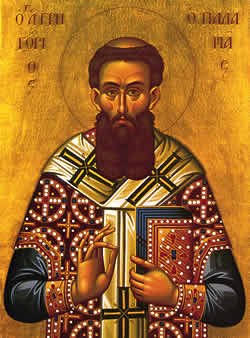
Troparion of St Gregory of Palamas Tone 8
Light of Orthodoxy, Pillar and Teacher of the Church,/ adornment of monks and champion of theologians,/O Gregory, wonderworker, boast of Thessalonica,/ preacher of grace, pray that our souls may be saved.
Kontakion of St Gregory Palamas Tone 8
Organ of wisdom, clear trumpet of theology,/ Gregory of divine speech, we praise thee./ As thou dost stand before the Primordial Mind direct our minds to Him that we may cry:/ Rejoice, O Gregory, herald of grace!
Gregory Palamas - An Historical Study
Introduction to Saint Gregory Palamas (from Saint Gregory Palamas Monastery)
A Homily on the Dormition of Our Supremely Pure Lady Theotokos and Ever-Virgin Mary
St Gregory Palamas: On the Holy Icons
Knowledge of God according to St. Gregory Palamas (from Orthodox Psychotherapy, Chapter Six)
St. Gregory Palamas and the Tradition of the Fathers by Fr. George Florovsky
The Teaching of Gregory Palamas on Man by Panayiotis Christou
Light to the World: The Life of Saint Gregory Palamas (1296--1359) (from AGAIN magazine)
A life of the saint from the OCA site:
Saint Gregory Palamas, Archbishop of Thessalonica, was born in the year 1296 in Constantinople. St. Gregory's father became a prominent dignitiary at the court of Andronicus II Paleologos (1282-1328), but he soon died, and Andronicus himself took part in the raising and education of the fatherless boy. Endowed with fine abilities and great diligence, Gregory mastered all the subjects which then comprised the full course of medieval higher education. The emperor hoped that the youth would devote himself to government work. But Gregory, barely twenty years old, withdrew to Mount Athos in the year 1316 (other sources say 1318) and became a novice in the Vatopedi monastery under the guidance of the monastic Elder St. Nicodemus of Vatopedi (July 11). There he was tonsured and began on the path of asceticism. A year later, the holy Evangelist John the Theologian appeared to him in a vision and promised him his spiritual protection. Gregory's mother and sisters also became monastics.After the demise of the Elder Nicodemus, St. Gregory spent eight years of prayerful effort under the guidance of the Elder Nicephorus, and after the latter's death, Gregory transferred to the Lavra of St. Athanasius (July 5). Here he served in the trapeza, and then became a church singer. But after three years, striving for a greater degree of spiritual perfection, he resettled in the small skete of Glossia. The head of this monastery began to teach the youth the method of concentrated spiritual prayer and mental activity, which was gradually appropriated and cultivated by monastics, beginning with the great desert ascetics of the fourth century: Evagrius Pontikos and St. Macarius of Egypt (January 19).
Later on, in the eleventh century in the works of St. Simeon the New Theologian (March 12), those praying in outward manner received detailed instruction in mental activity, and it was implemented by the Athos ascetics. The experienced use of mental prayer (or prayer of the heart), requiring solitude and quiet, is called "Hesychasm" (from the Greek "hesychia" meaning calm, silence), and those practicing it were called "hesychasts." During his stay at Glossia the future hierarch Gregory became fully embued with the spirit of hesychasm and adopted it as an essential part of his life. In the year 1326, because of the threat of Turkish invasions, he and the brethren retreated to Thessalonica, where he was then ordained to the holy priesthood.
St. Gregory combined his priestly duties with the life of a hermit. Five days of the week he spent in silence and prayer, and only on Saturday and Sunday did the pastor come out to his people. He celebrated divine services and preached sermons. For those present in church, his teaching often evoked both tenderness and tears. Sometimes he visited theological gatherings of the city's educated youth, headed by the future patriarch, Isidore. After he returned from a visit to Constantinople, he found near Thessalonica the locale of Bereia, a place suitable for solitary life. Soon he gathered here a small community of solitary monks and guided it for five years. In 1331 the saint withdrew to Mt. Athos and lived in solitude at the skete of St. Sava, near the Lavra of St. Athanasius. In 1333 he was appointed Igumen of the Esphigmenou monastery in the northern part of the Holy Mountain. In 1336 the saint returned to the skete of St. Sava, where he devoted himself to theological works, continuing with this until the end of his life.
But amidst all this, in the 1330s events took place in the life of the Eastern Church which put St. Gregory among the most significant universal apologists of Orthodoxy, and brought him reknown as the teacher of hesychasm.
In about the year 1330 the learned monk Barlaam had arrived in Constantinople from Calabria, in Italy. He was the author of treatises on logic and astronomy, a skilled and sharp-witted orator, and he received a university chair in the capital city and began to expound on the works of St. Dionysius the Areopagite (October 3), whose "apophatic" ("negative", in contrast to "kataphatic" or "positive") theology was acclaimed in equal measure in both the Eastern and the Western Churches. Soon Barlaam journeyed to Mt. Athos, where he became acquainted with the the hesychasts' manner of spiritual life. Saying that it was impossible to know the essence of God, he declared mental prayer a heretical error. Journeying from Mt. Athos to Thessalonica, and from there to Constantinople and later again to Thessalonica, Barlaam entered into disputes with the monks and attempted to demonstrate the created, material nature of the light of Tabor (i.e. at the Transfiguration). He ridiculed the teachings of the monks about the methods of prayer and about the uncreated light seen by the hesychasts.
St. Gregory, at the request of the Athonite monks, countered at first with verbal admonitions. But seeing the futility of such efforts, he put his theological arguments in writing. Thus appeared the "Triads in Defense of the Holy Hesychasts" (1338). Towards the year 1340 the Athonite ascetics, with the assistance of the saint, compiled a general reply to the attacks of Barlaam, the so-called "Hagiorite Tome." At the Constantinople Council of 1341 in the church of Hagia Sophia St. Gregory Palamas debated with Barlaam, focusing upon the nature of the light of Mount Tabor. On May 27, 1341 the Council accepted the position of St. Gregory Palamas, that God, unapproachable in His Essence, reveals Himself through His energies, which are directed towards the world and are able to be perceived, like the light of Tabor, but which are neither material nor created. The teachings of Barlaam were condemned as heresy, and he himself was anathemized and fled to Calabria.
But the dispute between the Palamites and the Barlaamites was far from finished. To these latter belonged Barlaam's disciple, the Bulgarian monk Akyndinos, and also Patriarch John XIV Kalekos (1341-1347); the emperor Andronicus III Paleologos (1328-1341) was also inclined toward their opinion. Akyndinos, whose name means "one who inflicts no harm," actually caused great harm by his heretical teaching. Akyndinos wrote a series of tracts in which he declared St. Gregory and the Athonite monks guilty of causing church disorders. The saint, in turn, wrote a detailed refutation of Akyndinos' errors. The patriarch supported Akyndinos and called St. Gregory the cause of all disorders and disturbances in the Church (1344) and had him locked up in prison for four years. In 1347, when John the XIV was replaced on the patriarchal throne by Isidore (1347-1349), St. Gregory Palamas was set free and was made Archbishop of Thessalonica.
In 1351 the Council of Blachernae solemnly upheld the Orthodoxy of his teachings. But the people of Thessalonica did not immediately accept St. Gregory, and he was compelled to live in various places. On one of his travels to Constantinople the Byzantine ship fell into the hands of the Turks. Even in captivity, St. Gregory preached to Christian prisoners and even to his Moslem captors. The Hagarenes were astonished by the wisdom of his words. Some of the Moslems were unable to endure this, so they beat him and would have killed him if they had not expected to obtain a large ransom for him. A year later, St. Gregory was ransomed and returned to Thessalonica.
St. Gregory performed many miracles in the three years before his death, healing those afflicted with illness. On the eve of his repose, St. John Chrysostom appeared to him in a vision. With the words "To the heights! To the heights!" St. Gregory Palamas fell asleep in the Lord on November 14, 1359. In 1368 he was canonized at a Constantinople Council under Patriarch Philotheus (1354-1355, 1364-1376), who compiled the Life and Services to the saint.
October 19, 2005
Our Holy Father Among the Saints, the Priest John, of Kronstadt
Troparion of St John of Kronstadt Tone 4
With the Apostles thy message has gone out to the ends of the world,/ and with the Confessors thou didst suffer for Christ;/ thou art like the Hierarchs through thy preaching of the Word;/ with the Righteous thou art radiant with God's grace./ The Lord has exalted thy humility above the heavens/ and given us thy name as a source of miracles./ O wonderworker living in Christ forever,/ have mercy on those in trouble/ and hear us when we call to thee with faith, O our beloved shepherd John.
Another Troparion of St John of Kronstadt (composed by Archbishop Maximovich of San Francisco) Tone 4
O Wonderworker living in Christ forever,/ with love have mercy on those in danger;/ hear thy children who call upon thee with faith;/ be compassionate to those who hope for aid from thee,/ O Father John of Kronstadt, our beloved shepherd.
Kontakion of St John of Kronstadt Tone 4
Thou wast chosen by God in infancy/ and in childhood received the gift of learning./ Thou wast called to the priesthood in a vision during sleep/ and didst become a wonderful shepherd of Christ's Church./ Pray to Christ our God/ that we may all be with thee in the Kingdom of heaven,/ O Father John, namesake of grace.
A life of St. John of Kronstadt, with an essay by Protopresbyter Michael Pomazansky on St. John's worldview
October 18, 2005
The Holy Apostle and Evangelist, Luke the Physician

Troparion of St Luke Tone 3
Holy Apostle and Evangelist Luke,/ intercede with our merciful God,/ that He may grant to our souls/ the forgiveness of our sins.
Kontakion of St Luke Tone 2
Let us praise holy Luke, the star of the Church,/ herald of piety and proclaimer of mysteries;/ for the Word Who alone knows the secrets of hearts/ has chosen him with Paul/ as a teacher of the nations.
Orthodox Church in America website:
The Holy Apostle and Evangelist Luke, was a native of Syrian Antioch, a companion of the holy Apostle Paul (Phil 1:24, 2 Tim 4:10-11), and a physician enlightened in the Greek medical arts. Hearing about Christ, Luke arrived in Palestine and fervently accepted the preaching of salvation from the Lord Himself. Included among the Seventy Apostles, St. Luke was sent by the Lord with the others to preach the Kingdom of Heaven during the earthly life of the Savior (Lk 10:1-3). After the Resurrection, the Lord Jesus Christ appeared to Sts. Luke and Cleopas on the road to Emmaus.
The Apostle Luke took part in the second missionary journey of the Apostle Paul, and from that time they were inseparable. At a point when all his coworkers had left the Apostle Paul, the Apostle Luke stayed on with him to tackle all the work of pious deeds (2 Tim 4:10-11). After the martyric death of the First-Ranked Apostles Peter and Paul, St. Luke left Rome to preach in Achaia, Libya, Egypt and the Thebaid. In the city of Thebes, he finished his life in martyrdom.
Tradition ascribes the painting of the first icons of the Mother of God to St. Luke. "Let the grace of Him Who was born of Me and My mercy be with these Icons," said the All-Pure Virgin in beholding the icons. St. Luke also painted icons of the First-Ranked Apostles Peter and Paul. The Gospel of St. Luke was written in the years 62-63 at Rome, under the guidance of the Apostle Paul. St. Luke in the preliminary verses (1:3) spells out exactly the aim of his work: he recorded in greater detail the chronological course of events in the framework of everything known by Christians about Jesus Christ and His teachings, and by doing so he provided a firmer historical basis of Christian hope (1:4). He carefully investigated the facts, and made generous use of the oral tradition of the Church and of what the All-Pure Virgin Mary Herself had told him (2:19, 51).
In the theological content of the Gospel of Luke the teaching about the universal salvation made possible by the Lord Jesus Christ stands out first of all, and the universal significance of the preaching of the Gospel.
The Holy Apostle also wrote in the years 62-63 at Rome, the Acts of the Holy Apostles. The Acts, which is a continuation of the four Gospels, speaks about the works and the fruits of the holy Apostles after the Ascension of the Savior. At the center of the narrative is the Council of the holy Apostles at Jerusalem in the year 51, a Church event of great critical significance, which resulted in the distancing of Christianity from Judaism and its independent dispersion into the world (Acts 15:6-29). The theological objective of the Book of Acts is that of the Dispensation of the Holy Spirit, actualized in the Church founded by the Lord Jesus Christ, from the time of the Ascension and Pentecost to the Second Coming of Christ.
October 04, 2005
Christian Confessor, Sara of Rawlpindi, Pakistan
According to this report:
On Sept. 5, APMA [a reporting agency] stated, [Sara] Tabasum went out late one night to buy some loaves of bread. She was reportedly abducted by her former neighbors and two other men. According to APMA, "They put a piece of cloth soaked in some intoxicant on her mouth, after which she fainted."When Tabasum regained consciousness she found herself in Bibis [her former neighbors'] house, where three men reportedly including Babar Bibi, raped her.
Tabasum was reportedly told that by Perveen Bibi that she could be "saved" if she embraced Islam and married one of Perveens Muslim brothers.
According to APMA, "On refusing, Sara was beaten badly during captivity and shifted to another house ... where five persons raped her. She was repeatedly asked by Perveen and other men to embrace Islam and recite (the) Islamic creed to save herself from the misery. Perveens husband Babar even told her that they (had) killed her brother Suleman, and her mother (had) also embraced Islam. (With that in mind), it would be better for her to become (a) Muslim now, otherwise she could be killed or made (a) ‘prostitute."
Tabasum refused to renounce her faith and embrace Islam, APMA reported. She was subsequently taken to another house, where she was reportedly assaulted by seven people.
Finally on Sept. 20, APMA reported a deal was made to sell Tabasum to a gang, and it was at this point while being transported to another location that she jumped out of the vehicle and escaped.
Each time I pray for others, per the liturgy of intercessions, I pray for "the captives." Of late I have added "especially those persecuted for the faith and those who will be tortured, maimed and killed for Christ this day." This is a reminder of how crucially important praying such intercessions are for us who face no persecution at all. May the Lord have mercy on all his sons and daugthers called to suffer for his Gospel.
September 30, 2005
Our Father Among the Saints, Gregory, Illuminator of Armenia
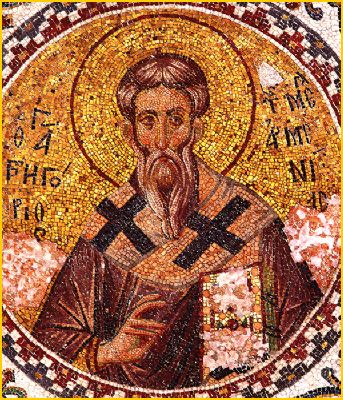
Troparion of St Gregory Tone 3
Thou didst sow the knowledge of God in the hearts of the faithful,/ by cultivating the Faith;/ made radiant by the wounds of martyrdom/ thou didst shed thy light on all./ O Hierarch Gregory, pray to Christ our God to grant us His great mercy.
Kontakion of St Gregory Tone 2
Let us the faithful praise Hierarch Gregory/ who is a shepherd, teacher and enlightener;/ and he is an athlete for the Truth./ He intercedes with Christ our God that we may be saved.
--A Life of Saint Gregory, from Christian History and Biography
September 11, 2005
Our Father Among the Saints, Euphrosynos the Cook
Troparion Tone 4
Thou didst live righteously in great humility, / in labors of asceticism and in guilelessness of soul / O righteous Euphrosynos. / Hence, by a mystical vision, thou didst demonstrate most wondrously the heavenly joy which thou hadst found. / Do thou make us worthy to be partakers thereof by thine intercessions.
From the OCA website:
Saint Euphrosynus the Cook was from one of the Palestinian monasteries, and his obedience was to work in the kitchen as a cook. Toiling away for the brethren, St. Euphrosynus did not absent himself from thought about God, but rather dwelt in prayer and fasting. He remembered always that obedience is the first duty of a monk, and therefore he was obedient to the elder brethren.The patience of the saint was amazing: they often reproached him, but he made no complaint and endured every unpleasantness. St. Euphrosynus pleased the Lord by his inner virtue which he concealed from people, and the Lord Himself revealed to the monastic brethren the spiritual heights of their unassuming fellow-monk.
One of the priests of the monastery prayed and asked the Lord to show him the blessings prepared for the righteous in the age to come. The priest saw in a dream what Paradise is like, and he contemplated its inexplicable beauty with fear and with joy.He also saw there a monk of his monastery, the cook Euphrosynus. Amazed at this encounter, the presbyter asked Euphrosynus, how he came to be there. The saint answered that he was in Paradise through the great mercy of God. The priest again asked whether Euphrosynus would be able to give him something from the surrounding beauty. St. Euphrosynus suggested to the priest to take whatever he wished, and so the priest pointed to three luscious apples growing in the garden of Paradise. The monk picked the three apples, wrapped them in a cloth, and gave them to his companion.
When he awoke in the early morning, the priest thought the vision a dream, but suddenly he noticed next to him the cloth with the fruit of Paradise wrapped in it, and emitting a wondrous fragrance. The priest, found St. Euphrosynus in church and asked him under oath where he was the night before. The saint answered that he was where the priest also was. Then the monk said that the Lord, in fulfilling the prayer of the priest, had shown him Paradise and had bestown the fruit of Paradise through him, " the lowly and unworthy servant of God, Euphrosynus."
The priest related everything to the monastery brethren, pointing out the spiritual loftiness of Euphrosynus in pleasing God, and he pointed to the fragrant paradaisical fruit. Deeply affected by what they heard, the monks went to the kitchen, in order to pay respect to St. Euphrosynus, but they did not find him there. Fleeing human glory, the monk had left the monastery. The place where he concealed himself remained unknown, but the monks always remembered that their monastic brother St. Euphrosynus had come upon Paradise, and that they in being saved, through the mercy of God would meet him there. They reverently kept and distributed pieces of the apples from Paradise for blessing and for healing.
Our holy monastic father Euphrosynus was born of simple parents although he surpassed even those of noble lineage in good works. For there are many who are devoid of good works, despite their noble birth, and so are cast down into Hades while the simple in their humility are lifted up to paradise by God as was the godly Euphrosynus. Because of his virtuous life he was translated to paradise, as we will see, and was shown to be an inhabitant there.Euphrosynus lived in a monastery where he served the brethren, laboring in the kitchen and serving them with great humility and submissiveness as though they were not men but God Himself. He labored in obedience day and night, but he never left off praying and fasting. His patience was inexpressible. He bore much abuse and disparagement and suffered frequent vexations. Scorched by the material fire of the cookstove, he was warmed by the spiritual fire of the love of God, and his heart burned with longing for the Lord. While passing his days preparing food for the brethren, he at the same time prepared a table for himself in the kingdom of God by his virtuous life, where he would eat his fill with those of whom it is said, Blessed is he that shall eat bread in the kingdom of God. He served the Lord secretly so that he might be rewarded by Him openly, even as it came to pass.
The Lord's reward to His servant was made manifest in the following manner. A certain priest who lived in the same monastery prayed fervently to the Lord that He reveal to him the things which are prepared for them that love Him. One night he had a vision. It seemed to him that he was standing in a garden, and as he considered the unutterable beauty of this garden, he saw Euphrosynus, the monastery's cook, walking by. The priest approached him and asked, "Brother Euphrosynus, what is this place? Can this be paradise?"
"It is paradise, Father," answered Euphrosynus.
Again the priest inquired, "How is that you are here?"
Euphrosynus the cook replied, "This is the dwelling place of God's elect, and by God's great goodness I have made my abode here as well."
The priest asked, "Do you have authority over all these beautiful things?"
Euphrosynus replied, "As far as I am able, I distribute to others the things you see here."
The priest inquired, "Can you give me some portion of these things?"
"By the grace of my God, take what you desire," Euphrosynus said.
The priest then pointed to some apples and asked for them. Euphrosynus took three apples, placed them in a kerchief, and gave them to the priest, saying, "Take what you have requested and delight therein."
At that moment, the semantron was struck for Matins, and the priest awoke and came to himself. He thought that he had been dreaming, but when he stretched out his hand to pick up his handkerchief, he found in it the three apples that he had received from Euphrosynus in the vision. They gave off an ineffable fragrance. Amazed, he arose from his couch, placed the apples on the bed, and went to church where he found Euphrosynus standing together with the brethren at the morning service. Approaching Euphrosynus, the priest implored him to reveal where he had been that night.
Euphrosynus replied, "Forgive me, Father; I have been in that place where we saw one another."
The priest said, "You must reveal God's greatness, so that the truth is not concealed!"
But the wise Euphrosynus humbly answered, "You, Father, implored the Lord to reveal to you the reward given to His chosen. The Lord was pleased to make this known to your godliness through me, wretched and unworthy as I am, and thus, we found ourselves together in paradise."
The priest inquired, "What did you give me, Father, in paradise when I spoke with you?"
"I gave you the three fragrant apples which you have placed on your bed in your cell," answered Euphrosynus. "But forgive me, Father, for I am a worm and not a man."
When Matins had finished, the priest summoned the brethren and showed them the three apples from paradise, and he told them exactly what had occurred. All smelled the ineffable fragrance emitted by those apples and discerned their spiritual sweetness, and they marvelled at what they were told by the priest. They hurried to the kitchen to reverence the servant of God, but they could not find him. When Euphrosynus left the church, he hid from the glory of men, and no one knew where he had gone. It is pointless to inquire into his whereabouts, for if he had access to paradise, where could he not have hidden himself?
The brethren divided the apples among themselves and distributed pieces of them as a blessing to many, especially to those who were in need of healing. Whoever ate of these apples was healed of his infirmities, and thus, all received great benefit from the holy and venerable Euphrosynus. The account of the vision was written down not only on scrolls but also in the hearts of those who were told of it, and all who heard thereof strove to increase their labors and please God.
By the prayers of the venerable Euphrosynus, may the Lord deem us also worthy to dwell in paradise. Amen.
September 02, 2005
Blessed Hieromonk Seraphim (Rose) of Platina
(It should be noted that icons of holy fathers do not receive the halo until they are canonized by synod. At this time, Fr. Seraphim has not been canonized, so strictly speaking the halo on this icon is premature.)
Troparian Tone 4
As a faithful ascetic of Saint Herman / you flowered as a spiritual rose in Platina / As an illuminator of Orthodoxy in America / your writings bring hope throughout the world / Having taught us the True Faith / O Blessed Seraphim / pray to God for us.
Kontakion Tone 4
Being one supremely devoted to the Mother of God / thou didst take up thine abode on a mountainside near Platina / and there thou didst crucify thy flesh, with its lusts and passions, through ascetic struggle / wherefore thou art become the first born American saint, / an inspiration and guiding star to American Orthodoxy. / Wherefore we cry unto thee, / save us by thy prayers, / O Seraphim our Holy Father.
A Prayer to Father Seraphim:
Oh, Our Holy Father Blessed Seraphim, you lived your life in accordance with the commandment of Christ to die to yourself, pick up your cross and follow Him. Having done so, you produced much fruit for God's harvest. Please pray to the Lord for us, your spiritual children, who live in an age of unbelief and hostility to absolute truth. Pray that Christ our God strengthen us and give us the wisdom and faith to survive the ordeals ahead. Pray for our family and friends, both living and dead. Pray that the inner eyes of our souls be opened to see the divine and true Gospel of our Lord, God and Savior Jesus Christ, that we might acquire the Holy Spirit within ourselves. Pray that we all might someday dwell in bliss with you and the other Saints in the Kingdom of Heaven. Pray to the Mother of God to entreat her Son to have mercy on our souls. For glorious and unending is the Kingdom of the Father and of the Son and of the Holy Spirit, both now and ever and unto the ages of ages. Amen.
An account of the death of Father Seraphim from his biography, Father Seraphim Rose: His Life and Works:
On the morning that followed the Transfiguration Vigil, Fr. Seraphim served what was to be his last Liturgy on earth. Soon afterwards he fell ill and could not come to the monastery services. It was not unusual for him to be sick, and when he was he never complained, so that it was difficult to know just how bad his condition was. This particular illness caused him acute stomach pains. He remained in his secluded cabin, keeping his pain to himself. The heat, which had abated during the summer pilgrimage, now grew stifling and increased his discomfort. The aforementioned John from the Santa Cruz fellowship, now a catechumen, went to ask him some questions about the Holy Scriptures. "I found him to be in so much pain that he could not think clearly," John recalls. "As usual, he listened patiently to my questions. He tried his best to be cheerful and not show his suffering, but finally he had to say that he just couldn't answer right then." (1014)
When Fr. Seraphim was examined at the hospital, the doctors found his condition to be quite serious. His blood had somehow clotted on the way to his intestines, and part of the intestines had already died and become gangrenous. . . .
Fr. Seraphim was immediately taken to an operating room, where the dead part of his intestines was removed. . . . (1015)
Having finished the first operation, the doctors thought that Fr. Seraphim would survive. Further tests, however, showed that the problem was not over: the blood had begun to clot again. The doctors immediately operated a second time, removing even more intestines, but they were coming across a great dilemma: if they used anticoagulants to prevent the blood from clotting, he would bleed to death internally, but if they did not use such drugs more and more tissue would die. A specialist in this rare disease was called in from San Francisco, but even he was at a lost to stop the damage. At this point doctors could give Fr. Seraphim only a two percent chance of recovery. (1016)
During Fr. Seraphim's week-long agony, it was manifest to Fr. Herman and others that he had indeed been purified, conquering his will and offering it as a burnt sacrifice to God. There was not a trace of anger or rebellion in him now, only devotion, love, contrition and repentance. Once before administering Holy Communion to him, Fr. Herman read the Gospel and then, holding the book over the dying man, began to bless him with it. Suddenly Fr. Seraphim, exerting every last bit of strength in his dying, convulsing frame, raised himself up to kiss that sublime Book that has given him life. . . . (1020)
At about 10:30 on Thursday morning the doctors announced that there was nothing more they could do. Fr. Seraphim, weakned beyond recovery during a week of suffering, had begun to have multiple organ failures. Within minutes the watch over the dying had ended, and a new life had begun for him. . . . (1022)
Fr. Seraphim reposed on August 20/September 2, 1982. He was only forty-eight years old. . . . (1022-1023)
Fr. Seraphim's body was placed in the middle of the monastery church, in a simple wooden coffin that had been built by Fr. Vladimir Anderson's son, Basil. There it was to remain until the burial. The Psalter began to be read around the clock in the church. The vigil had now become a vigil of prayer for the repose of Fr. Seraphim's soul. (1023)
In the three days between his death and his burial, Fr. Seraphim's unembalmed body never stiffened, nor did decay of any kind set in, even in the summer heat. There was no deathly pallor about him whatsoever; in fact, his coloring was literally golden. The skin remained soft and the body seemed to be, in the words of one monastery pilgrim, "one of a sleeping child." . . . Since incorruption has from ancient times been viewed as a sign of sanctity in the Orthodox Church, all those present felt that they were witness to a manifestation of God's grace. (1025)
Another account of his repose can be found here.
Accounts of miracles attributed to Blesssed Seraphim's intercessions can be found here.
An akathist to Father Seraphim can be found here.
Father Seraphim's biography.
Information to obtain the video of the 20th anniversary of Blessed Seraphim's repose, from The Father Seraphim Rose Foundation, is available here.
Transcribed talks of Father Seraphim online
Signs of the End Times (This talk is part of Father Seraphim's lectures on CD)
The Search for Orthodoxy
In Step With Sts. Patrick and Gregory of Tours
Raising the Mind, Warming the Heart
The Orthodox World-View
The Royal Path: True Orthodoxy in an Age of Apostasy
The Holy Fathers of Orthodox Spirituality: The Inspiration and Sure Guide to True Christianity Today Part I, Part II, Part III
How to Read the Holy Scriptures Part I, Part II, Part III
August 13, 2005
Translation of the Relics of Our Holy Father Among the Saints, Maximos the Confessor
Troparion of St Maximos Tone 3
By an outpouring of the Holy Spirit/ thou didst pour forth Christ's sacred teachings./ Thou didst expound with divine authority the self-emptying of God the Word/ and wast radiant in thy confession of the True Faith./ Glorious Father Maximos, pray to Christ our God to grant us His great mercy.
Kontakion of St Maximos Tone 2
O Maximos divinely inspired champion of the Church,/ sure and illumined exponent of Orthodoxy,/ thou harp and trumpet of godliness,/ divine and holy adornment of monks:/ cease not to intercede for us all.
Translation of the relics of St Maximus the Confessor
Commemorated on August 13
Saint Maximus the Confessor was born in Constantinople around 580 and raised in a pious Christian family. He received an excellent education, studying philosophy, grammar, and rhetoric. He was well-read in the authors of antiquity and he also mastered philosophy and theology. When St. Maximus entered into government service, he became first secretary (asekretis) and chief counselor to the emperor Heraclius (611-641), who was impressed by his knowledge and virtuous life.
St. Maximus soon realized that the emperor and many others had been corrupted by the Monothelite heresy, which was spreading rapidly through the East. He resigned from his duties at court, and went to the Chrysopolis monastery (at Skutari on the opposite shore of the Bosphorus), where he received monastic tonsure. Because of his humility and wisdom, he soon won the love of the brethren and was chosen igumen of the monastery after a few years. Even in this position, he remained a simple monk.
In 638, the emperor Heraclius and Patriarch Sergius tried to minimize the importance of differences in belief, and they issued an edict, the "Ekthesis" ("Ekthesis tes pisteos" or "Exposition of Faith), which decreed that everyone must accept the teaching of one will in the two natures of the Savior. In defending Orthodoxy against the "Ekthesis," St. Maximus spoke to people in various occupations and positions, and these conversations were successful. Not only the clergy and the bishops, but also the people and the secular officials felt some sort of invisible attraction to him, as we read in his Life.
When St. Maximus saw what turmoil this heresy caused in Constantinople and in the East, he decided to leave his monstery and seek refuge in the West, where Monothelitism had been completely rejected. On the way, he visited the bishops of Africa, strengthening them in Orthodoxy, and encouraging them not to be deceived by the cunning arguments of the heretics.
The Fourth Ecumenical Council had condemned the Monophysite heresy, which falsely taught that in the Lord Jesus Christ there was only one nature (the divine). Influenced by this erroneous opinion, the Monothelite heretics said that in Christ there was only one divine will ("thelema") and only one divine energy ("energia"). Adherents of Monothelitism sought to return by another path to the repudiated Monophysite heresy. Monothelitism found numerous adherents in Armenia, Syria, Egypt. The heresy, fanned also by nationalistic animosities, became a serious threat to Church unity in the East. The struggle of Orthodoxy with heresy was particularly difficult because in the year 630, three of the patriarchal thrones in the Orthodox East were occupied by Monothelites: Constantinople by Sergius, Antioch by Athanasius, and Alexandria by Cyrus.
St. Maximus traveled from Alexandria to Crete, where he began his preaching activity. He clashed there with a bishop, who adhered to the heretical opinions of Severus and Nestorius. The saint spent six years in Alexandria and the surrounding area.
Patriarch Sergius died at the end of 638, and the emperor Heraclius also died in 641. The imperial throne was eventually occupied by his grandson Constans II (642-668), an open adherent of the Monothelite heresy. The assaults of the heretics against Orthodoxy intensified. St. Maximus went to Carthage and he preached there for about five years. When the Monothelite Pyrrhus, the successor of Patriarch Sergius, arrived there after fleeing from Constantinople because of court intrigues, he and St. Maximus spent many hours in debate. As a result, Pyrrhus publicly acknowledged his error, and was permitted to retain the title of "Patriarch." He even wrote a book confessing the Orthodox Faith. St. Maximus and Pyrrhus traveled to Rome to visit Pope Theodore, who received Pyrrhus as the Patriarch of Constantinople.
In the year 647 St. Maximus returned to Africa. There, at a council of bishops Monotheletism was condemned as a heresy. In 648, a new edict was issued, commissioned by Constans and compiled by Patriarch Paul of Constantinople: the "Typos" ("Typos tes pisteos" or "Pattern of the Faith"), which forbade any further disputes about one will or two wills in the Lord Jesus Christ. St. Maximus then asked St. Martin the Confessor (April 14), the successor of Pope Theodore, to examine the question of Monothelitism at a Church Council. The Lateran Council was convened in October of 649. One hundred and fifty Western bishops and thirty-seven representatives from the Orthodox East were present, among them St. Maximus the Confessor. The Council condemned Monothelitism, and the Typos. The false teachings of Patriarchs Sergius, Paul and Pyrrhus of Constantinople, were also anathematized.
When Constans II received the decisions of the Council, he gave orders to arrest both Pope Martin and St. Maximus. The emperor's order was fulfilled only in the year 654.St. Maximus was accused of treason and locked up in prison. In 656 he was sent to Thrace, and was later brought back to a Constantinople prison.
The saint and two of his disciples were subjected to the cruelest torments. Each one's tongue was cut out, and his right hand was cut off. Then they were exiled to Skemarum in Scythia, enduring many sufferings and difficulties on the journey.
After three years, the Lord revaled to St. Maximus the time of his death (August 13, 662). Three candles appeared over the grave of St. Maximus and burned miraculously. This was a sign that St. Maximus was a beacon of Orthodoxy during his lifetime, and continues to shine forth as an example of virtue for all. Many healings occurred at his tomb.
In the Greek Prologue, August 13 commemorates the Transfer of the Relics of St. Maximus from Lazika on the southeast shore of the Black Sea to Constantinople, to the Monastery of the Theotokos at Chrysopolis (where he had been the igumen), across the Bosphoros from Constantinople. This transfer took place after the Sixth Ecumenical Council.
August 13 could also be the date of the saint's death, however. It is possible that his main commemoration was moved to January 21 because August 13 is the Leavetaking of the Feast of the Transfiguration of the Lord.
St. Maximus has left to the Church a great theological legacy. His exegetical works contain explanations of difficult passages of Holy Scripture, and include a Commentary on the Lord's Prayer and on Psalm 59, various "scholia" or "marginalia" (commentaries written in the margin of manuscripts), on treatises of the Hieromartyr Dionysius the Areopagite (October 3) and St. Gregory the Theologian (January 25). Among the exegetical works of St. Maximus are his explanation of divine services, entitled "Mystagogia" ("Introduction Concerning the Mystery").
The dogmatic works of St. Maximus include the Exposition of his dispute with Pyrrhus, and several tracts and letters to various people. In them are contained explanations of the Orthodox teaching on the Divine Essence and the Persons of the Holy Trinity, on the Incarnation of the Word of God, and on "theosis" ("deification") of human nature.
"Nothing in theosis is the product of human nature," St. Maximus writes in a letter to his friend Thalassius, "for nature cannot comprehend God. It is only the mercy of God that has the capacity to endow theosis unto the existing... In theosis man (the image of God) becomes likened to God, he rejoices in all the plenitude that does not belong to him by nature, because the grace of the Spirit triumphs within him, and because God acts in him" (Letter 22).
St. Maximus also wrote anthropological works (i.e. concerning man). He deliberates on the nature of the soul and its conscious existence after death. Among his moral compositions, especially important is his "Chapters on Love." St. Maximus the Confessor also wrote three hymns in the finest traditions of church hymnography, following the example of St. Gregory the Theologian.
The theology of St. Maximus the Confessor, based on the spiritual experience of the knowledge of the great Desert Fathers, and utilizing the skilled art of dialectics worked out by pre-Christian philosophy, was continued and developed in the works of St. Simeon the New Theologian (March 12), and St. Gregory Palamas (November 14).
July 02, 2005
St. John the Wonderworker of Shanghai and San Francisco
From the St. Herman account of his life:
To the manager of the orphanage where he lived, who had spoken in the spring of 1966 of a diocesan meeting to be held three years later, he indicated, "I will not be here then. " In May, 1966, a woman who had known Vladika for twelve years - and whose testimony, according to Metropolitan Philaret, is "worthy of complete confidence" - was amazed to hear him say, "I will die soon, at the end of June... not in San Francisco, but in Seattle.... " Metropolitan Philaret himself testifies of Vladika's extraordinary final farewell to him when returning to San Francisco from the last session of the Synod which he attended in New York. After the Metropolitan had served the customary moleben before traveling, Vladika, instead of sprinkling his own head with holy water, as is always done by hierarchs, bent low and asked the Metropolitan to sprinkle him; and after this, instead of the usual mutual kissing of hands, Vladika firmly took the Metropolitan's hand and kissed it, withdrawing his own . . .
Again, on the evening before his departure for Seattle, four days before his death, Vladika astonished a man for whom he had just served a moleben with the words, " You will not kiss my hand again. " And on the day of his death, at the conclusion of the Divine Liturgy which he celebrated, he spent three hours in the altar praying, emerging not long before his death, which occurred at 3:50 p. m. on July 2 (June 19, OS), 1966. He died in his room in the parish building next to the church, without preparatory signs of any illness or affliction. He was heard to fall and, having been placed in a chair by those who ran to help him, breathed his last peacefully and with little evident pain, in the presence of the miracle working Kursk Icon of the Sign. Thus was Vladika found worthy to imitate the blessed death of his patron, St. John of Tobolsk.
St. Herman Brotherhood account of St. John's Life (and another here).
An Account of the Examination of the Incorrupt Relics of St. John the Wonderworker
Services to St. John, especially an Akathist to St. John
Troparion (Tone 5)
Thy care for thy flock in its sojourn has prefigured the supplications which thou didst ever offer up for the whole world. Thus do we believe, having come to know thy love, O holy hierarch and wonder-worker John. Wholly sanctified by God through the ministry of the all-pure Mysteries, and thyself strengthened thereby, thou didst hasten unto suffering, O most gladsome healer--hasten now also to the aid of us who honor thee with all our heart.
Kontakion (Tone 4)
Thy heart hath gone out to all who entreat thee with love, O holy hierarch John, and who remember the struggle of thy whole industrious life, and thy painless and easy repose, O faithful servant of the all-pure Directress.
Troparion (Tone 6)
Glorious apostle to an age of coldness and unbelief, invested with the grace-filled power of the saints of old, divinely-illumined seer of heavenly mysteries, feeder of orphans, hope of the hopeless, thou didst enkindle on earth the fire of love for Christ upon the dark eve of the day of judgment; pray now that this sacred flame may also rise from our hearts.
Kontakion of St John (Tone 8)
Chosen wonderworker and superb servant of Christ/ who pourest out in the latter times/ inexhaustible streams of inspiration and multitude of miracles,/ we praise thee with love and call out to thee:/ Rejoice, holy Hierarch John, wonderworker of the latter times.
O beloved Hierarch John, while living amongst us thou didst see the future as if present, distant things as if near the hearts and minds of men as if they were thine own. We know that in this thou wast illumined by God, with Whom thou wast ever in the mystical communion of prayer, and with Whom thou now abidest eternally. As thou once didst hear the mental petitions of thy far-scattered flock even before they could speak to thee, so now hear our prayers and bring them before the Lord. Thou hast gone over unto the life unaging, unto the other world, yet thou art in truth not far from us, for heaven is closer to us than our own souls. Show us who feel frightened and alone the same compassion that thou didst once show to the trembling fatherless ones. Give to us who have fallen into sin, confusion and despair the same stern yet loving instruction that thou didst once give to thy chosen flock. In thee we see the living likeness of our Maker, the living spirit of the Gospel and the foundation of our Faith. In the pure life that thou hast led during our sinful times, we see a model of virtue, a source of instruction and inspiration. Beholding the grace bestowed upon thee, we know that God hath not abandoned His people. It is rather we that haste fallen from Him, and so must regain the likeness of Divinity as thou hast done. Through thine intercession, O blessed one, grant that we may increase our striving toward our heavenly homeland, setting our affections on things above, laboring in prayer and virtue, waging war against the attacks of our fallen nature. Invoke the mercy of God, that we may one day join thee in His Kingdom. For our deepest wish is to live forever with Him, with the Father, and the Son and the Holy Spirit, now and ever and to the ages of ages. Amen.
June 22, 2005
Our Father Among the Saints, Alban, Protomartyr of Britain
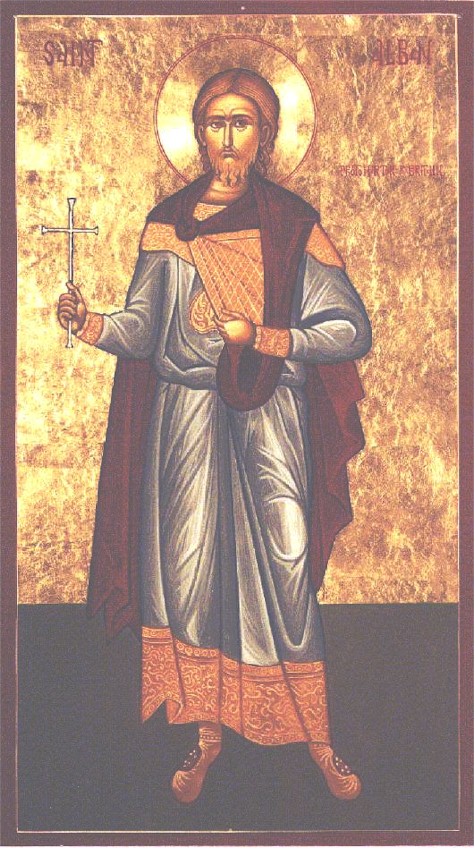
Troparion of St Alban Tone 4
Thy holy martyr Alban in his struggle/ has gained the crown of life, O Christ our God;/ for strengthened by Thee and with a pure heart/ he spoke boldly before wordly judges,/ giving up his sacred head to Thee, the Judge of all.
From Bede: Ecclesiastical History of England:
THE PASSION OF ST. ALBAN AND HIS COMPANIONS, WHO AT THAT TIME SHED THEIR BLOOD FOR OUR LORD. [A.D. 305.]AT that time suffered St. Alban, of whom the priest Fortunatus, in the Praise of Virgins, where he makes mention of the blessed martyrs that came to the Lord from all parts of the world, says
In Britain's isle was holy Alban born.
This Alban, being yet a pagan, at the time when the cruelties of wicked princes were raging against Christians, gave entertainment in his house to a certain clergyman, flying from the persecutors. This man he observed to be engaged in continual prayer and watching day and night; when on a sudden the Divine grace shining on him, he began to imitate the example of faith and piety which was set before him, and being gradually instructed by his wholesome admonitions, he cast off the darkness of idolatry, and became a Christian in all sincerity of heart. The aforesaid clergyman having been some days entertained by him, it came to the ears of the wicked prince, that this holy confessor of Christ, whose time of martyrdom had not yet come, was concealed at Alban's house. Whereupon he sent some soldiers to make a strict search after him. When they came to the martyr's house, St. Alban immediately presented himself to the soldiers, instead of his guest and master, in the habit or long coat which he wore, and was led bound before the judge.
It happened that the judge, at the time when Alban was carried before him, was standing at the altar, and offering sacrifice to devils. When he saw Alban, being much enraged that he should thus, of his own accord, put himself into the hands of the soldiers, and incur such danger in behalf of his guest, he commanded him to be dragged up to the images of the devils, before which he stood, saying, "Because you have chosen to conceal a rebellious and sacrilegious person, rather than to deliver him up to the soldiers, that his contempt of the gods might meet with the penalty due to such blasphemy, you shall undergo all the punishment that was due to him, if, you abandon the worship of our religion." But St. Alban, who had voluntarily declared himself a Christian to the persecutors of the faith, was not at all daunted at the prince's threats, but putting on the armour of spiritual warfare, publicly declared that he would not obey the command. Then said the judge, "Of what family or race are you?" "What does it concern you," answered Alban, "of what stock I am? If you desire to hear the truth of my religion be it known to you, that I am now a Christian, and bound by Christian duties." "I ask your name," said the judge; "tell me it immediately." "I am called Alban by my parents," replied he; "and I worship and adore the true and living God, who created all things." Then the judge, inflamed with anger, said, "If you will enjoy the happiness of eternal life, do not delay to offer sacrifice to the great gods." Alban rejoined, "These sacrifices, which by you are offered to devils, neither can avail the subjects, nor answer the wishes or desires of those that offer up their supplications to them. On the contrary, whosoever shall offer sacrifice to these images shall receive the everlasting pains of hell for his reward."The judge, hearing these words, and being much incensed, ordered this holy confessor of God to be scourged by the executioners, believing he might by stripes shake that constancy of heart, on which he could not prevail by words. He, being most cruelly tortured, bore the same patiently, or rather joyfully, for our Lord's sake. When the judge perceived that he was not to be overcome by tortures, or withdrawn from the exercise of the Christian religion, he ordered him to be put to death. Being led to execution, he came to a river, which, with a most rapid course, ran between the wall of the town and the arena where he was to be executed. He there saw a multitude. of persons of both sexes, and of several ages and conditions, who were doubtlessly assembled by Divine instinct, to attend the blessed confessor and martyr, and had so taken up the bridge on the river, that he could scarce pass over that evening. In short, almost all had gone out, so that the judge remained in the city without attendance. St Alban, therefore, urged by an ardent and devout wish to arrive quickly at martyrdom, drew near to the stream, and on lifting up his eyes to heaven, the channel was immediately dried up, and he perceived that the water had departed and made way for him to pass. Among the rest, the executioner, who was to have put him to death, observed this, and moved by Divine inspiration hastened to meet him at the place of execution, and casting down the sword which he had carried ready drawn, fell at his feet, praying that he might rather suffer with the martyr, whom was ordered to execute or, if possible, instead of him.
While he thus from a persecutor was become a companion in the faith, and the other executioners hesitated to take up the sword which was lying on the ground, the reverend confessor, accompanied by the multitude, ascended a hill, about 500 paces from the place, adorned, or, rather clothed with all kinds of flowers, having its sides neither perpendicular, nor even craggy, but sloping down into a most beautiful plain, worthy from its lovely appearance to be the scene of a martyr's sufferings. On the top of this hill, St. Alban prayed that God would give him water, and immediately a living spring broke out before his feet, the course being confined, so that all men perceived that the river also had been dried up in consequence of the martyr's presence. Nor was it likely that the martyr, who had left no water remaining in the river, should want some on the top of the hill, unless he thought it suitable to the occasion. The river having performed the holy service, returned to its natural course, leaving a testimony of its obedience. Here, therefore, the head of most courageous martyr was struck off, and here he received the crown of life, which God has promised to those who love Him. But he who gave the wicked stroke, was not permitted to rejoice over the deceased; for his eyes dropped upon the ground together with the blessed martyr's head.
At the same time was also beheaded the soldier, who before, through the Divine admonition, refused to give the stroke to the holy confessor. Of whom it is apparent, that though he was not regenerated by baptism, yet he was cleansed by the washing of his own blood, and rendered worthy to enter the kingdom of heaven. Then the judge, astonished at the novelty of so many heavenly miracles, ordered the persecution to cease immediately, beginning to honour the death of the saints, by which he before thought they might have been diverted from the Christian faith. The blessed Alban suffered death on the twentysecond day of June, near the city of Verulam, which is now by the English nation called Verlamacestir, or Varlingacestir, where afterwards, when peaceable Christian times were restored, a church of wonderful workmanship, and suitable to his martyrdom, was erected. In which place, there ceases not to this day the cure of sick persons, and the frequent working of wonders.
At the same time suffered Aaron and Julius, citizens of Chester, and many more of both sexes in several places; who, when they had endured sundry torments, and their limbs had been torn after an unheardof manner, yielded their souls up, to enjoy in the heavenly city a reward for the sufferings which they had passed through.
Anglican Chaplet of St. Alban
(based on Lectionary Lessons)
Cross: Do not be astonished, brothers and sisters, that the world hates you. We know that we have passed from death to life because we love one another. Whoever does not love abides in death. All who hate a brother or sister are murderers, and you know that murderers do not have eternal life abiding in them. We know love by this, that he laid down his life for us—and we ought to lay down our lives for one another. -- 1 John 3:13-16
Invitatory Bead: Almighty God, by whose grace and power your holy martyr Alban triumphed over suffering and was faithful even unto death: Grant to us, who now remember him with thanksgiving, to be so faithful in our witness to you in this world, that we may receive with him the crown of life; through Jesus Christ our Lord, who lives and reigns with you and the Holy Spirit, one God, for ever and ever.
Cruciform Bead: O taste and see that the LORD is good; happy are those who take refuge in him. -- Psalm 34:8
Week Beads: Psalm 34:1-7
1st: I will bless the LORD at all times; his praise shall continually be in my mouth.
2nd: My soul makes its boast in the LORD; let the humble hear and be glad.
3rd: O magnify the LORD with me, and let us exalt his name together.
4th: I sought the LORD, and he answered me, and delivered me from all my fears.
5th: Look to him, and be radiant; so your faces shall never be ashamed.
6th: This poor soul cried, and was heard by the LORD, and was saved from every trouble.
7th: The angel of the LORD encamps around those who fear him, and delivers them.
Exit Cross: ‘Do not think that I have come to bring peace to the earth; I have not come to bring peace, but a sword. For I have come to set a man against his father, and a daughter against her mother, and a daughter-in-law against her mother-in-law; and one’s foes will be members of one’s own household. Whoever loves father or mother more than me is not worthy of me; and whoever loves son or daughter more than me is not worthy of me; and whoever does not take up the cross and follow me is not worthy of me. Those who find their life will lose it, and those who lose their life for my sake will find it. ‘Whoever welcomes you welcomes me, and whoever welcomes me welcomes the one who sent me. Whoever welcomes a prophet in the name of a prophet will receive a prophet’s reward; and whoever welcomes a righteous person in the name of a righteous person will receive the reward of the righteous; and whoever gives even a cup of cold water to one of these little ones in the name of a disciple--truly I tell you, none of these will lose their reward.’ -- Matthew 10:34-42
June 09, 2005
Our Father Among the Saints, Cyril, Abbot of White Lake Monastery
Troparion of St Cyril of the White Lake Tone 1
O Father Cyril, uprooting the thorns of passions/ thou didst blossom as a lily in David's wilderness,/ where thou didst gather a multitude of disciples/ and guide them as a father in the fear of God./ Glory to Him Who has strengthened thee; glory to Him Who has crowned thee;/ glory to Him Who through thee works healings for all.
Kontakion of St Cyril of the White Lake Tone 8 Thou didst scorn all ways and thoughts which dragged thee down/ and didst rejoice to yearn for the heavenward course./ With the Saints before the Trinity pray that thy flock may be preserved;/ for as we celebrate thy repose we cry to thee:/ Rejoice, O blessed Father Cyril.
From the Prolog:
Cyril was born and educated in Moscow of an aristocratic family. He was tonsured a monk in Simonov Monastery where he lived a life of asceticism to the amazement of the other monks. In order to conceal his virtues, he pretended insanity. He personally spoke to St. Sergius of Radonezh and received many beneficial instructions from him. Against his wishes he was elected abbot of Simonov monastery. He prayed constantly to the All-Holy Birth-giver of God to show him the way whereby he could, in silence, live a life of asceticism. One night he saw a great light and heard a voice: "Cyril, depart from here and go to the White Lake!" And indeed, he departed from the Simonov Monastery with one companion and went to the vicinity of the White Lake and there, in the dense pine forest, began to live a life of asceticism. In time, this wilderness was transformed into a large monastery. The Venerable Cyril received the great gift of miracle-working from God and cured the sick and worked many other miracles. He died in the year 1429 A.D. in his ninetieth year and took up habitation with the Lord Whom he ardently loved his entire life.
June 01, 2005
St. Justin the Philosopher, Martyr
Troparion of St Justin Tone 4
O Justin, teacher of divine knowledge,/ thou didst shine with the rays of true philosophy/ and wast wisely armed against the enemy./ Confessing the truth thou didst contend with the martyrs:/ with them ever entreat Christ our God to save our souls.
Kontakion Tone 2
The whole Church of God is adorned with the wisdom of your divine words, O Justin;/the world is enlightened by the radiance of your life./By the shedding of your blood, you have received a crown./As you stand before Christ with the angels, pray unceasingly for us all!
An account of his martyrdom can be found here.
From St. Justin's first apology comes this account of the Eucharist and weekly Christian worship:
Chapter LXVI.-Of the Eucharist.And this food is called among us the Eucharist, of which no one is allowed to partake but the man who believes that the things which we teach are true, and who has been washed with the washing that is for the remission of sins, and unto regeneration, and who is so living as Christ has enjoined. For not as common bread and common drink do we receive these; but in like manner as Jesus Christ our Saviour, having been made flesh by the Word of God, had both flesh and blood for our salvation, so likewise have we been taught that the food which is blessed by the prayer of His word, and from which our blood and flesh by transmutation are nourished, is the flesh and blood of that Jesus who was made flesh. For the apostles, in the memoirs composed by them, which are called Gospels, have thus delivered unto us what was enjoined upon them; that Jesus took bread, and when He had given thanks, said, "This do ye in remembrance of Me, this is My body; "and that, after the same manner, having taken the cup and given thanks, He said, "This is My blood; "and gave it to them alone. Which the wicked devils have imitated in the mysteries of Mithras, commanding the same thing to be done. For, that bread and a cup of water are placed with certain incantations in the mystic rites of one who is being initiated, you either know or can learn.
Chapter LXVII.-Weekly Worship of the Christians.
And we afterwards continually remind each other of these things. And the wealthy among us help the needy; and we always keep together; and for all things wherewith we are supplied, we bless the Maker of all through His Son Jesus Christ, and through the Holy Ghost. And on the day called Sunday, all who live in cities or in the country gather together to one place, and the memoirs of the apostles or the writings of the prophets are read, as long as time permits; then, when the reader has ceased, the president verbally instructs, and exhorts to the imitation of these good things. Then we all rise together and pray, and, as we before said, when our prayer is ended, bread and wine and water are brought, and the president in like manner offers prayers and thanksgivings, according to his ability, and the people assent, saying Amen; and there is a distribution to each, and a participation of that over which thanks have been given, and to those who are absent a portion is sent by the deacons. And they who are well to do, and willing, give what each thinks fit; and what is collected is deposited with the president, who succours the orphans and widows and those who, through sickness or any other cause, are in want, and those who are in bonds and the strangers sojourning among us, and in a word takes care of all who are in need. But Sunday is the day on which we all hold our common assembly, because it is the first day on which God, having wrought a change in the darkness and matter, made the world; and Jesus Christ our Saviour on the same day rose from the dead. For He was crucified on the day before that of Saturn (Saturday); and on the day after that of Saturn, which is the day of the Sun, having appeared to His apostles and disciples, He taught them these things, which we have submitted to you also for your consideration.
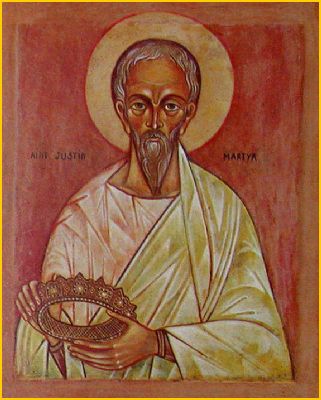
March 14, 2005
Our Father Among the Saints, Benedict of Nursia, Father of Monks
Troparion Tone 1
By thine ascetical struggles, O Godbearing Benedict,/ thou didst prove true to thy name./ For thou wast the son of benediction, and didst become a model and rule/ to all who emulate thy life and cry:/ Glory to Him Who has strengthened thee; glory to Him Who has crowned thee;/ glory to Him Who through thee works healings for all.
Kontakion Tone 8
Like a sun of the Dayspring from on high/ thou didst enlighten the monks of the West and instruct them by word and deed./ By the sweat of thine ascetical achievements/ purge from the filth of passions us who honour thee and cry:/ Rejoice, O Father Benedict.
Prayer to St. Benedict of Nursia
O holy Father, St. Benedict, blessed by God both in grace and in name, who, while standing in prayer, with hands raised to heaven, didst most happily yield thy angelic spirit into the hands of thy Creator, and hast promised zealously to defend against all the snares of the enemy in the last struggle of death, those who shall daily remind thee of thy glorious departure and heavenly joys; protect me, I beseech thee, O glorious Father, this day and every day, by thy holy blessings, that I may never be separated from our dear Lord, from the society of thyself, and of all the blessed. Through the same Christ our Lord. Amen.
[Note: In the West, St. Benedict's death is celebrated 21 March, and his feast day is celebrated 11 July]
St. Gregory the Great's Life of St. Benedict
The Rule of St. Benedict (in English)
About the Rule of St. Benedict
About the medal of St. Benedict
About St. Scholastica, St. Benedict's twin sister
A brief account of St. Benedict, his life and influence (Roman Catholic Order of St. Benedict website)
From the OCA Website:
Saint Benedict, founder of Western monasticism, was born in the Italian city of Nursia in the year 480. When he was fourteen years of age, the saint's parents sent him to Rome to study. Unsettled by the immorality around him, he decided to devote himself to a different sort of life.At first St. Benedict settled near the church of the holy Apostle Peter in the village of Effedum, but news of his ascetic life compelled him to go farther into the mountains. There he encountered the hermit Romanus, who tonsured him into monasticism and directed him to live in a remote cave at Subiaco. From time to time, the hermit would bring him food.
For three years the saint waged a harsh struggle with temptations and conquered them. People soon began to gather to him, thirsting to live under his guidance. The number of disciples grew so much, that the saint divided them into twelve communities. Each community was comprised of twelve monks and was a separate skete. The saint gave each skete an igumen from among his experienced disciples, and only the novice monks remained with St. Benedict for instruction.
The strict monastic Rule St. Benedict established for the monks was not accepted by everyone, and more than once he was criticized and abused by dissenters.
Finally he settled in Campagna and on Mount Cassino he founded the Monte Cassino monastery, which for a long time was a center of theological education for the Western Church. The monastery possessed a remarkable library. St. Benedict wrote his Rule, based on the experience of life of the Eastern desert-dwellers and the precepts of St. John Cassian the Roman (February 29).
The Rule of St. Benedict dominated Western monasticism for centuries (by the year 1595 it had appeared in more than 100 editions). The Rule prescribed the renunciation of personal possessions, as well as unconditional obedience, and constant work. It was considered the duty of older monks to teach the younger and to copy ancient manuscripts. This helped to preserve many memorable writings from the first centuries of Christianity.
Every new monk was required to live as a novice for a year, to learn the monastic Rule and to become acclimated to monastic life. Every deed required a blessing. The head of this cenobitic monastery is the igumen. He discerns, teaches, and explains. The igumen solicits the advice of the older, experienced brethren, but he makes the final decisions. Keeping the monastic Rule was strictly binding for everyone and was regarded as an important step on the way to perfection.
St. Benedict was granted by the Lord the gift of foresight and wonderworking. He healed many by his prayers. The monk foretold the day of his death in 547. The main source for his Life is the second Dialogue of St. Gregory.
St. Benedict's sister, St. Scholastica (February 10), also became famous for her strict ascetic life and was numbered among the saints.
Meeting St. Benedict
I first became aware of St. Benedict during my time at a Protestant Bible college, specifically during spring semester of 1990. I was in a period of my life where I began to search for the historic Church, and a period of spiritual struggle when I became extremely dissatsified with the way of life my heritage churches, and evangelical Christianity in general, had given me for spiritual growth. I had been for a long time just spinning my wheels with the schema of morning devotions (read a couple of chapters in the Bible and pray), praise choruses, and church attendance. I wanted something more. My searches combined in a return to the historic Church and monasticism.
If you read anything about monasticism in the West, you pretty quickly come across St. Benedict of Nursia. And I did. I happened across a book by Esther de Waal, entitled Living with Contradiction, which contained the whole of the Prologue to the saint's Rule, and a bit more than a hundred pages of meditations and reflections on the themes of the Prologue. I was instantly hooked. I didn't know much about St. Benedict himself, nor even about what role the saints played in the Church, but I knew enough to realize St. Benedict was a teacher and father in God from whom I could learn much.
It was only a handful of months later that one of those serendipitous, coincidental moments happened that later leave you wondering if a divine appointment, unbeknownst to oneself, had occurred. I had gone with some classmates and a professor to our sister school for a conference, and happened one of the afternoons to be in the campus bookstore. As I browsed the shelves without any real purpose, other than to look for titles that might interest me, my eyes happened to notice a little red pocketsized book entitled RB 1980: The Rule of St. Benedict in English. It was $1.99. Without a second's hesitation, I picked it up and made my way to the checkout to buy it.
Over the years since then, I have read several books on St. Benedict and his Rule, and my relationship with him has grown. For many years his role in my life was simply that of teacher. I tried to emulate the balance in my life that his Rule exhibits; proportionate time for work, study and prayer. Eventually I began to pray the hours of the Church, and his Rule guided me in praying the Psalter and reading the Scriptures. As an Episcopalian, I grew to appreciate his life in ways I had not as a Stone-Campbell Movement Christian, but he was still a teacher more than anything else. When I was in Rome several years ago, I purchased one of the saint's medals, and wore it from time to time. I became associated with a Benedictine monastery in the Episcopal Church, and went there a handful of times on retreat.
But it wasn't until I began moving toward the Orthodox Church that I realized the role of the saints in the life of the Church and the individual believer. I grew to understand that without me realizing it, St. Benedict had become one of my patron saints. (The other is Blessed Hieromonk Seraphim of Platina, who is as yet not formally canonized.) In the fifteen years since I first met St. Benedict, I cannot knowingly attribute any dramatic and miraculous answers to prayer. St. Benedict does not work quite that way in my life. Rather, after coming to Orthodoxy I simply began to ask his intercessions daily and to daily venerate his icons: to pray that I might crucify the passions, be attentive in my prayers, and become more like Christ. One thing I can attribute to his answered prayers for me is for my strengthening in the Church's fasts and to being mindful of the passions when they are as yet but thoughts.
You can no doubt assume that I am taking great solace in the fact that Lent starts for me this year on his feast day!
I now regularly read from his Rule each day, and at lunch read selections from his Life by St. Gregory the Dialogist (whose feast we celebrated Saturday). I still go to the Rule for guidance, not only when I seek to reassert balance to my life, but for teaching on simply struggling in the Christian faith toward theosis. My own experience is that St. Benedict is a faithful and sure guide.
God is glorified in his saints, and the glory of God shines brightly in the life and witness of St. Benedict. Holy Father of Monks, pray for us, that we may be made worthy of the Kingdom of Heaven.
March 12, 2005
Our Father Among the Saints, Gregory the Dialogist, Pope of Rome
Troparion of St Gregory Tone 3
Thou didst excellently dispense the Word of God,/ endowed with discretion of speech, O Hierarch Gregory;/ for by thy life thou didst set the virtues before us,/ and dost radiate the brightness of holiness./ O Righteous Father, pray to Christ our God to grant us His great mercy.
Kontakion of St Gregory Tone 8
We praise thee, God-inspired harp of the Church and God-possessed tongue of wisdom;/ for thou didst prove to be an image and model of the Apostles and didst emulate their zeal./ Wherefore we cry to thee: Rejoice, O Gregory the Dialogist.
The Pastoral Rule of St. Gregory (starts with Part I, clicking on the "> Page" button at the top and bottom of the page brings you to the next part; entire Rule is available online)
The Dialogues of St. Gregory (starts with Book I, clicking on the "> Page" button at the top and bottom of the page brings you to the next book; entire Dialogues are available online; Book II is the life of St. Benedict)
From the OCA website (scroll down to St. Gregory; opens in popup window):
Saint Gregory Dialogus, Pope of Rome, was born in Rome around the year 540. His grandfather was Pope Felix, and his mother Sylvia (November 4) and aunts Tarsilla and Emiliana were also numbered among the saints by the Roman Church. Having received a most excellent secular education, he attained high government positions.Leading a God-pleasing life, he yearned for monasticism with all his soul. After the death of his father, St. Gregory used his inheritance to establish six monasteries. At Rome he founded a monastery dedicated to the holy Apostle Andrew the First-Called, where he received monastic tonsure. Later, on a commission of Pope Pelagius II, St. Gregory lived for a while in Constantinople. There he wrote his Commentary on the Book of Job.
After the death of Pope Pelagius, St. Gregory was chosen to the Roman See. For seven months he would not consent to accept this service, considering himself unworthy. He finally accepted consecration only after the persistent entreaties of the clergy and flock.
Wisely leading the Church, St. Gregory worked tirelessly in propagating the Word of God. St. Gregory compiled the Liturgy of the Presanctified Gifts in the Latin language, which before him was known only in the verbal tradition. Affirmed by the Sixth Ecumenical Council, this liturgical service was accepted by all the Orthodox Church.
He zealously struggled against the Donatist heresy; he also converted the inhabitants of Brittany pagans and Goths, adhering to the Arian heresy to the True Faith.
St. Gregory has left behind numerous written works. After the appearance of his book, DIALOGUES CONCERNING THE LIFE AND MIRACLES OF THE ITALIAN FATHERS (DIALOGI DE VITA ET MIRACULIS PATRUM ITALIORUM), the saint was called "Dialogus." His PASTORAL RULE (or LIBER REGULAE PASTORALIS) was well-known. In this work, St. Gregory describes the model of the true pastor. His letters (848), dealing with moral guidance, have also survived.
St. Gregory headed the Church for thirteen years, ministering to all the needs of his flock. He was characterized by an extraordinary love of poverty, for which he was granted a vision of the Lord Himself.
Pope St. Gregory the Great, as he is known, died in the year 604, and his relics rest in the cathedral of the holy Apostle Peter in the Vatican.
February 18, 2005
Our Father Among the Saints, Leo, Pope of Rome

Troparion of St Leo Tone 3
Thou wast the Church's instrument/ in strengthening the Church's teaching of true doctrine;/ thou didst shine forth from the West like a sun/ and didst dispel the heretics' error./ O righteous Leo, entreat Christ our God to grant us His great mercy.
Kontakion of St Leo Tone 3
From the throne of thy priesthood, O glorious one,/ thou didst stop the mouths of the spiritual lions;/ thou didst illumine thy flock with the light of the knowledge of God/ and with the inspired doctrines of the Holy Trinity./ Thou art glorified as a divine initiate of the grace of God.
Catholic Encyclopedia article on St. Leo
From the OCA website:
Saint Leo I the Great, Pope of Rome (440-461), received a fine and diverse education, which opened for him the possibility of an excellent worldly career. He yearned for the spiritual life, however, and so he chose the path of becoming an archdeacon under holy Pope Sixtus III (432-440), after whose death St. Leo was chosen as Bishop of Rome in September 440.These were difficult times for the Church, when heretics assaulted Orthodoxy with their false teachings. St. Leo combined pastoral solicitude and goodness with an unshakable firmness in the confession of the Faith. He was in particular one of the basic defenders of Orthodoxy against the heresies of Eutyches and Dioskoros, who taught that there was only one nature in the Lord Jesus Christ. He was also a defender against the heresy of Nestorius.
He exerted all his influence to put an end to the unrest by the heretics in the Church, and by his letters to the holy emperors Theodosius II (408-450) and Marcian (450-457), he actively promoted the convening of the Fourth Ecumenical Council, at Chalcedon in 451, to condemn the heresy of the Monophysites.
At the Council at Chalcedon, at which 630 bishops were present, a letter of St. Leo to the deceased St. Flavian, Patriarch of Constantinople (447-449) was read. St. Flavian had suffered for Orthodoxy under the "Robber Council" of Ephesus in the year 449. In the letter of St. Leo the Orthodox teaching about the two natures [the divine and the human] in the Lord Jesus Christ was set forth. All the bishops present at the Council were in agreement with this teaching, and so the heretics Eutyches and Dioskoros were excommunicated from the Church.
St. Leo was also a defender of his country against the incursions of barbarians. In 452, by the persuasive power of his words, he stopped Attila the Hun from pillaging Italy. Again in the year 455, when the leader of the Vandals [a Germanic tribe], Henzerich, turned towards Rome, he persuaded him not to pillage the city, burn buildings, nor to spill blood.
He knew the time of his death beforehand, and he prepared himself, with forty days of fasting and prayer, to pass from this world into eternity.
He died in the year 461 and was buried at Rome. His literary and theological legacy is comprised of 96 sermons and 143 letters, of which the best known is his Epistle to St. Flavian.
January 14, 2005
Our Holy Mother Among the Saints, Nina, Equal to the Apostles, Enlightener of Georgia

Troparion of St Nina, Equal-To-The-Apostles Tone 4
O handmaid of the Word of God,/ who in preaching equaled the first-called Apostle Andrew,/ and emulated the other Apostles,/ enlightener of Iberia and reed-pipe of the Holy Spirit,/ holy Nina, pray to Christ our God to save our souls.
Kontakion of St Nina Tone 2
Let us sing praises to the chosen of Christ,/ Equal-to-the-Apostles and preacher of God's word,/ the bearer of good tidings who brought the people of Katralina/ to the path of life and truth,/ the disciple of the Mother of God,/ our zealous intercessor and unwearing guardian,/ the most praised Nina.
From the Prolog:
Nina was a relative of St. George the Great Martyr and Juvenal, the Patriarch of Jerusalem. Her parents belonged to the nobility in Cappadocia and since they both were tonsured in the monastic state, Nina was educated under the tutelage of Patriarch Juvenal. Hearing about the people of Georgia, the virgin Nina, from an early age, desired to go to Georgia and to baptize the Georgians. The All-Holy Mother of God appeared to Nina and promised to take her to this land. When our Lord opened the way, the young Nina, indeed, traveled to Georgia where, in a short period of time, she gained the love of the Georgian people. Nina succeeded in baptizing the Georgian Emperor Mirian, his wife Nana and their son Bakar, who, later on, zealously assisted in Nina's missionary work. During her lifetime, Nina traveled throughout Georgia, mainly to convert the entire nation to the Faith of Christ, exactly at the time of the terrible persecution of the Christians at the hands of Emperor Diocletian. Having rested from her many labors, Nina died in the Lord in the year 335 A.D. Her body is entombed in the Cathedral Church in Mtzkheta. She worked many miracles during her life and after her death.
From the OCA website:
Holy Equal-to-the-Apostles Nino, Enlightener of Georgia, was born around the year 280 in the city of Kolastra in Cappadocia. Her father Zabulon was related to the holy Great Martyr George (April 23). He came from an illustrious family, and pious parents, and he was highly regarded by the emperor Maximian (284-305). Zabulon, a Christian, served in the military under the emperor, and he took part in the liberation of Christian captives from Gaul (modern France). St. Nino's mother, Susanna, was a sister of the Patriarch of Jerusalem. [Translator's note: In 1996, the parents of St. Nino were numbered among the Saints.The commemoration of Sts. Zabulon and Susanna is May 20].When she was twelve years old, St. Nino went to Jerusalem with her parents, who had only this one daughter. By their mutual consent and with the blessing of the Patriarch, Zabulon devoted his life to the service of God at the Jordan, and Susanna was made a deaconness in the church of the Holy Resurrection. The upbringing of St. Nino was entrusted to the pious Eldress, Nianphora. St. Nino displayed diligence and obedience for two years. By the grace of God, she got into the firm habit of fulfilling the rule of prayer, and reading the Holy Scriptures.
Once, while tearfully reading the Gospel passages describing the Crucifixion of Christ the Savior, she wondered about the fate of the Chiton (Tunic) of the Lord (Jn 19:23-24). When St. Nino asked where the Lord's Chiton (Tunic) had gone (October 1), the Eldress Nianphora declared that the Lord's incorrupt Chiton had been carried off by the Rabbi Eleazar of Mtskhet and taken back with him to a place named Iberia (Georgia), and called the appanage (i.e., the "allotted portion") of the Mother of God. During Her earthly life, the All-Pure Virgin had received Georgia as her allotted portion, but an angel of the Lord appeared to Her and foretold that Georgia would become Her earthly portion only after Her Repose. She was told that Mt. Athos (also called the portion of the Mother of God) would be given to Her by God.
The Elderess Nianphora told her that Georgia had not yet been enlightened by the light of Christianity, St. Nino entreated the Most Holy Theotokos to grant that she would see Georgia converted to Christ, and might also enable her to find the Tunic of the Lord.
The Queen of Heaven heard the prayer of the young righteous one. Once, when St. Nino was resting after long prayer, the All-Pure Virgin appeared to her in a dream, and entrusting her with a cross plaited from sprigs, She said, "Take this cross, for it will be for you a shield and protection against all enemies both visible and invisible. Go to the land of Iberia, proclaim there the Gospel of the Lord Jesus Christ and spread forth His grace, and I will be your Protectress."
Awakening, St. Nino saw the cross (now preserved in a special reliquary in the Tbilisi Zion cathedral church) in her hand. Rejoicing in spirit, she went to her uncle, the Patriarch of Jerusalem, and told him about her vision. The Patriarch then blessed the young virgin in her deed of Apostolic service.
On the way to Georgia, St. Nino escaped martyrdom, which however befell her companions: the emperor's daughter Ripsimia, her guide Gaiania and thirty-five virgins (September 30), who had fled to Armenia from Rome to escape persecution under the emperor Diocletian (284-305). Bolstered in spirit by visions of an angel of the Lord, who appeared the first time holding a censer, and a scroll the second time, St. Nino continued on her way and arrived in Georgia in the year 319. News of her soon spread through the area of Mtskhet, where she lived in asceticism. Numerous miracles accompanied her preaching. On the Feast of the Transfiguration of the Lord, as pagan priests offered sacrifice in the presence of the emperor Mirian and a multitude of the people, the idols Armaz, Gatsi, and Gaim were toppled from a high mountain through the prayers of St. Nino. This was accompanied by a strong storm.
Entering Mtskhet, the ancient capital of Georgia, St. Nino found shelter in the household of a childless imperial official, whose wife Anastasia was delivered from infertility through the prayers of St. Nino, and she came to believe in Christ.
St. Nino healed the Georgian empress Nana from a grievous infirmity. After her Baptism, she ceased to worship idols and became a zealous Christian instead (October 1). In spite of the miraculous healing of his wife, the emperor Mirian (265-342), in view of the complaints of the pagans, prepared to subject St. Nino to fierce tortures. "At that very moment, when they plotted to execute the righteous one, the sun darkened and an impenetrable mist covered the place where the emperor was."
The emperor suddenly fell blind, and seized by terror, his retainers began to beg their pagan idols for the light to return. "But Armaz, Gaim and Gatsi were deaf, and the darkness only intensified. Then with one voice they cried out to the God of Nino. Instantly, the darkness was lifted, and the sun shone in all its radiance." This event occurred on May 6, 319.
Emperor Mirian, healed from his blindness by St. Nino, accepted holy Baptism with all his retainers. By 324, Christianity had established itself in Georgia.
The Chronicles relate that through her prayers, the location of the Lord's Chiton was revealed to St. Nino. At this place the first Christian church was built in Georgia (at first a wooden church, but then a stone cathedral, in honor of the Twelve Holy Apostles, the "Svetitskhoveli").
At the request of the emperor Mirian, and with the cooperation of the Byzantine emperor St. Constantine (306-337), Bishop Eustathios of Antioch was sent to Georgia with two priests and three deacons. Christianity took a definite hold upon the land. The mountain regions of Georgia, however, remained without enlightenment.
St. Nino traveled with the presbyter James and one of the deacons, to the upper regions of the Aragva and Iori Rivers, where she preached the Gospel to the people. Many of them came to believe in Christ and accepted holy Baptism. Then St. Nino proceeded to Kakhetia (Eastern Georgia) and settled in the village of Bodbe, in a small tent beside a mountain. Here she led an ascetic life of constant prayer, and converting the local inhabitants to Christ. Amidst all these was the empress of Kakhetia, named Sodzha [Sophia], who accepted Baptism with all her court and a multitude of the people.
Having completed her apostolic service in Georgia, St. Nino had a revelation from God of her impending end. In a letter to the emperor Mirian, she requested him to send Bishop John, so that he might prepare her for her final journey. Not only Bishop John did come, but also the emperor with all the clergy went to Bodbe, where many healings took place at the deathbed of St. Nino. For the edification of the people who had come, and at the request of her disciples, St. Nino told them of her life. This narration, written down by Solomia of Udzharm, has served as the basis of the Life of St. Nino.
Having received the Holy Mysteries, St. Nino instructed that her body be buried at Bodbe, and then she peacefully departed to the Lord in the year 335 (according to other sources, in the year 347, at the age of sixty-seven, after 35 years of apostolic labor).
The emperor, the clergy and the people, grieving over the death of St. Nino, wished to transfer her relics to the Mtskhet cathedral church, but they were not able to remove the coffin of the ascetic from her chosen place of rest. The emperor Mirian laid the foundations of a church on this site in 342, and his son the emperor Bakur (342-364) completed and dedicated the church in the name of St. Nino's relative, the holy Great Martyr George.
Later, a women's monastery dedicated to St. Nino was founded at this place. The relics of the saint, concealed beneath a crypt at her command, were glorified by many miracles and healings. The Georgian Orthodox Church, with the consent of the Patriarchate of Antioch, designated St. Nino the Enlightener of Georgia as Equal-to-the-Apostles. She was numbered among the Saints, and her Feast was established as January 14, the day of her blessed repose.
January 12, 2005
Holy Virgin Martyr Tatiana of Rome
Troparion of St Tatiana of Rome Tone 4
Strengthened by the power of faith,/ thou didst contend for Christ our God, O glorious Tatiana;/ thou didst endure every affliction/ and by thy courage put Belial to shame./ We beseech thee to deliver us from the power of the evil one.
Kontakion of St Tatiana of Rome Tone 4
Thou wast radiant in suffering, Tatiana,/ and in the royal purple of thy blood thou didst fly like a dove to heaven./ Wherefore pray unceasingly for those who honour thee.
From the Prologue:
Tatiana was a Roman whose parents were of great nobility. She was a Christian and a deaconess in the church. After the death of Emperor Heliogabalus, Emperor Alexander, whose mother Mammaea was a Christian, reigned in Rome. The emperor himself was wavering and indecisive in the Faith for he kept statues of Christ, Apollo, Abraham and Orpheus in his palace. His chief assistants persecuted the Christians without the emperor's orders. When they brought out the virgin Tatiana for torture, she prayed to God for her torturers. And behold, their eyes were opened and they saw four angels around the martyr. Seeing this, eight of them believed in Christ for which they also were tortured and slain. The tormentors continued to torture St. Tatiana. They whipped her, cut off parts of her body; they scraped her with irons. So all disfigured and bloody, Tatiana was thrown into the dungeon that evening so that the next day, they could, again, begin anew with different tortures. But God sent His angels to the dungeon to encourage her and to heal her wounds so that, each morning, Tatiana appeared before the torturers completely healed. They threw her before a lion, but the lion endeared himself to her and did her no harm. They cut off her hair, thinking, according to their pagan reasoning, that some sorcery or some magical power was concealed in her hair. Finally, Tatiana along with her father were both beheaded. Thus, Tatiana ended her earthly life about the year 225 A.D., and this heroic virgin, who had the fragile body of a woman but a robust and valiant spirit, was crowned with the immortal wreath of glory.
From the OCA website:
The Holy Virgin Martyr Tatiana was born into an illustrious Roman family, and her father was elected consul three times. He was secretly a Christian and raised his daughter to be devoted to God and the Church. When she reached the age of maturity, Tatiana decided to remain a virgin, betrothing herself to Christ. Disdaining earthly riches, she sought instead the imperishable wealth of Heaven. She was made a deaconess in one of the Roman churches and served God in fasting and prayer, tending the sick and helping the needy.When Rome was ruled by the sixteen-year-old Alexander Severus (222-235), all power was concentrated in the hands of the regent Ulpian, an evil enemy and persecutor of Christians. Christian blood flowed like water. Tatiana was also arrested, and they brought her into the temple of Apollo to force her to offer sacrifice to the idol. The saint began praying, and suddenly there was an earthquake. The idol was smashed into pieces, and part of the temple collapsed and fell down on the pagan priests and many pagans. The demon inhabiting the idol fled screeching from that place. Those present saw its shadow flying through the air.
Then they tore holy virgin's eyes out with hooks, but she bravely endured everything, praying for her tormentors that the Lord would open their spiritual eyes. And the Lord heard the prayer of His servant. The executioners saw four angels encircle the saint and beat her tormentors. A voice was heard from the heavens speaking to the holy virgin. Eight men believed in Christ and fell on their knees before St. Tatiana, begging them to forgive them their sin against her. For confessing themselves Christians they were tortured and executed, receiving Baptism by blood.
The next day St. Tatiana was brought before the wicked judge. Seeing her completely healed of all her wounds, they stripped her and beat her, and slashed her body with razors. A wondrous fragrance then filled the air. Then she was stretched out on the ground and beaten for so long that the servants had to be replaced several times. The torturers became exhausted and said that an invisible power was beating them with iron rods. Indeed, the angels warded off the blows directed at her and turned them upon the tormentors, causing nine of them to fall dead. They then threw the saint in prison, where she prayed all night and sang praises to the Lord with the angels.
A new morning began, and they took St. Tatiana to the tribunal once more. The torturers beheld with astonishment that after such terrible torments she appeared completely healthy and even more radiant and beautiful than before. They began to urge her to offer sacrifice to the goddess Diana. The saint seemed agreeable, and they took her to the heathen temple. St. Tatiana made the Sign of the Cross and began to pray. Suddenly, there was a crash of deafening thunder, and lightning struck the idol, the sacrificial offerings and the pagan priests.
Once again, the martyr was fiercely tortured. She was hung up and scraped with iron claws, and her breasts were cut off. That night, angels appeared to her in prison and healed her wounds as before. On the following day, they took St. Tatiana to the circus and loosed a hungry lion on her. The beast did not harm the saint, but meekly licked her feet.
As they were taking the lion back to its cage, it killed one of the torturers. They threw Tatiana into a fire, but the fire did not harm the martyr. The pagans, thinking that she was a sorceress, cut her hair to take away her magical powers, then locked her up in the temple of Zeus.
On the third day, pagan priests came to the temple intending to offer sacrifice to Zeus. They beheld the idol on the floor, shattered to pieces, and the holy martyr Tatiana joyously praising the Lord Jesus Christ. The judge then condemned the valiant sufferer to be beheaded with a sword. Her father was also executed with her, because he had raised her to love Christ.
January 09, 2005
Our Father Among the Saints and Martyr, St Philip, Metropolitan of Moscow and All Russia

Troparion of St Philip Tone 8
Successor of first Hierarchs, pillar of Orthodoxy, champion of truth and new confessor,/ thou didst lay down thy life for thy flock./ As thou hast boldness towards Christ, O Philip, pray for suffering Russia/ and for those who honour thy memory.
Kontakion of St Philip Tone 3
Let us praise wise Philip, guide and teacher of Orthodoxy,/ herald of the truth and emulator of the Golden Mouth,/ the lamp of Russia who fed his children with divine words;/ for by chanting with his tongue he taught us to praise with our lips,/ as a noble vessel of the grace of God.
From the OCA website:
Saint Philip, Metropolitan of Moscow, in the world Theodore, was descended from the illustrious noble lineage of the Kolichevi, occupying a prominent place in the Boyar duma at the court of the Moscow sovereigns. He was born in the year 1507. His father, Stephen Ivanovich, "a man enlightened and filled with military spirit," attentively prepared his son for government service. Theodore's pious mother Barbara, who ended her days in monasticism with the name Barsanouphia, implanted in the soul of her son a sincere faith and deep piety. Young Theodore Kolichev applied himself diligently to the Holy Scripture and to the writings of the holy Fathers. The Moscow Great Prince Basil III, the father of Ivan the Terrible, brought young Theodore into the court, but he was not attracted to court life. Conscious of its vanity and sinfulness, Theodore all the more deeply immersed himself in the reading of books and visiting the churches of God. Life in Moscow repelled the young ascetic. The young Prince Ivan's sincere devotion to him, promising him a great future in government service, could not deter him from seeking the Heavenly City.
On Sunday, June 5, 1537, in church for Divine Liturgy, Theodore felt intensely in his soul the words of the Savior: "No man can serve two masters" (Mt 6:24), which determined his ultimate destiny. Praying fervently to the Moscow wonderworkers, and without bidding farewell to his relatives, he secretly left Moscow in the attire of a peasant, and for a while he hid himself away from the world in the village of Khizna, near Lake Onega, earning his livelihood as a shepherd.His thirst for ascetic deeds led him to the reknowned Solovki monastery on the White Sea. There he fulfilled very difficult obediences: he chopped firewood, dug the ground, and worked in the mill. After a year and a half of testing, the igumen Alexei tonsured him, giving him the monastic name Philip and entrusting him in obedience to the Elder Jonah Shamina, a converser with St. Alexander of Svir (August 30).
Under the guidance of experienced elders Philip grew spiritually, and progressed in fasting and prayer. Igumen Alexei sent him to work at the monastery forge, where St. Philip combined the activity of unceasing prayer with his work with a heavy hammer.
He was always the first one in church for the services, and was the last to leave. He toiled also in the bakery, where the humble ascetic was comforted with a heavenly sign. In the monastery afterwards they displayed the "Bakery" image of the Mother of God, through which the heavenly Mediatrix bestowed Her blessing upon the humble baker Philip. With the blessing of the igumen, St. Philip spent a certain while in wilderness solitude, attending to himself and to God.
In 1546 at Novgorod the Great, Archbishop Theodosios made Philip igumen of the Solovki monastery. The new igumen strove with all his might to exalt the spiritual significance of the monastery and its founders, Sts. Sabbatios and Zosimas of Solovki (September 27, April 17). He searched for the Hodigitria icon of the Mother of God brought to the island by the first head of Solovki, St. Sabbatios. He located the stone cross which once stood before the saint's cell. The Psalter belonging to St. Zosimas (+1478), the first igumen of Solovki, was also found. His robe, in which igumens would vest during the service on the days when St. Zosimas was commemorated, was also discovered.
The monastery experienced a spiritual revival. A new monastic Rule was adopted to regulate life at the monastery. St. Philip built majestic temples: a church of the Dormition of the Mother of God, consecrated in the year 1557, and a church of the Transfiguration of the Lord. The igumen himself worked as a simple laborer, helping to build the walls of the Transfiguration church. Beneath the north portico he dug himself a grave beside that of his guide, the Elder Jonah. Spiritual life in these years flourished at the monastery: struggling with the brethren with the disciples of Igumen Philip were Sts. John and Longinus of Yarenga (July 3) and Bassian and Jonah of Pertominsk (July 12).
St. Philip often withdrew to a desolate wilderness spot for quiet prayer, two versts from the monastery, which was later known as the Philippov wilderness.
But the Lord was preparing the saint for other work. In Moscow, Tsar Ivan the Terrible fondly remembered the Solovki hermit from his childhood. The Tsar hoped to find in St. Philip a true companion, confessor and counsellor, who in his exalted monastic life had nothing in common with the sedition of the nobles. The Metropolitan of Moscow, in Ivan's opinion, ought to have a certain spiritual meekness to quell the treachery and malice within the Boyar soul. The choice of St. Philip as archpastor of the Russian Church seemed to him the best possible.
For a long time the saint refused to assume the great burden of the primacy of the Russian Church. He did not sense any spiritual affinity with Ivan. He attempted to get the Tsar to abolish the Oprichniki [secret police]. Ivan the Terrible attempted to argue its civil necessity. Finally, the dread Tsar and the holy Metropolitan came to an agreement: St. Philip would not meddle in the affairs of the Oprichniki and the running of the government, he would not resign as Metropolitan in case the Tsar could not fulfill his wishes, and that he would be a support and counsellor of the Tsar, just as former Metropolitans supported the Moscow sovereigns. On July 25, 1566 St. Philip was consecrated for the cathedra of Moscow's hierarch saints, whose number he was soon to join.
Ivan the Terrible, one of the greatest and most contradictory figures in Russian history, lived an intensely busy life. He was a talented writer and bibliophile , he was involved in compiling the Chronicles (and himself suddenly cut the thread of the Moscow chronicle writing), he examined the intricacies of the monastic Rule, and more than once he thought about abdicating the throne for the monastic life.
Every aspect of governmental service, all the measures undertaken to restructure civil and social life, Ivan the Terrible tried to rationalize as a manifestation of Divine Providence, as God acting in history. His beloved spiritual heroes were St. Michael of Chernigov (September 20) and St. Theodore the Black (September 19), military men active with complex contradictory destinies, moving toward their ends through whatever the obstacles before them, and fulfilling their duties to the nation and to the Church.
The more the darkness thickened around Ivan, the more resolutely he demanded cleansing and redemption of his soul. Journeying on pilgrimage to the St. Cyril of White Lake monastery, he declared his wish to become a monk to the igumen and the brethren. The haughty autocrat fell on his knees before the igumen, who blessed his intent. Ivan wrote, "it seems to me, an accursed sinner, that I am already robed in black."
Ivan imagined the Oprichnina in the form of a monastic brotherhood, serving God with weapons and military deeds. The Oprichniki were required to dress in monastic garb and attend long and tiring church services, lasting from 4 to 10 o'clock in the morning. "Brethren" not in church at 4 o'clock in the morning, were given a penance by the Tsar. Ivan and his sons fervently wished to pray and sing in the church choir. From church they went to the trapeza, and while the Oprichniki ate, the Tsar stood beside them. The Oprichniki gathered leftover food from the table and distributed it to the poor at the doorway of the trapeza.
Ivan, with tears of repentance and wanting to be an esteemer of the holy ascetics, the teachers of repentance, he wanted to wash and burn away his own sins and those of his companions, cherishing the assurance that even his terribly cruel actions would prove to be for the welfare of Russia and the triumph of Orthodoxy. The most clearly spiritual action and monastic sobriety of Ivan the Terrible is revealed in his "Synodikon." Shortly before his death, he ordered full lists compiled of the people murdered by him and his Oprichniki. These were then distributed to all the Russian monasteries. Ivan acknowledged all his sins against the nation, and besought the holy monks to pray to God for the forgiveness of his tormented soul.
The pseudo-monasticism of Ivan the Terrible, a dark most grievous oppression over Russia, tormented St. Philip, who considered it impossible to mix the earthly and the heavenly, serving the Cross and serving the sword. St. Philip saw how much unrepentant malice and envy was concealed beneath the black cowls of the Oprichniki. There were outright murderers among them, hardened in lawless bloodletting, and profiteers seeking gain, rooted in sin and transgressions. By the sufferance of God, history is often made by the hands of the impious, and Ivan the Terrible wanted to whiten his black brotherhood before God. The blood spilled by its thugs and fanatics cried out to Heaven.
St. Philip decided to oppose Ivan. This was prompted by a new wave of executions in the years 1567-1568. In the autumn of 1567, just as the Tsar was setting out on a campaign against Livonia, he learned about a boyar conspiracy. The plotters intended to seize the Tsar and deliver him to the Polish king, who already was on the move with an army towards Russian territory.
Ivan dealt severely with the conspirators, and again he shed much blood. It was bitter for St. Philip, and the conscience of the saint compelled him boldly to enter into defense of the executed. The final rift occurred in the spring of 1568. On the Sunday of the Veneration of the Cross, March 2, 1568, when the Tsar with his Oprichniki entered the Dormition cathedral in monastic garb, as was their custom, St. Philip refused to bless him, and began openly to denounce the lawless acts committed by the Oprichniki. The accusations of the hierarch shattered the harmony of the church service. In a rage Ivan retorted, "Would you oppose us? We shall see your firmness! I have been too soft on you."
The Tsar began to show ever greater cruelty in persecuting all those who opposed him. Executions followed one after the other. The fate of the saintly confessor was sealed. But Ivan wanted to preserve a semblance of canonical propriety. The Boyar Duma obediently carried out his decision to place the Primate of the Russian Church on trial. A cathedral court was set up to try Metropolitan Philip in the presence of a diminished Boyar Duma, and false witnesses were found. To the deep sorrow of the saint, these were monks of the Solovki monastery, his former disciples and novices whom he loved. They accused St. Philip of a multitude of transgressions, including sorcery.
"Like all my ancestors," the saint declared, "I came into this world prepared to suffer for truth." Having refuted all the accusations, the holy sufferer attempted to halt the trial by volunteering to resign his office. His resignation was not accepted, however, and new abuse awaited the martyr.
Even after a sentence of life imprisonment had been handed down, they compelled St. Philip to serve Liturgy in the Dormition cathedral. This was on November 8, 1568. In the middle of the service, the Oprichniki burst into the temple, they publicly read the council's sentence of condemnation, and then abused the saint. Tearing his vestments off, they dressed him in rags, dragged him out of the church and drove him off to the Theophany monastery on a simple peasant's sledge.
For a long while they held the martyr in the cellars of the Moscow monasteries. They placed his feet into stocks, they held him in chains, and put a heavy chain around his neck. Finally, they drove him off to the Tver Otroch monastery. And there a year later, on December 23,1569, the saint was put to death at the hands of Maliuta Skuratov. Only three days before this the saint foresaw the end of his earthly life and received the Holy Mysteries. At first, his relics were committed to earth there at the monastery, beyond the church altar. Later, they were transferred to the Solovki monastery (August 11, 1591) and from there to Moscow (July 3, 1652).
Initially, the memory of St. Philip was celebrated by the Russian Church on December 23, the day of his martyric death. In 1660, the celebration was transferred to January 9.
January 06, 2005
Christian Persecution in Iraq Today and It's Implications for the Future
Nina Shea & James Y. Ray, in an article on Christians and Iraq from NRO highlight both the persecution of Christians in Iraq right now and the possible implications that would follow. The excerpted article follows below (emphases added). Read it all!
Tens of thousands of Iraq's nearly one million ChaldoAssyrians, as this indigenous cultural and linguistic ethnic group is called under Iraq's Transitional Administrative Law, have fled into exile over the past few months. Their leaders fear that, like the Iraqi Jews — who accounted for a third of Iraq's population until facing relentless persecution in the middle of the last century — they may leave en masse. Though many Iraqis, particularly moderates, suffer violence, the ChaldoAssyrians, along with the smaller non-Muslim minorities of Sabean Mandeans and Yizidis, may be as a group all but eradicated from Iraq. Their exodus began in earnest in August after the start of a terrorist bombing campaign against their churches. With additional church bombings right before Christmas, hundreds more Christian families escaped in fear to Jordan and Syria.
In the run up to elections, Sunni terrorists and insurgents have targeted the ChaldoAssyrians with particular ferocity, linking them to the West. The main Assyrian Christian news agency AINA.org reported last week that the kidnapping tally for Christians now ranges in the thousands, with ransom payments averaging $100,000 each. One who could not afford the payment, 29-year-old Laith Antar Khanno, was found beheaded in Mosul on December 2, two weeks after his kidnapping. Cold-blooded assassinations of Christians are also on the rise. Prominent Assyrian surgeon and professor Ra'aad Augustine Qoryaqos was shot dead by three terrorists while making his rounds in a Ramadi clinic on December 8. That same week two other Christian businessmen from Baghdad, Fawzi Luqa and Haitham Saka, were abducted from work and murdered.Both Sunni and Shiite extremists who seek to impose their codes of behavior have been ruthless toward the Christians, throwing acid in the faces of women without the hijab (veil) and gunning down the salesclerks at video and liquor stores. In the north, Kurdish administrators have withheld U.S. reconstruction funds from ChaldoAssyrian areas, and, together with local peshmerga forces, have confiscated some Christian farms and villages. Of the $20 billion that American taxpayers generously provided for the reconstruction of Iraq two years ago, none so far has gone to rebuild ChaldoAssyrian communities. The State Department is distributing these funds exclusively to the Arab- and Kurdish-run governorates — the old Saddam Hussein power structure — who fail to pass on the ChaldoAssyrian share.
Though Iraq's president, prime minister, and Grand Ayatollah Sistani have all denounced the attacks against the Christians, the persecution has not abated. The ChaldoAssyrians have endured much throughout the last century in Iraq, including brutal Arabization and Islamization campaigns. But this current period may see their last stand as a cohesive community.
Should the ChaldoAssyrian community disappear from Iraq, it would mean the end of their Aramaic language (spoken by Jesus), and their customs, rites, and culture. A unique part of Christian patrimony would disappear along with this first-century church. The United States would have presided over the destruction of one of the world's oldest Christian communities. Its reverberations would be keenly felt just beyond Iraq's borders. As Christian scholar Habib Malik wrote last month in the daily press of his native Lebanon, if the democratic project of Iraq ends in dismal failure for the ChaldoAssyrians, the future will be bleak for all the historic churches of the Middle East. No wonder Pope John Paul II used his public appearances on both Christmas and New Year's to express "great apprehension" and "profound regret" about the situation in Iraq.
Further loss of ChaldoAssyrian influence in Iraq would also have dire implications for Iraq itself and for American policy. The ChaldoAssyrians are a disproportionately skilled and educated group, and they also possess that increasingly scarce trait in the Middle East: the virtue of toleration. They are a natural political bloc for building a democracy with minority protections and individual rights. Their presence bolsters Muslim moderates who claim religious pluralism as a rationale for staving off governance by Islamic sharia law.
The ChaldoAssyrians who continue to tough it out in Iraq do so desperately clinging to the hope that liberal democracy will take root there. They and their communities in the American diaspora, numbering around 450,000, are stirring with activity in preparation for the elections at the end of January. These elections will choose a National Assembly that will draft the country's permanent constitution. They are eager to see individual rights to religious freedom and all fundamental freedoms carried over from the interim constitution into the permanent government. . . .
While Iraq's hard-line Shiite parties are heavily financed by Iran, Kurdish leaders have long been bankrolled by the U.S., and Sunni insurgents are funded by Syria, the pro-democracy ChaldoAssyrians have no sponsors. The U.S. policy of providing democracy-building funds to political parties in emerging democracies, made legendary with Solidarity in Poland, ended a decade ago. The U.S. government is taking steps to compensate one religious minority that might fare poorly in the election. According to press reports, the U.S. administration has called for assembly seats to be set aside for the Sunni minority, which is boycotting the elections after warnings by extremist Sunni leaders. But no provisions have been made for ChaldoAssyrian Christians, who, unlike many insurgent Sunnis, work for the Coalition rather than build roadside bombs against it.
In short, ChaldoAssyrian candidates and parties are alone and without funds. If these Christians fail to win seats in the assembly, they will have no direct say in the critical drafting of the country's permanent constitution. Don't expect the United States to speak up for them — or for other moderates. . . .
There is an urgent need for immediate private funding to help pro-democracy ChaldoAssyrian candidates and voters in the January 30 elections. The private response to southeast Asia's tsunami victims proves that concerned individuals can make a critical difference. Only a small fraction of that generous outpouring is needed to keep the ChaldoAssyrians politically competitive — through voter education, candidate spots on television and radio, campaign literature, get-out-the-vote efforts, and other election essentials. Tax-deductible donations for this purpose can be sent to: Iraq Freedom Account, Assyrian American National Federation, 5550 North Ashland, Chicago, IL 60640.
— Nina Shea is the director of Freedom House's Center for Religious Freedom. James Y. Rayis, an Atlanta lawyer, is vice chair of the Chicago-based ChaldoAssyrian American Advocacy Council.
January 01, 2005
Our Father Among the Saints, Basil the Great of Caesarea

Troparion of St Basil the Great Tone 1
Thy fame has gone forth into all the earth,/ which has received thy word./ Thereby thou hast taught the Faith; thou hast revealed the nature of created things;/ thou hast made a royal priesthood of the ordered life of men./ Righteous Father Basil, intercede with Christ our God/ that our souls may be saved.
Kontakion of St Basil the Great Tone 4
Thou wast an unshaken foundation of the Church/ and didst give to all mortals an inviolate lordship/ which thou didst seal with thy doctrine,/ O righteous Basil, / revealer of the mysteries of heaven.
From the OCA website:
Saint Basil the Great, Archbishop of Caesarea in Cappadocia, "belongs not to the Church of Caesarea alone, nor merely to his own time, nor was he of benefit only to his own kinsmen, but rather to all lands and cities worldwide, and to all people he brought and still brings benefit, and for Christians he always was and will be a most salvific teacher." Thus spoke St. Basil's contemporary, St. Amphilochios, Bishop of Iconium (November 23).St. Basil was born in the year 330 at Caesarea, the administrative center of Cappadocia. He was of illustrious lineage, famed for its eminence and wealth, and zealous for the Christian Faith. The saint's grandfather and grandmother on his father's side had to hide in the forests of Pontus for seven years during the persecution under Diocletian.
St. Basil's mother St. Emmelia was the daughter of a martyr. On the Greek calendar, she is commemorated on May 30. St. Basil's father was also named Basil. He was a lawyer and reknowned rhetorician, and lived at Caesarea.
Ten children were born to the elder Basil and Emmelia: five sons and five daughters. Five of them were later numbered among the saints: Basil the Great; Macrina (July 19) was an exemplar of ascetic life, and exerted strong influence on the life and character of St. Basil the Great; Gregory, afterwards Bishop of Nyssa (January 10); Peter, Bishop of Sebaste (January 9); and Theosebia, a deaconess (January 10).
St. Basil spent the first years of his life on an estate belonging to his parents at the River Iris, where he was raised under the supervision of his mother Emmelia and grandmother Macrina. They were women of great refinement, who remembered an earlier bishop of Cappadocia, St. Gregory the Wonderworker (November 17). Basil received his initial education under the supervision of his father, and then he studied under the finest teachers in Caesarea of Cappadocia, and it was here that he made the acquaintance of St. Gregory the Theologian (January 25 and January 30). Later, Basil transferred to a school at Constantinople, where he listened to eminent orators and philosophers. To complete his education St. Basil went to Athens, the center of classical enlightenment.
After a four or five year stay at Athens, Basil had mastered all the available disciplines. "He studied everything thoroughly, more than others are wont to study a single subject. He studied each science in its very totality, as though he would study nothing else." Philosopher, philologist, orator, jurist, naturalist, possessing profound knowledge in astronomy, mathematics and medicine, "he was a ship fully laden with learning, to the extent permitted by human nature."
At Athens a close friendship developed between Basil the Great and Gregory the Theologian (Nazianzus), which continued throughout their life. In fact, they regarded themselves as one soul in two bodies. Later on, in his eulogy for Basil the Great, St. Gregory the Theologian speaks with delight about this period: "Various hopes guided us, and indeed inevitably, in learning... Two paths opened up before us: the one to our sacred temples and the teachers therein; the other towards preceptors of disciplines beyond."
About the year 357, St. Basil returned to Caesarea, where for a certain while he devoted himself to rhetoric. But soon, refusing offers from Caesarea's citizens who wanted to entrust him with the education of their offspring, St. Basil entered upon the path of ascetic life.
After the death of her husband, Basil's mother, her eldest daughter Macrina, and several maidservants withdrew to the family estate at Iris and there began to lead an ascetic life. Basil was baptized by the bishop of Caesarea Dianios, and was tonsured a Reader (On the Holy Spirit, 29). He first read the Holy Scriptures to the people, then explained them.
Later on, "wanting to acquire a guide to the knowledge of truth", the saint undertook a journey into Egypt, Syria and Palestine, to meet the great Christian ascetics dwelling there. On returning to Cappadocia, he decided to do as they did. He distributed his wealth to the needy, then settled on the opposite side of the river not far from his mother Emmelia and sister Macrina, gathering around him monks living a cenobitic life.
By his letters, Basil drew his good friend Gregory the Theologian to the monastery. Sts. Basil and Gregory labored in strict abstinence in their dwelling place, which had no roof or fireplace, and the food was very humble. They themselves cleared away the stones, planted and watered the trees, and carried heavy loads. Their hands were constantly calloused from the hard work. For clothing Basil had only a tunic and monastic mantle. He wore a hairshirt, but only at night, so that it would not be obvious.
In their solitude, Sts. Basil and Gregory occupied themselves in an intense study of Holy Scripture. They were guided by the writings of the Fathers and commentators of the past, especially the good writings of Origen. From all these works they compiled an anthology called Philokalia. Also at this time, at the request of the monks, St. Basil wrote down a collection of rules for virtuous life. By his preaching and by his example St. Basil assisted in the spiritual perfection of Christians in Cappadocia and Pontus; and many indeed turned to him. Monasteries were organized for men and for women, in which places Basil sought to combine the cenobitic (koine bios, or common) lifestyle with that of the solitary hermit.
During the reign of Constantius (337-361) the heretical teachings of Arius were spreading, and the Church summoned both its saints into service. St. Basil returned to Caesarea. In the year 362 he was ordained deacon by Bishop Meletios of Antioch. In 364 he was ordained to the holy priesthood by Bishop Eusebios of Caesarea. "But seeing," as Gregory the Theologian relates, "that everyone exceedingly praised and honored Basil for his wisdom and reverence, Eusebios, through human weakness, succumbed to jealousy of him, and began to show dislike for him." The monks rose up in defense of St. Basil. To avoid causing Church discord, Basil withdrew to his own monastery and concerned himself with the organization of monasteries.
With the coming to power of the emperor Valens (364-378), who was a resolute adherent of Arianism, a time of troubles began for Orthodoxy, the onset of a great struggle. St. Basil hastily returned to Caesarea at the request of Bishop Eusebios. In the words of Gregory the Theologian, he was for Bishop Eusebios "a good advisor, a righteous representative, an expounder of the Word of God, a staff for the aged, a faithful support in internal matters, and an activist in external matters."
From this time church governance passed over to Basil, though he was subordinate to the hierarch. He preached daily, and often twice, in the morning and in the evening. During this time St. Basil composed his Liturgy. He wrote a work "On the Six Days of Creation" (Hexaemeron) and another on the Prophet Isaiah in sixteen chapters, yet another on the Psalms, and also a second compilation of monastic rules. St. Basil wrote also three books "Against Eunomios," an Arian teacher who, with the help of Aristotelian concepts, had presented the Arian dogma in philosophic form, converting Christian teaching into a logical scheme of rational concepts.
St. Gregory the Theologian, speaking about the activity of Basil the Great during this period, points to "the caring for the destitute and the taking in of strangers, the supervision of virgins, written and unwritten monastic rules for monks, the arrangement of prayers [Liturgy], the felicitous arrangement of altars and other things." Upon the death of Eusebios, the Bishop of Caesarea, St. Basil was chosen to succed him in the year 370. As Bishop of Caesarea, St. Basil the Great was the newest of fifty bishops in eleven provinces. St. Athanasios the Great (May 2), with joy and with thanks to God welcomed the appointment to Cappadocia of such a bishop as Basil, famed for his reverence, deep knowledge of Holy Scripture, great learning, and his efforts for the welfare of Church peace and unity.
Under Valens, the external government belonged to the Arians, who held various opinions regarding the divinity of the Son of God, and were divided into several factions. These dogmatic disputes were concerned with questions about the Holy Spirit. In his books Against Eunomios, St. Basil the Great taught the divinity of the Holy Spirit and His equality with the Father and the Son. Subsequently, in order to provide a full explanation of Orthodox teaching on this question, St. Basil wrote his book On the Holy Spirit at the request of St. Amphilochios, the Bishop of Iconium.
St. Basil's difficulties were made worse by various circumstances: Cappadocia was divided in two under the rearrangement of provincial districts. Then at Antioch a schism occurred, occasioned by the consecration of a second bishop. There was the negative and haughty attitude of Western bishops to the attempts to draw them into the struggle with the Arians. And there was also the departure of Eustathios of Sebaste over to the Arian side. Basil had been connected to him by ties of close friendship. Amidst the constant perils St. Basil gave encouragement to the Orthodox, confirmed them in the Faith, summoning them to bravery and endurance. The holy bishop wrote numerous letters to the churches, to bishops, to clergy and to individuals. Overcoming the heretics "by the weapon of his mouth, and by the arrows of his letters," as an untiring champion of Orthodoxy, St. Basil challenged the hostility and intrigues of the Arian heretics all his life. He has been compared to a bee, stinging the Church's enemies, yet nourishing his flock with the sweet honey of his teaching.
The emperor Valens, mercilessly sending into exile any bishop who displeased him, and having implanted Arianism into other Asia Minor provinces, suddenly appeared in Cappadocia for this same purpose. He sent the prefect Modestus to St. Basil. He began to threaten the saint with the confiscation of his property, banishment, beatings, and even death.
St. Basil said, "If you take away my possessions, you will not enrich yourself, nor will you make me a pauper. You have no need of my old worn-out clothing, nor of my few books, of which the entirety of my wealth is comprised. Exile means nothing to me, since I am bound to no particular place. This place in which I now dwell is not mine, and any place you send me shall be mine. Better to say: every place is God's. Where would I be neither a stranger and sojourner (Ps 38/39:13)? Who can torture me? I am so weak, that the very first blow would render me insensible. Death would be a kindness to me, for it will bring me all the sooner to God, for Whom I live and labor, and to Whom I hasten."
The official was stunned by his answer. "No one has ever spoken so audaciously to me," he said.
"Perhaps," the saint remarked, " that is because you've never spoken to a bishop before. In all else we are meek, the most humble of all. But when it concerns God, and people rise up against Him, then we, counting everything else as naught, look to Him alone. Then fire, sword, wild beasts and iron rods that rend the body, serve to fill us with joy, rather than fear."
Reporting to Valens that St. Basil was not to be intimidated, Modestus said, "Emperor, we stand defeated by a leader of the Church." Basil the Great again showed firmness before the emperor and his retinue and made such a strong impression on Valens that the emperor dared not give in to the Arians demanding Basil's exile. "On the day of Theophany, amidst an innumerable multitude of the people, Valens entered the church and mixed in with the throng, in order to give the appearance of being in unity with the Church. When the singing of Psalms began in the church, it was like thunder to his hearing. The emperor beheld a sea of people, and in the altar and all around was splendor; in front of all was Basil, who acknowledged neither by gesture nor by glance, that anything else was going on in church." Everything was focused only on God and the altar-table, and the clergy serving there in awe and reverence.
St. Basil celebrated the church services almost every day. He was particularly concerned about the strict fulfilling of the Canons of the Church, and took care that only worthy individuals should enter into the clergy. He incessantly made the rounds of his own church, lest anywhere there be an infraction of Church discipline, and setting aright any unseemliness. At Caesarea, St. Basil built two monasteries, a men's and a women's, with a church in honor of the 40 Martyrs (March 9) whose relics were buried there. Following the example of monks, the saint's clergy, even deacons and priests, lived in remarkable poverty, to toil and lead chaste and virtuous lives. For his clergy St. Basil obtained an exemption from taxation. He used all his personal wealth and the income from his church for the benefit of the destitute; in every center of his diocese he built a poor-house; and at Caesarea, a home for wanderers and the homeless.
Sickly since youth, the toil of teaching, his life of abstinence, and the concerns and sorrows of pastoral service took their toll on him. St. Basil died on January 1, 379 at age 49. Shortly before his death, the saint blessed St. Gregory the Theologian to accept the See of Constantinople.
Upon the repose of St. Basil, the Church immediately began to celebrate his memory. St. Amphilochios, Bishop of Iconium (+ 394), in his eulogy to St. Basil the Great, said: "It is neither without a reason nor by chance that holy Basil has taken leave from the body and had repose from the world unto God on the day of the Circumcision of Jesus, celebrated between the day of the Nativity and the day of the Baptism of Christ. Therefore, this most blessed one, preaching and praising the Nativity and Baptism of Christ, extolling spiritual circumcision, himself forsaking the flesh, now ascends to Christ on the sacred day of remembrance of the Circumcision of Christ. Therefore, let it also be established on this present day annually to honor the memory of Basil the Great festively and with solemnity."
Saint Basil is also known as the revealer of heavenly mysteries (Ouranophantor), a "renowned and bright star," and "the glory and beauty of the Church." His honorable head is in the Great Lavra on Mt. Athos.
In some countries it is customary to sing special carols today in honor of St. Basil. He is believed to visit the homes of the faithful, and a place is set for him at the table. People visit the homes of friends and relatives, and the mistress of the house gives a small gift to the children. A special bread (Vasilopita) is blessed and distributed after the Liturgy. A silver coin is baked into the bread, and whoever receives the slice with the coin is said to receive the blessing of St. Basil for the coming year.
December 12, 2004
The Blessed Repose of Our Father Among the Saints, Herman of Alaska, Patron of the Americas
Troparion of St Herman of Alaska Tone 4
Blessed ascetic of the northern wilds/ and intercessor for the whole world;/ teacher of Orthodoxy, instructor of piety,/ adornment of Alaska and gladness of America,/ holy Father Herman, pray to Christ our God that He may save our souls.
Kontakion of St Herman of Alaska Tone 8
Monk of Valaam and beloved of the Mother of God,/ new zealot of the old desert-dwellers in thy labours;/ armed with prayer as thy sword and shield, thou wast terrible to demons and pagan darkness./ O St. Herman, we cry to thee: pray to Christ our God that our souls may be saved.
[Note: The Orthodox Church in America celebrates St. Herman's repose on 13 Dec.]
The time of the Elder's passing had come. One day he ordered his disciple, Gerasim, to light a candle before the icons, and to read the Acts of the Holy Apostles. After some time his face glowed brightly and he said in a loud voice, "Glory to Thee, 0 Lord!" He then ordered the reading to be halted, and he announced that the Lord had willed that his life would now be spared for another week. A week later again by his orders the candies were lit, and the Acts of the Holy Apostles were read. Quietly the Elder bowed his head on the chest of Gerasim; the cell was filled with a pleasant smelling odor; and his face glowed, and Father Herman was no more! Thus in blessedness he died, he passed away in the sleep of a righteous man in the 81st year of his life of great labor, the 25th day of December, 1837. (According to the Julian Calendar, the 13th of December 1837, although there are some records which state he died on the 28th of November, and was buried on the 26th of December).Those sent with the sad news to the harbor returned to announce that the administrator of the colony Kashevarov had forbidden the burial of the Elder until his own arrival. He also ordered that a finer coffin be made for Father Herman, and that he would come as soon as possible and would bring a priest with him. But then a great wind came up, a rain fell, and a terrible storm broke. The distance from the Harbor to Spruce Island is not great - about a two hour journey - but no one would agree to go to sea in such weather. Thus it continued for a full month and although the body lay in state for a full month in the warm house of his students, his face did not undergo any change at all, and not the slightest odor emanated from his body. Finally through the efforts of Kuzma Uchilischev, a coffin was obtained. No one arrived from the Harbor, and the inhabitants of Spruce Island alone buried in the ground the remains of the Elder. Thus the words which Herman uttered before his death were fulfilled. After this the wind quieted down, and the surface of the sea became as smooth as a mirror.
One evening from the village Katani (on Afognak) was seen above Spruce Island an unusual pillar of light which reached up to heaven. Astonished by the miraculous appearance, experienced elders and the creole Gerasim Vologdin and his wife, Anna, said, "it seems that Father Herman has left us," and they began to pray. After a time, they were informed that the Elder had indeed passed away that very night. This same pillar was seen in various places by others. The night of his death in another of the settlements on Afognak was seen a vision; it seemed as though a man was rising from Spruce Island into the clouds.
The disciples buried their father, and placed above his grave a wooden memorial marker. The priest on Kodiak, Peter Kashevarov, says, "I saw it myself, and I can say that today it seems as though it had never been touched by time; as though it had been cut this day."
Having witnessed the life of Father Herman glorified by his zealous labors, having seen his miracles, and the ful- fillment of his predictions, finally having observed his blessed falling-asleep, "in general all the local inhabitants" witnesses Bishop Peter, "have the highest esteem for him, as though he was a holy ascetic, anti are fully convinced thdt he has found favor in the presence of God."
In 1842, five years after the passing away of the Elder, Innocent, Archbishop of Kamchatka and the Aleutians, was near Kodiak on a sailing vessel which was in great distress. He looked to Spruce Island, and said to himself, "if you, Father Herman, have found favor in God's presence then may the wind change!" It seems as though not more than fifteen minutes had passed, said the Bishop, when the wind became favorable, and he successfully reached the shore. In thanksgiving for his salvation, Archbishop Innocent himself conducted a Memorial Service over the grave of the Blessed Elder Herman.
In 1970, the Orthodox Church in America glorified the monk Herman as the Venerable Herman of Alaska, Wonderworker of All America.
November 08, 2004
Christian Persecution in Iraq
Militants Bomb Orthodox Church in Baghdad
BAGHDAD, Iraq (AP) - Masked men detonated a bomb near an Orthodox church in southern Baghdad on Monday, and police at the scene said three people were killed and 34 wounded.
A guard at the St. Bahnam and Sheik Matti Orthodox Church in the capital's Doura neighborhood said the militants drove up in a pickup truck.
"They were all armed," said Khalaf Enad. "They quickly poured out of the car, pointed their weapons at me and said 'Get in.' They opened fire for over a minute and then I heard a big explosion."
The blast created a crater over 12 feet wide and 3 feet deep.
Church deacon Matti Qeryaqos, who lives nearby, said the explosion shattered church windows and blew the doors off their hinges, collapsing the outer wall. He said there was no service at the church at the time of the blast, and that the dead and wounded were mostly neighbors.
Mohammed Aziz said strong explosions rocked the area. "I felt my house shaking three times and then saw the fire set in the church."
Police sealed off the area and fired bullets in the air to disperse the crowd, according to another witness, Lyon Emad Elias, whose home faces the church.
October 20, 2004
Christian Persecution in North Korea, Iraq and Pakistan
Voice of the Martyrs reports that:
In 2003, a North Korean army general was shot and killed by a fellow officer for evangelizing to his unit. Many other Christians are currently facing similar situations of execution or imprisonment for sharing their faith, owning a Bible, or for no explanation at all. Yet sources say that these are "very strong believers" and they refuse to deny their faith, even in the face of torture and death.
According to reports from former government officials and prisoners, like Soon-Ok Lee, treatment of religious prisoners is much more severe, particularly for Christians. . . .
Imprisoned Christians are not the only ones under pressure. The sources also tell of prisoners’ families being threatened or, in some cases, held hostage.
North Korean Christians that were saved in the spiritual revivals in the late 1940’s have played a vital role in the survival of Christianity in North Korea. Sources report that these believers have kept the faith alive by passing down their faith from generation to generation.
Foreign and religious contact is highly discouraged among the people of North Korea and strictly limited. Often the few people allowed to travel outside of the country show interest in Christianity but will not even accept a Bible because of the negative affects it could have on their families back in North Korea. Sources also report that Christians fear outside contact due to government informants posing as believers. The North Korean church has been forced to exist completely underground.
North Koreans are under great pressure, Christian and non-Christian alike, but there are many inside and outside the country that seek to bring the saving message of Jesus to these thirsty people.
The Barnabus Fund reports that a Pakistani Christian is tortured to death by police and 40 Christian protestors are arrested:
Nasir Masih, a young Christian man, died in prison on 19th August 2004 four days after being beaten and tortured by officers in two different police stations. When local Christians sought to have the police brutality investigated, 40 of the protesting Christians were arrested.
Nasir Masih, son of a municipal sanitary worker from Sheikhupura, near Lahore, Punjab Province, went to join in the celebrations for Pakistan’s Independence Day on 15th August. He got into a fight with local Muslims who beat him severely and then had him arrested on false charges of theft.
At Police Station B-Division, Sheikhupura District, Nasir was beaten again and then handed over to Saddar Police Station, also in Sheikhupura District. Here he was tortured to the point where he lost consciousness. The following morning, 16th August, the police sent Nasir to the area magistrate who did not see him but sent him straight to District Jail Sheikhupura. Nasir was given no treatment for his injuries and died in prison on 19th August. There were 21 injury marks visible on his body, but four doctors who examined it said they could not determine the cause of death.
CHRISTIAN PROTESTS
When Nasir’s family heard of his death they went to the prison to collect his body, accompanied by a crowd of local people. The family and others present refused to accept the body unless the Superintendent of the prison would accept responsibility for Nasir’s death. The Superintendent refused to accept responsibility and blamed the police; the police in turn blamed the local Muslims who had originally been fighting with Nasir.
Despite the refusal of all officials to accept responsibility for Nasir’s death, his family eventually received the body. But a crowd of hundreds of Christians began to shout protests and blocked the traffic. Eventually at 10.00 p.m. that night the police Deputy Inspector General agreed to register a case against the police.
The police registered cases against 40 of the protestors (mainly sanitary workers), who were arrested at their work places on 21st August, the day after the protest. They have since been released, but the case against them is still pending.
INJUSTICE FOR CHRISTIANS
When the Christian crowd were calling for the police to be held responsible for the death of Nasir Masih, they were opposed by some other local people. One shouted, “You Chuhras, you are just wasting your time, you cannot succeed in getting justice.” Chuhras occupy the lowest place of the caste system which still remains strong in the Punjab, and many Christians are descendants of converted Chuhras. This is one of the reasons why Christians are generally despised in Pakistan and find it hard to get justice from the police and judiciary.
Reuters reports on Islamic militants blowing up churches in Iraq:
Five churches were hit in a string of bomb attacks before dawn that seemed designed to intimidate the country's small but deep-rooted Christian community, already shaken by a deadlier series of bombings of churches that killed 11 people in August.
"If they don't want us in Iraq, let them say it and we will leave," said Samir Hermiz, 40, standing by a Catholic church reduced to ashes. "I'm really thinking of leaving Iraq."
Iraq's 650,000 Christians, about three percent of the population, are mostly Chaldeans, Assyrians and Catholics.
October 19, 2004
St. John of Kronstadt
Troparion of St John of Kronstadt Tone 4
With the Apostles thy message has gone out to the ends of the world,/ and with the Confessors thou didst suffer for Christ;/ thou art like the Hierarchs through thy preaching of the Word;/ with the Righteous thou art radiant with God's grace./ The Lord has exalted thy humility above the heavens/ and given us thy name as a source of miracles./ O wonderworker living in Christ forever,/ have mercy on those in trouble/ and hear us when we call to thee with faith, O our beloved shepherd John.
Another Troparion of St John of Kronstadt (composed by Archbishop Maximovich of San Francisco) Tone 4
O Wonderworker living in Christ forever,/ with love have mercy on those in danger;/ hear thy children who call upon thee with faith;/ be compassionate to those who hope for aid from thee,/ O Father John of Kronstadt, our beloved shepherd.
Kontakion of St John of Kronstadt Tone 4
Thou wast chosen by God in infancy/ and in childhood received the gift of learning./ Thou wast called to the priesthood in a vision during sleep/ and didst become a wonderful shepherd of Christ's Church./ Pray to Christ our God/ that we may all be with thee in the Kingdom of heaven,/ O Father John, namesake of grace.
From a life of St. John:
Born in 1829 from pious parents of very modest means, St. John was quick to learn the power of prayer. As a child he was a slow learner, but one night after fervently praying for God's help in his studies, he suddenly felt as if he were violently shaken, as if "the mind opened up in his head." From then on he became a good pupil, graduating at the head of his class. He went on to seminary in St. Petersburg where he began to prepare for missionary activity in Siberia and Alaska. But in a dream he saw himself as a priest in a large cathedral and soon thereafter he married and was ordained and appointed to serve in the St. Andrew Cathedral of Kronstadt--the very cathedral which had appeared in his dream. Kronstadt was a port city full of poverty, drunkenness and immorality. It was here that Father John poured out his compassionate love and began his extraordinary ministry founded on prayer. Literally thousands, including Jews and Moslems, flocked to him for spiritual and material aid and were witnesses to his God given powers of healing, spiritual discernment and prophecy. His genuine Christian love brought many to repentance and conversion and the cathedral which held up to 5,000 people was packed every day for Divine Liturgy. He died Dec. 20, 1908, and his funeral, attended by tens of thousands, conveyed that radiance of Paschal joy which constantly shone upon the face of Father John whom many affectionately called, the "Easter batiushka".
From a life by Blessed Seraphim Rose:
In her canonization and glorification of St. John of Kronstadt, the Russian Orthodox Church Abroad not only confirms for her own faithful the sanctity of their beloved and venerated pastor and father, but now holds up his holy example of a life in Christ for the whole world to see. Up to this time, one might say, he has belonged to the Orthodox Russian people. Few outside of faithful Russians have been aware of the last flowering of Holy Russia, of the profoundest Orthodox spirituality that occurred just before the Revolution; St John was the most fragrant blossom of this flowering. In his life of asceticism and constant prayer, in the spiritual care he devoted to the thousands and millions of Orthodox believers who comprised his flock, and above all in the untold miracles he worked during his own lifetime and after his death, miracles which continue to the present day, - St. John is revealed to be beyond doubt one of the greatest of Russian and, indeed, of all Orthodox Saints.
This great Saint has had a special role to play in the life of the Orthodox Russian people. He was a prophet who foresaw the fall of the Russian Empire and the exile of the Russian faithful. Seeing the spiritual cause of this fall in the worldliness and lack of living faith that were so widespread in the last days of the Empire, he called Orthodox faithful to repentance and renewed awareness of their Christian vocation and responsibility. His appeal is still heard today, and if the Orthodox Russian people dispersed in exile throughout the world are still faithful to Holy Orthodoxy – even if only a small remnant – it is in part due to his still-living example and his holy prayers.
But now St. John, while remaining the spiritual patron of the suffering Russian people, has become a Saint of the universal Orthodox Church of Christ. It is no accident that his canonization has taken place outside of Russia, in the still free world into which he foresaw that the Russian people would be sent, and in which Orthodox churches would be erected, as a testimony of Christian Truth before a world that is, despite its pretensions, unbelieving. To this unbelieving world, in all the languages in which his words have been and will yet be translated, he now speaks the same message that he spoke to the Russian people in his own lifetime. This world, with its imposing outward structure that makes it seem to some so secure, is actually tottering, its foundation rotting away from the self-love and unbelief with which it is filled. Its fall is at hand, and the same godless beast that once swallowed the holy Russian land now stands ready to devour the rest of the world and complete his aim to exterminate the last Christians and lead apostate humanity in its worship of Antichrist.
This, perhaps, is what lies before us if we do not return to the path of a righteous Christian life. There are some who would consider such thoughts of the imminent Second Coming of Christ and the terrible Last Judgment, of which St. John constantly reminded us, to be too “negative.” But if his warnings were correct, then we have to fill our hearts not with fear and terror, but with tearful repentance, with zeal to lead a truly Christian life, and with fervent hope of attaining the Kingdom of Heaven, which is our true home.
It is to nothing but a genuine and profound Christian faith that St. John calls us. In an age when too many pastors preach a “new Christianity” that is only worldliness in disguise, his is a rare and much-needed voice – not for Russians alone, not for Orthodox Christians alone, but for the whole world, if it will but listen.
O holy Saint of Christ, John of Kronstadt, pray to God for us!
As may be guessed, St. John is a very popular saint, and there are many accounts of his life:
Life of St. John of Kronstadt (a full multi-part reading)
Saint John of Kronstadt by Bishop Alexander (Mileant), translated by Marina Vraciu/ Seraphim Larin (a full multi-part reading)
A Spiritual Portrait of Saint John of Kronstadt
And if you wondered what it was like to make Holy Confession with Saint John of Kronstadt, you can go here.
And here is a preparation for confession by St. John.
Bishop Kallistos Ware has an article on confession and St. John.
October 10, 2004
The Holy Elder Ambrose of Optina

Troparion Tone 5
We run to the O Ambrose our Father,
as to a healing spring.
For thou dost truly instruct us on the path of salvation,
preserving us from misfortune and calamity by thy prayers,
consoling us in sorrows of body and soul,
teaching above all by humilty, patience and love.
Pray to Christ, the Lover of mankind, and to our Fervent Intercessor
that our souls may be saved.
Kontakion Tone 3
Having fulfilled the precepts of the Shepherd of shepherds,
thou didst inherit the grace of eldership,
having pity for all who run to thee with faith.
Therefore we, thy children, cry out to thee with love:
Holy Father Ambrose, pray to Christ our God that He would save our souls.
An account of his life:
On October 23rd (the 10th, old style) the Church commemorates the assembly of the holy Optina elders, and among them the holy elder Ambrose, who died on precisely that day in 1891.
The venerable Ambrose of Optina was born Alexander Grenkov in 1812, in the family of church sacristan Mikhail Grenkov. In his youth, while studying at the Tambov Theological Seminary, Alexander became terribly ill and gave a vow, if he regained his health, to enter a monastery. But becoming well, the lively and sociable youth did not hurry to fulfill his vow. However, new health problems reminded him of his promise, and in 1839 he entered the Optina Hermitage in the Kaluga province, becoming a disciple of the famous elder Leo. From him the young novice gained the experience of the great saints of antiquity in acquiring grace. In 1845 he fell prey to a new and severe illness, which because monk Ambrose’s cross to the end of his life. Soon he began to help the elder Macarius as a confessor, began to see people, to participate in the hermitage’s publishing efforts. After the repose of the elder, hieroschemamonk Macarius, in 1860, St. Ambrose became the brothers’ spiritual advisor.
Thousands of believers from all corners of Russia came to the clairvoyant elder for advice. He was visited and engaged in spiritual discussions by the writers Dostoyevsky, Solovyev, Leontyev, Aleksey Tolstoy, Leo Tolstoy… The venerable elder never allowed himself to say a vain or wrathful word, but spoke only for the purpose of correction or spiritual guidance. From the Lord he received the gifts of healing and clairvoyance. Never refusing to help those in need, the holy elder could appear to people who entreated him at a distance, in dreams and face-to-face. He became a great intercessor for the Russian people, having transformed thousands of human destinies by the grace of the Holy Spirit.
Saint Ambrose reposed on October 10, 1891 in the Shamordino convent which he had founded. His relics remain at the Optina Hermitage.
A more detailed life can be found here.
Another life can be found here.
A prophecy of Elder Ambrose can be found here.
A selections of letters of Elder Ambrose can be found here.
The book Elder Ambrose of Optina, can be obtained from St. Herman Press.
September 21, 2004
St. Quadratus, Apostle of the Seventy and Bishop of Athens
Today also happens to be the leavetaking of the feast of the Elevation of the Holy Cross and the feast day of St. Quadratus, Bishop of Athens. From the Orthodox Church in America website:
Saint Quadratus, Apostle of the 70 preached the Word of God at Athens and at Magnesia (eastern peninsula of Thessaly), and was Bishop of Athens. His biographer called him "a morning star" among the clouds of paganism. He converted many pagans to the true faith in Christ the Savior, and his preaching aroused the hatred of the pagans. Once, an angry mob fell upon the saint to pelt him with stones. Preserved by God, St. Quadratus remained alive, and they threw him into prison, where he died of starvation. His holy body was buried in Magnesia.
In the year 126, St. Quadratus wrote an Apologia in defence of Christianity. Presented to the emperor Hadrian (117-138), the Apologia affected the persecution of Christians, since the emperor issued a decree saying that no one should be convicted without just cause. This Apologia was known to the historian Eusebios in the fourth century. At the present time, only part of this Apologia survives, quoted by Eusebios: "The deeds of our Savior were always witnessed, because they were true. His healings and raising people from the dead were visible not only when they were healed and raised, but always. They lived not only during the existence of the Savior upon the earth, but they also remained alive long after His departure. Some, indeed, have survived to our own time."
Troparion of St Quadratus Tone 1
Thy life became radiant with wisdom; thou didst draw down the fire of the Spirit/ and discern the doctrines of life,/ Quadratus, Apostle of Christ./ We cry to thee as to an enlightener:/ Glory to Christ Who has glorified thee; glory to Him Who has crowned thee:/ glory to Him Who through thee works healings for all.
Kontakion of St Quadratus Tone 8
O Lord, the world offers to Thee the Apostle Quadratus as a holy Hierarch and Martyr./ As we hymn his memory we pray Thee/ to grant forgiveness to those who sing: Alleluia.
August 26, 2004
Holy Martyrs Adrian and Natalie
From today's Prolog of Ohrid:
THE HOLY MARTYR ADRIAN AND NATALIA
Adrian and Natalia were husband and wife, both of noble and wealthy families from Nicomedia. Adrian was the head of the Praetorium and a pagan and Natalia was secretly a Christian. Both were young and lived together in marriage for only thirteen months until martyrdom. When the nefarious Emperor Maximian visited Nicomedia, he ordered that Christians be seized and subjected to torture. In a cave near the city, twenty-three Christians were hidden. Someone reported them to the authorities and they were cruelly flogged with oxen whips and rods and then cast into prison. After that they were taken out of prison and brought before the Praetor to register their names. Adrian observed these people, tortured but patient, serene and meek and he made them swear to tell him what they expect from their God for so many tortures endured. They spoke to him concerning the blessedness of the righteous in the Kingdom of God. Hearing this and, again observing these people, Adrian, at once, turned to the scribe and said to him: "Write down my name with these saints, I also am a Christian." When the emperor learned of this, he asked Adrian: "Have you gone out of your mind?" To that Adrian replied: "I have not gone out of my mind but rather I came to my senses." Learning of this, Natalia greatly rejoiced and when Adrian, with the others, sat chained in prison, she came and administered to all of them. When they flogged and tortured her husband with various tortures, Natalia encouraged him to endure to the end. After lengthy tortures and imprisonment, the emperor ordered that an anvil be brought to prison and their legs and hands be broken with a hammer. This was carried out and Adrian, with twenty-three honorably men, gave up the spirit under the greatest of tortures. Natalia took their relics to Constantinople and honorably buried them there. After a few days, Adrian appeared to her all in light and beauty and called her, that she also come to God and she peacefully gave up her spirit to God.
Troparion of Ss Adrian and Natalie Tone 3
Thou didst value the Faith as imperishable wealth, O thrice-blessed one,/ and didst abandon thy father's ungodliness./ Accepting thy spouse's word, thou wast made radiant in contest./ O glorious Adrian, pray to Christ our God for us,/ together with godly-minded Natalie.
Kontakion of Ss Adrian and Natalie Tone 4
Thou didst lay to heart the words of thy godly-minded spouse,/ O Adrian martyr of Christ./ Eagerly didst thou run to the tortures, and with thy wife receive a crown.
Another Kontakion of Ss Adrian and Natalie Tone 4
The memory of the martyrs has dawned,/ and all the ends of the world are radiant./ They cry out with gladness; O Christ, Thou art the joy of the martyrs.
August 24, 2004
Holy Hieromartyr Eutyches, Disciple of the Apostle St John
From today's reading from the Prolog
Eutyches was one of the lesser apostles and was born in Sebastopol. He was a disciple and imitator of the Apostle John the Theologian and the Apostle Paul. Even though he is not numbered among the seventy apostles, nevertheless, he is called an apostle because he was a disciple of the great apostles and because in his evangelical service he displayed true apostolic zeal. Consecrated a missionary bishop, St. Eutyches traveled much, having an angel as his companion. In prison, he received heavenly bread from an angel. When his body was scraped with a serrated iron rod, blood flowed from him with unusual fragrant myrrh. He was thrown into a fire and before wild beasts and finally beheaded with a sword in Sebastopol.
Troparion of St Eutyches Tone 4
O disciple of the holy Apostles, thou wast a teacher of godliness/ and didst openly proclaim the incarnation of the Word./ Thou didst suffer as a martyr and confirm the word of Faith by thy miracles./ O Hieromartyr and Father Eutyches/ pray to Christ our God for our souls.
Kontakion of St Eutyches Tone 3
Thou wast a successor of the Apostles and an example to bishops/ O Eutyches who didst die as a martyr./ Thou didst shine like the sun and illuminate all,/ dispelling the darkness of godlessness./ Wherefore we venerate thee as Christ's divine servant.
August 19, 2004
The Holy Martyr St. Andrew the Commander and the 2593 Martyrs with Him
From today's entry in the Prolog of Ohrid:
THE HOLY MARTYR ANDREW, STRATELATES [THE TRIBUNE THE COMMANDER]
Andrew was an officer, a tribune, in the Roman army during the reign of Emperor Maximian. He was a Syrian by birth and served in Syria. When the Persians menaced the Roman Empire with there military, Andrew was entrusted with the army to battle against the enemy. During this occasion, Andrew was promoted as a commander - Stratelates. Secretly a Christian, even though he was not baptized, Andrew trusted in the living God and, of the many soldiers, he chose only the best and entered into battle. He said to his soldiers before the battle that if they would call upon the help of the one, true God, Christ the Lord, their enemies will scatter as dust before them. Truly, all the soldiers filled with enthusiasm at Andrew and his faith invoked Christ for assistance and made an assault. The Persian army was utterly destroyed. When the victorious Andrew returned to Antioch some, who were envious, accused Andrew of being a Christian and the imperial deputy summoned him to court. Andrew openly confessed his unwavering faith in Christ. After bitter tortures, the deputy threw Andrew into prison and wrote to the emperor in Rome. Knowing Andrew's respect among the people and in the army, the emperor ordered the deputy to free Andrew to freedom and to seek another opportunity and another reason (not his faith) and then to kill him. Through God's revelation, Andrew learned of the emperor's command and, taking with him his faithful soldiers, 2593 in number, departed with them to Tarsus in Cilicia and there, all were baptized by Bishop Peter. Persecuted even there by the imperial authorities, Andrew with his detachment withdrew farther into the Armenian mountain Tavros. Here, in a ravine while they were at prayer, the Roman army caught up with them and all to the last one were beheaded. Not one of them even wanted to defend themselves but all were desirous of a martyr's death for Christ. On this spot, where a stream of the martyr's blood flowed, a spring of healing water erupted which cured many from every disease. Bishop Peter came secretly with his people and, on the same spot, honorably buried the bodies of the martyrs. Dying honorably, they were all crowned with the wreath of glory and took up habitation in the Kingdom of Christ our Lord.
Troparion of St Andrew the Commander Tone 3
Thou didst recruit a divinely chosen army for Christ the King/ by the power of the holy Faith,/ and as their commander and model thou didst excel with them in the warfare of martyrdom./ Wherefore together with them intercede with the Lord Who has glorified thee/ to grant us His great mercy.
Kontakion of St Andrew Tone 4
O Andrew most excellent commander, thou didst lead an army of martyrs to Christ./ And with them, O Andrew, thou didst proclaim: / O Compassionate One, Thou art the martyrs' Crown.
August 09, 2004
The Glorification of Our Holy Father and Patron of the Americas, St Herman of Alaska
Prayer to Saint Herman of Alaska
O Almighty God, We praise and glorify You, Our Lord and Creator. All the earth and everything within it acknowledges You as Creator, The Eternal Father.
Heaven and Earth, Angels and Men, together, praise and glorify You, the most glorious company of Apostles, the praiseworthy fellowship of Prophets, the great and noble gathering of Martyrs, the whole community of Saints, all praise You.
We the members of the holy community on earth pray: Make us worthy with all the Saints in Heaven, especially the newly glorified Elder, the Blessed Herman of Alaska, to reign in Your everlasting glory.
On this day the Holy Catholic and Apostolic Church praises and glorifies You, our God, in joyful thanksgiving. The inheritors and children of the Holy Church of Christ which you, O Blessed Father Herman and your holy companions planted here, now flowering and growing throughout this great continent, gather at your reliquary. We gaze at your Relies in the knowledge that your soul joins together with the Apostles, Prophets, Martyrs, Saints and the Heavenly Hosts before the Throne of the Most Merciful God in praise of the Holy Trinity.
O Blessed Herrnit of Spruce Island, good teacher of the faith in the Holy Trinity, and our Spiritual Father, intercede before the throne of the Almighty God, for peace within the Church, the dispelling of all disunity, faithlessness and discord.
Come to the aid of our spiritual leaders that they may always be true and ef- fective instruments of the Holy Spirit, with the power to proclaim the evangelical truths, with the wisdom to enlighten the unenlightened, with the spirit to inspire all to love the knowledge of God, with the perseverance to defend the Church, even unto death, from all enemies both within and without and at all times.
May the hearts of your spiritual children be filled with that faith and love of the Holy Church which you manifested in your holy life; praying to Him to: deliver us from the temptations which cause us to fall; renew our child-like faith in our Heavenly Father; replace our trust in God, and in Him alone; satisfy our thirst for the true knowledge of God; teach us to serve God faithfully; transfigure our life that it may truly reflect the image and likeness of God.
O Holy Father and Patron of the Church in Araerica: Be a physician to the weak in faith; be a support to the fallen; be a defender to the defenceless; be a bulwark of strength to the weary in spirit; be a guide to the travelers by sea, by land and by air; be our heavenly intercessor.
O Blessed Father Herman of Alaska, together with all the Saints and the Heavenly Hosts, pray to God that on each of us He will bestow wisdom for our mind, strength for our will, light for our spirit, enabling us to attain to the true peace of life which is from God alone. We praise with joyous and grateful hearts, the Life-Creating Trinity: Father Almighty, Only-Begotten Son, Comforter, Holy Spirit, now and ever, and unto ages of ages. Amen.
Troparion of St Herman of Alaska Tone 4
Blessed ascetic of the northern wilds/ and intercessor for the whole world;/ teacher of Orthodoxy, instructor of piety,/ adornment of Alaska and gladness of America,/ holy Father Herman, pray to Christ our God that He may save our souls.
Kontakion of St Herman of Alaska Tone 8
Monk of Valaam and beloved of the Mother of God,/ new zealot of the old desert-dwellers in thy labours;/ armed with prayer as thy sword and shield, thou wast terrible to demons and pagan darkness./ O St. Herman, we cry to thee: pray to Christ our God that our souls may be saved.
A homily from Bishop Dimitri (OCA) on the canonization of St. Herman of Alaska, 9 August 1970.
Other documents related to St. Herman and his canonization.
More links related to St. Herman.
Akathist to St. Herman of Alaska (PDF file)
From The Life of Valaam Monk, Herman.
Once the Elder was invited on board a frigate that had come from St. Petersburg. The captain of the frigate was a man quite learned, highly educated; he had been sent to America by Imperial command to inspect all the colonies. With the captain were some 25 officers, likewise educated men. In this company there sat a desert-dwelling monk of small stature, in an old garment, who by his wise conversation brought all his listeners to such a state that they did not know how to answer him. The captain himself related: "We were speechless fools before him!"
Father Herman gave them all one common question: "What do you, gentlemen, love above all, and what would each of you wish for his happiness?" Diverse answers followed. One desired wealth, one glory, one a beautiful wife, one a fine ship which he should command, and so on in this fashion. "Is it not true," said Father Herman at this, "that all your various desires can be reduced to one - that each of you desires that which, in his understanding, he considers best and most worthy of love?" "Yes, it is so," they all replied. "Well, then, tell me," he continued, "can there be anything better, higher above everything, more surpassing everything and in general more worthy of love, than our Lord Jesus Christ Himself, who created us, perfectly adorned us, gave life to all, supports all, nourishes and loves all, who Himself is love and more excellent than all men? Should not a person then love God high above all and desire and seek Him more than all else?" All began to say: "Well, yes! That is understood! That speaks for itself!"
"And do you love God?" the Elder then asked. All replied: "Of course, we love God. How can one not love God?" "And I, sinful one, for more than forty years have been striving to love God, and cannot say that I perfectly love Him," answered Father Herman; then he began to show how a person should love God. "If we love someone," he said, "we always think of him, strive to please him, day and night our heart is occupied with this subject. Is it thus that you, gentlemen, love God? Do you often turn to Him, do you always think of Him, do you always pray to Him, and fulfill His holy commandments?" It had to be acknowledged that they did not! "For our good, for our happiness," concluded the Elder, "at least let us make a promise to ourselves, that from this day, from this hour, from this very moment we shall strive to love God above all, and fulfill His holy will!" Behold what an intelligent, superb conversation Father Herman conducted in society; without doubt this conversation must have imprinted itself on the hearts of his listeners for their whole life!
(Yanovsky, in Life of Monk Herman of Valaam, 1868)
Another life of St. Herman.
August 04, 2004
The Seven Holy Youths of Ephesus
Today is the feast day of the Seven Holy Youths of Ephesus. From the Prolog of Ohrid:
There was a great persecution of Christians during the reign of Decius. The emperor himself came to Ephesus and there arranged a boisterous and noisy celebration in honor of the lifeless idols as well as a terrible slaughter of Christians. Seven young men, soldiers, refrained from the impure offering of sacrifices and they earnestly prayed to the one God to save the Christian people. They were the sons of the most influential elders of Ephesus and their names were Maximilian, Jamblichus, Martin [Martinian], John, Dionysius, Exacustodianus, and Antonin [Antoninus]. When they were accused before the emperor, they retreated to a hill outside Ephesus called Celion and there they hid in a cave. When the emperor learned of this, he commanded that the cave be sealed off. However, God according to His far-reaching Providence caused a miraculous and long-lasting sleep to fall upon the young men. The imperial courtiers, Theodore and Rufinus, secret Christians, built in that wall a copper sarcophagus with lead plaques on which were written the names of these young men and their martyr's death during the reign of Emperor Decius. More than two hundred years then passed. During the reign of Emperor Theodosius the Younger (408-450 A.D.), there was a great dispute about the resurrection. There were some that doubted the resurrection. Emperor Theodosius was in great sorrow as a result of this dispute among the faithful and prayed to God that He, in some way, would reveal the truth to men. At that time of turmoil in the Church some sheepherders of Adolius, who owned the hill Celion began to build folds for the sheep and removed stone after stone from that cave. The youths then awakened from their sleep young and healthy, the same as when they fell asleep. The news of this miracle was spread abroad on all sides so that even Theodosius himself came with a great entourage and with delight conversed with the youths. After a week, they again fell into the sleep of death to await the general resurrection. Emperor Theodosius wanted to place their bodies in gold sarcophagi but they appeared to him in a dream and told him to leave them in the earth as they were laid out.
Troparion of the holy Youths Tone 4
O miracle of faith! The seven holy youths remained in a cave/ as though in a royal palace and died without corruption./ After many years they rose up from sleep/ to convince all men of the Resurrection./ Through their prayers, O Christ our God, have mercy on us all.
Kontakion of the holy Youths Tone 4
They forsook the things of the world as corrupt;/ they received the gifts of incorruption and remained in death without corruption./ They arose after many years/ having buried their enemies' unbelief./ Today as we praise these seven holy youths let us give glory to Christ.
August 01, 2004
Christian Persecution in Iraq
News reports indicate that five explosions occurred in Baghdad and Mosul today. From the Washington Post:
The total number of casualties remained uncertain; initial reports ranged from 3 to 12 persons killed and more than 50 injured but officials said they expected the toll to rise significantly. While hundreds have died over the past 15 months in bombings directed at the U.S. led coalition, Iraqi supporters and people working for the interim government of Iraq, this appeared to be the first seemingly coordinated assault on Iraq's minority Christian population and its institutions. . . .
The attacks on churches came over the course of about two hours. The relative order of the attacks remained unclear as did the names of all the churches.
An Interior Ministry spokesman quoted by the Associated Press said a total of four churches were hit in Baghdad: two in the busy Karada district where many Christians live and worship, one in the Dora neighborhood and one in New Baghdad.
An Armenian Christian church and an Assyrian Christian Church in Karada were among the targets, authorities said. Reuters reported that the deadliest attack, at a Chaldean church in southern Baghdad, killed at least 12 people as worshipers left the building, according to witnesses.
In Mosul, a Christian church was hit by a car bomb attack, killing at least one civilian and wounding 15, the Reuters news agency said. . . .
There are about 800,000 Christians in Iraq, most of them in Baghdad. There have been a string of attacks in recent weeks on alcohol sellers throughout Iraq, the majority of whom are Christians of either the Assyrian, Chaldean or Armenian denominations.
FOX News reports the reaction of some of the Iraqi Christians:
"What are the Muslims doing? Does this mean that they want us out?" Brother Louis, a deacon at Our Lady of Salvation, asked as he cried outside the damaged Assyrian Catholic church. "Those people who commit these awful criminal acts have nothing to do with God. They will go to hell." . . .
"We were in Mass and suddenly we heard a big boom, and I couldn't feel my body anymore. I didn't feel anything," said Marwan Saqiq, who was covered in blood after the attack on Our Lady of Salvation in Baghdad's heavily Christian Karada neighborhood. "I saw people taking me out with the wood and glass shattered everywhere." . . .
"I saw injured women and children and men, the church's glass shattered everywhere," said Juliette Agob, who was inside the Armenian church during the first explosion.
Firefighters and residents struggled with water hoses to put out the flames consuming cars and the front of the church. Four unexploded artillery shells were visible inside the exploded car.
The back wall of the Catholic church bore the brunt of that bomb. Bricks were scattered about, revealing the graves from a cemetery behind the building. The bomb left a hole 8 feet wide in the ground.
Relatives raced to the area to search for loved ones.
One, Roni George, sat down and wept after failing to find his parents and brothers, who were at Mass.
In other news of Christian persecution, the Barnabus Fund reports an Iraqi Christian Killed For Selling Food To Americans
The Christian owner of Al-Hanna restaurant in Mosul's Al-Dawasa district was murdered by the Islamic Wahhabbeen group on Monday 19th July because he had American customers. A local report states that the militants accused the shopkeeper: "You are a Christian. Why do you sell food to the Americans? Are you an agent for the Americans?"
After killing Hani Matti Betti, the owner of the restaurant, the militants cut both hands off his business partner, a Muslim, and also blinded him in both eyes. They stated that this was to be understood as a sign to anyone working with the Americans.
International Christian Concern reports in their 28 July item that Assyrian Christians are being calculatedly shut out of the election process. ICC reports in a 29 July item that many Iraqi Christians are fleeing the country in the wake of growing persecution at the hands of the radical Islamist who accuse them of working with the Americans.
The Assyrian Christians website is also reporting the killing of two Iraqi children, killed because they were Chrisitans. (Warning: Graphic pictures accompany the report!)
Two Assyrian Christian children have been killed in Baghdad. Raneed Raad 16 and her sister Raphid 6 were slaughtered in their home.
The family who are well known Assyrian Christians had been threatened. While the family was out terrorists entered and shot the two Children at point blank range.
`We are doing our best to get out to the world the simple message that the Assyrian Christians who are the indigenous people of Iraq are being intimidated, threatened and killed simply because they are Christians. The world must not stand by and watch. The last time this happened during the Assyrian Genocide nearly 2/3rds of our population were killed` says Amir George from Baghdad.
July 21, 2004
Christian Persecution in Turkey 1922
The Rev. Archimandrite Nektarios Serfes gives an historical account of Christian martyrs in Turkey:
Victims of horrible torture, many Orthodox clergy were martyred for their faith. Among the first was Metropolitan Chrysostomos who was martyred, not just to kill a man but, to insult a sacred religion and an ancient and honorable people. Chrysostomos was enthroned as Metropolitan of Smyrna on 10 May 1910. Metropolitan Chrysostomos courageously opposed the anti Christian rage of the Turks and sought to raise international pressure against the persecution of Turkish Christians. He wrote many letters to European leaders and to the western press in an effort to expose the genocide policies of the Turks. In 1922, in unprotected Smyrna, Chrysostomos said to those begging him to flee: "It is the tradition of the Greek Church and the duty of the priest to stay with his congregation."
On 9 September crowds were rushing into the cathedral for shelter when Chrysostomos, pale from fasting and lack of sleep, led his last prayer. The Divine Liturgy ended as Turkish police came to the church and led Chrysostomos away. The Turkish General Nouredin Pasha, known as the "butcher of Ionia", first spat on the Metropolitan and informed him that a tribunal in Angora (now Ankara) had already condemned him to death. A mob fell upon Chrysostomos and tore out his eyes. Bleeding profusely, he was dragged through the streets by his beard. He was beaten and kicked and parts of his body were cut off. All the while Chrysostomos, his face covered with blood, prayed: "Holy Father, forgive them, for they do not know what they are doing." Every now and then, when he had the strength, he would raise his hand and bless his persecutors; a Turk, realizing what the Metropolitan was doing, cut off his hand with a sword. Metropolitan Chrysostomos was then hacked to pieces by the angry mob.
Among the hundreds of Armenian clergy who were persecuted and murdered were Bishop Khosrov Behrigian and Very Reverend Father Mgrdich' Chghladian.
Bishop Behrigian (1869-1915) was born in Zara and became the primate for the Diocese of Caesarea/Kayseri in 1915. He was arrested by Turkish police upon his return from Etchmiadzin where he had just been consecrated bishop. Informed of his fate, the bishop asked for a bullet to the head. Deliberately ignoring his request, the police tied him to a "yataghan" where sheep were butchered an then proceeded to hack his body apart while he was still alive.
Father Chghladian was born in Tatvan. In May 1915, as part of the campaign of mass arrests, deportations and murders, the priest was tortured and displayed in a procession, led by sheiks and dervishes while accompanied by drums, through the streets of Dikranagerd. Once the procession returned to the mosque, in the presence of government officials, the sheiks poured oil over the priest and burned him alive.
Four of the martyred bishops who were murdered between 1921-1922 are today elevated to sainthood in the Greek Orthodox Church: They are, in addition to Metropolitan Chrysostomos, Bishops Efthimios, Gregorios and Ambrosios.
Bishop Efthimios of Amasia was captured by the Turkish police and tortured daily for 41 days. In the last days of his life he chanted his own funeral memorial until finally dying in his cell on 29 May 1921. Three days later a written order for his execution arrived from Mustafa Kemal (Ataturk).
Metropolitan Gregorios of Kydonion remained with his church until the end, helping 20,000 of his 35,000 parishioners escape to Mytilene and other free parts of Greece. On 3 October 1922, the remaining 15,000 Orthodox Christians were executed; the Metropolitan was saved in order to be buried alive.
Metropolitan Ambrosios of Moshonesion, along with 12 priests and 6,000 Christians, were sent by the Turks on a forced deportation march to Central Asia Minor. All of them perished on the road, some slain by Turkish irregulars and civilians, the remainder left to die of starvation. Bishop Ambrosios died on 15 September 1922 when Turkish police nailed horseshoes to his feet and then cut his body into pieces.
July 19, 2004
Christian Persecution in Indonesia
Pastor Assassinated While Preaching In Central Sulawesi
Rev. Susianty Tinulele of the Presbyterian Christian Church of Central Sulawesi (GKST) in Palu was shot dead while speaking from the pulpit during the 6.00 p.m. service on Sunday 18th July.
Four masked men, who arrived by motorbike, opened fire with machine guns on the preacher and worship team. Rev. Susianty was shot in the head and died instantly. Four teenage worshippers were hospitalised with serious injuries and one (a 17-year old girl) has since died.
Rev. Susianty is the latest victim of what appears to be a campaign to assassinate Christian leaders in Central Sulawesi which began in November 2003. She had taken food to GKST pastor Rinaldy Damanik in prison two days before her death, and her support for him may be one reason why she was targeted.
Central Sulawesi's police chief, Brig. Gen. Taufik Ridha, believes the campaign to kill prominent Christian figures may be an attempt to disrupt this year's elections in Indonesia. When police arrested suspected Jemaah Islamiah militants last year they found detailed descriptions of church services and lists of Christian officials.
Violence is also directed against Sulawesi Christians who are not church leaders. The night before Rev. Susianty's death, Mrs Helmy Tombiling (35) died from nine stab wounds to her chest and stomach, which were inflicted by attackers outside her home in Poso.
July 07, 2004
Christian Persecution in China, India, Afghanistan, and Iraq
From the Barnabas Fund comes these reports:
Taliban Claim to Have Cut the Throat of an Afghan Convert to Christianity
A spokesman for Afghanistan's Taliban guerrillas told Reuters that they had slit the throat of Muslim cleric Maulawi Assadullah on 30 June because he was propagating Christianity in the remote Awdand district of Ghazni province.
Speaking about the convert from Islam, Taliban spokesman Abdul Latif Hakimi said, "A group of Taliban dragged out Maulawi Assadullah and slit his throat with a knife because he was propagating Christianity." He said, "We have enough evidence and local accounts to prove that he was involved in the conversions of Muslims to Christianity."
Hakimi also warned that any foreign aid workers found to be involved in spreading Christianity in Afghanistan would face a similar fate. At least 33 foreign aid workers have been killed by the Taliban since the beginning of last year. The number of Afghan Christians killed by the Taliban is not known.
[See also the report from ICC below.]
Iraqi Christian Injured in Attack on Mosul Church
Two unidentified men injured a Christian woman when they threw a grenade from their car at the Holy Spirit Chaldean Catholic Church in the Hay Al-akha’a area of Mosul at 10:30 a.m. on 26 June. The injured woman, who was taken to hospital, is the sister of the parish priest.
And from International Christian Concern come these items:
Taliban Say Cut Throat of Afghan Christian
Afghanistan's Taliban guerrillas say they cut the throat of a Muslim cleric after they discovered him propagating Christianity and warned foreign aid workers they would face similar treatment if they did the same. Taliban spokesman Abdul Latif Hakimi telephoned Reuters on Thursday to say that the guerrillas killed Maulawi Assadullah in the remote Awdand district of Ghazni province the previous day. "A group of Taliban dragged out Maulawi Assadullah and slit his throat with a knife because he was propagating Christianity," he said. "We have enough evidence and local accounts to prove that he was involved in the conversion of Muslims to Christianity." Provincial officials could not immediately be reached for comment. Hakimi charged that a number of foreign aid agencies were also involved in spreading Christianity in Afghanistan, where the adherents to the religion are in a tiny minority. "We warn them that they face the same destiny as Assadullah if they continue to seduce people," he said.
Pastor Brutally Attacked in Indian Village
An Indian pastor brutally beaten in a night-time attack in West Tripura is still recovering from serious knife wounds. Letthang Gangte, a missionary of the Evangelical Congregational Church of India, received cuts to the head and back, and a deep stab wound in the stomach. Witnesses say it was a miracle he survived the attack from as many as 10 assailants who broke through the walls of the family’s mud hut around 3 a.m. on April 19. Mrs. Gangte sustained injuries to her head and one arm and the couple’s daughter Bebem, 7, and son Bawilun, 10, suffered slashes on their calves and thighs. The family had lived in the village of Rajghat since 1995. Sources think the attack was inspired by the recent propaganda efforts of militant Hindu groups to discourage local tribal peoples to convert to Christianity. The family’s sending church requested law enforcement authorities to investigate the crime, but the police refused, saying Gangte must first identify the men who attacked him.
Chinese Woman Beaten to Death After Distributing Bibles
A 34 year old woman has been beaten to death by police after she was arrested for handing out Bibles in southwest China’s Guizhou province, ASSIST News Service learned Monday, July 5. The French News Agency (AFP) quoted China's state run Legal Daily newspaper as saying that police in Guizhou’s Tongzi county arrested Jiang Zongxiu, a farmer, on June 18 on suspicion of “spreading rumors and inciting to disturb social order." They had planned to detain her for 15 days, the report said, alleging Jiang died in police custody the afternoon she was arrested. Her mother-in-law, Tan Dewei, who was arrested with Jiang but later released, told reporters police kicked Jiang repeatedly during interrogation, AFP reported. Police later informed Jiang’s family she had died of a sudden illness and turned over her body to the family, but relatives saw she was covered with bruises and blood stains, the report alleged. It is at least the second published killing of a Christian by Chinese police in as many months, although human rights watchdogs believe torture of Christians and dissidents is wide spread in the Communist nation.