October 12, 2006
Another Answer to Blessed Seraphim’s Intercessions on My Behalf
As I noted in the previous post, a year ago, I asked Blessed Seraphim to pray for me that I would gain a correct understanding of the questions I had about the Jesus Prayer, and a correct practice. The answers to his intercessions for me continue.
Not a talismanThe Jesus Prayer is not some talisman. Its power comes from faith in the Lord, and from a deep union of mind and heart with Him. With such a disposition, the invocation of the Lord’s Name becomes very effective in many ways. But a mere repetition of the words does not signify anything.
--Theophan the Recluse
Mechanical repetition leads to nothing
Do not forget that you must not limit yourself to a mechanical repetition of the words of the Jesus Prayer. This will lead to nothing except a habit of repeating the prayer automatically with the tongue, without event thinking about it. There is of course nothing wrong with this, but it constitutes only the extreme outer limit of the work.
The essential thing is to stand consciously in the presence of the Lord, with fear, faith and love.
--Theophan the Recluse
The place of breathing techniques (i)
In the treatise of Simeon the New Theologian about the three forms of prayer, in the works of Nikephoros the Monk, and in the Century of Kallistos and Ignatios Xanthopoulos—all contained in the Philokalia—the reader will find instructions about the technique whereby the mind can be introduced into the heart with the aid of physical breathing—in other words, a mechanical method designed to help us achieve inner prayer. This teaching of the Fathers has created and continues to create many perplexities for its readers, although in fact there is really nothing difficult about it. We advise our beloved brethren not to try to practice this mechanical technique unless it establishes itself in them of its own accord. Many who have attempted to learn it by practical experienced have damaged their lungs and achieved nothing. The essential thing is for the mind to unite with the heart at prayer, and this is accomplished by divine grace, in its own time, determined by God. The mechanical method described in these writings is fully replaced by an unhurried repetition of the prayer, a brief pause after each prayer, quiet and steady breathing, and enclosing the mind in the words of the prayer. With the aid of such means we can easily achieve a certain degree of attention. Before long the heart begins to be in sympathy with the attention of the mind as it prayers. Little by little the sympathy of the heart with the mind begins to change into a union of mind and heart; and then the mechanical technique suggested by the Fathers will appear by itself. All the mechanical methods of a material character are suggested by the Fathers solely as aids for a quicker and easier attainment of attention during prayer, and not as something essential. The essential, indispensable element in prayer is attention. Without attention there is no prayer. True attention, given by grace, comes when we make our heart dead to the world. Aids always remain no more than aids. The union of the mind with the heart is a union of the spiritual thoughts of the mind with the spiritual feelings of the heart.
--Bishop Ignatii
[Igumen Chariton of Valamo, The Art of Prayer (Faber and Faber, 1966), pp 99-100, 104-105]
October 11, 2006
The Intercessions of Blessed Hieromonk Seraphim on My Behalf Regarding the Jesus Prayer
About a year ago, I was reading the Light and Life Publishing book, by Anthony Coniaris, Confronting and Controlling Your Thoughts According to the Fathers of the Philokalia. I posted a few times citing portions of the book and reflecting on my struggle to practice such oneness of mind and to practice the Jesus Prayer. I also read Blessed Hieromonk Seraphim’s translation of a couple of works of St. Paisius Velichkovsky, much of which dealt with the Jesus Prayer. (At the counsel of one of our parishioners, a man more mature than me, I deleted those posts.) I also spoke with our parish priest about the Jesus Prayer and practicing it.
It was difficult for me to make sense of some of what I was reading and the counsel I was receiving. I now see that such counsel was not essentially contradictory, but it felt to me as though I was being encouraged in two opposite directions, to both pursue and avoid the same things. I was quite confused.
But I knew better than to simply trust my own thoughts, or work toward my own conclusions on the matter. So I simply stood still, neither pursuing nor avoiding what I had been counseled on, and just maintaining my modest and irregular practice.
One thing I did do, however, was to ask the intercessions of one of my patrons, Blessed Hieromonk Seraphim, on my behalf, that I might be brought to both correct thought and correct practice on the matters that were confused in my own mind.
For the next several months, however, I shied away from reading certain books on the Jesus Prayer, did not post on it, and simply continued what I had been doing, doing it no more nor no less than had been the case. I had one book on my shelf, Igumen Chariton of Valamo’s The Art of Prayer (Faber and Faber), which I frequently was drawn to read, but hesitated to do so, because I did not think I was at a point in my life where I would be making useful gain of such reading. I was concerned that reading it apart from a state of readiness to both receive and to practice the teaching would end up being spiritually harmful to me.
Recently, I have sensed a change, not only in heart but in act, in which I have found myself more ready to receive and to practice whatever may be given me in reading Igumen Chariton’s book. And in so doing, I have at last, about a year later, received the answer to Blessed Seraphim’s prayers on my behalf.
I wanted to share that extended passage with my readers, but I do so without identifying in any way the specific questions I wanted resolved. Absolutely everything of this sort must be brought to one’s spiritual father. If the passage, of itself and out of any context of my own life, is helpful to others, it will be no surprise, for St. Theophan the Recluse is a well-recognized saint. But for my part this post is nothing more than a marker of an answer to prayer.
The Jesus Prayer, and the warmth which accompanies itTo pray is to stand spiritually before God in our heart in glorification, thanksgiving, supplication, and contrite penitence. Everything must be spiritual. The root of all prayer is devout fear of God; from this comes belief about God and faith in Him, submission of oneself to God, hope in God, and cleaving to Him with the feeling of love, in oblivion of all created things. When prayer is powerful, all these spiritual feelings and movements are present in the heart with corresponding vigour.
How does the Jesus Prayer help us in this?
Through the feeling of warmth which develops in and around the heart as the effect of this Prayer.
The habit of prayer is not formed suddenly, but requires long work and toil.
The Jesus Prayer, and the warmth which accompanies it, helps better than anything else in the formation of the habit of prayer.
Note that these are the means, and not the deed itself.
It is possible for both the Jesus Prayer and the feeling of warmth to be present without real prayer. This does indeed happen, however strange it may seem.
When we pray we must stand in our mind before God, and think of Him alone. Yet various thoughts keep jostling in the mind, and draw it away from God. In order to teach the mind to rest on one thing, the Holy Fathers used short prayers and acquired the habit of reciting them unceasingly. This unceasing repetition of a short prayer kept the mind on the thought of God and dispersed all irrelevant thoughts. They adopted various short prayers, but it is the Jesus Prayer which has become particularly established among us and is most generally employed; ‘Lord Jesus Christ, Son of God, have mercy upon me, a sinner!’
So this is what the Jesus prayer is. It is one among various short prayers, oral like all others. Its purpose is to keep the mind on the single thought of God.
Whoever has formed the habit of this Prayer and uses it properly, really does remember God incessantly.
Since the remembrance of god in a sincerely believing heart is naturally accompanied by a sense of piety, hope, thanksgiving, devotion to God’s will, and by other spiritual feelings, the Jesus Prayer, which produces and preserves this remembrance of God, is called spiritual prayer. It is rightly so called only when it is accompanied by these spiritual feelings. But when not accompanied by them it remains oral like any other prayer of the same type.
This is how one should think of the Jesus Prayer. Now what is the meaning of this warmth which accompanies the practice of the Prayer?
In order to keep the mind on one thing by the use of short prayer, it is necessary to preserve attention and so lead it into the heart: for so long as the mind remains in the head, where thoughts jostle one another, it has not time to concentrate on one thing. But when attention descends into the heart, it attracts all the powers of the soul and body into one point there. This concentration of all human life in one place is immediately reflected in the heart by a special sensation that is the beginning of future warmth. This sensation, faint at the beginning, becomes gradually stronger, firmer, deeper. At first only tepid, it grows into warm feeling and concentrates the attention upon itself. And so it comes about that, whereas in the initial stages the attention is kept in the heart by effort of will, in due course this attention, by its own vigour, gives birth to warmth in the heart. This warmth then holds the attention without special effort. From this, the two go on supporting one another, and must remain inseparable; because dispersion of attention cools the warmth, and diminishing warmth weakens attention.
From this there follows a rule of the spiritual life: if you keep the heart alive towards God, you will always be in remembrance of God. This rule is laid down by St. John of the Ladder.
The question now arises whether this warmth is spiritual. No, it is not spiritual. It is ordinary physical warmth. But since it keeps attention of the mind in the heart, and thus helps the development there of the spiritual movements described earlier, it is called spiritual—provided however, that it is not accompanied by sensual pleasure, however slight, but keeps the soul and body in sober mood.
From this it follows that when the warmth accompanying the Jesus Prayer does not include spiritual feelings, it should not be called spiritual, but simply warm-blooded. There is nothing itself bad about this warm-blooded feeling, unless it is connected with sensual pleasure, however slight. If it is so connected, it is bad and must be suppressed.
Things begin to go wrong when the warmth moves about in parts of the body lower than the heart. And matters become still worse when, in enjoyment of this warmth, we imagine it to be all that matters, without bothering about spiritual feelings or even about remembrance of God; and so we set our heart only on having this warmth. This wrong course is occasionally possible, though not for all people, nor at all times. It must be noticed and corrected, for otherwise only physical warmth will remain, and we must not consider this warmth as spiritual or due to grace. This warmth is spiritual only when it is accompanied by the spiritual impetus of prayer. Anyone who calls it spiritual without this movement is mistaken. And anyone who imagines it to be due to grace is still more in error.
Warmth which is filled with grace is of a special nature and it is only this which is truly spiritual. It is distinct from the warmth of the flesh, and does not produce any noticeable changes in the body, but manifests itself by a subtle feeling of sweetness.
Everyone can easily identify and distinguish spiritual warmth by this particular feeling. Each must do it for himself: this is no business for an outsider.
--Theophan the Recluse
[Igumen Chariton of Valamo, The Art of Prayer (Faber and Faber, 1966), pp 93-95]
September 02, 2006
Blessed Hieromonk Seraphim (Rose) of Platina

(It should be noted that icons of holy fathers do not receive the halo until they are canonized by synod. At this time, Fr. Seraphim has not been canonized, so strictly speaking the halo on this icon is premature.)
Troparian Tone 4
As a faithful ascetic of Saint Herman / you flowered as a spiritual rose in Platina / As an illuminator of Orthodoxy in America / your writings bring hope throughout the world / Having taught us the True Faith / O Blessed Seraphim / pray to God for us.
Kontakion Tone 4
Being one supremely devoted to the Mother of God / thou didst take up thine abode on a mountainside near Platina / and there thou didst crucify thy flesh, with its lusts and passions, through ascetic struggle / wherefore thou art become the first born American saint, / an inspiration and guiding star to American Orthodoxy. / Wherefore we cry unto thee, / save us by thy prayers, / O Seraphim our Holy Father.
A Prayer to Father Seraphim:
Oh, Our Holy Father Blessed Seraphim, you lived your life in accordance with the commandment of Christ to die to yourself, pick up your cross and follow Him. Having done so, you produced much fruit for God's harvest. Please pray to the Lord for us, your spiritual children, who live in an age of unbelief and hostility to absolute truth. Pray that Christ our God strengthen us and give us the wisdom and faith to survive the ordeals ahead. Pray for our family and friends, both living and dead. Pray that the inner eyes of our souls be opened to see the divine and true Gospel of our Lord, God and Savior Jesus Christ, that we might acquire the Holy Spirit within ourselves. Pray that we all might someday dwell in bliss with you and the other Saints in the Kingdom of Heaven. Pray to the Mother of God to entreat her Son to have mercy on our souls. For glorious and unending is the Kingdom of the Father and of the Son and of the Holy Spirit, both now and ever and unto the ages of ages. Amen.
An account of the death of Father Seraphim from his biography, Father Seraphim Rose: His Life and Works:
On the morning that followed the Transfiguration Vigil, Fr. Seraphim served what was to be his last Liturgy on earth. Soon afterwards he fell ill and could not come to the monastery services. It was not unusual for him to be sick, and when he was he never complained, so that it was difficult to know just how bad his condition was. This particular illness caused him acute stomach pains. He remained in his secluded cabin, keeping his pain to himself. The heat, which had abated during the summer pilgrimage, now grew stifling and increased his discomfort. The aforementioned John from the Santa Cruz fellowship, now a catechumen, went to ask him some questions about the Holy Scriptures. "I found him to be in so much pain that he could not think clearly," John recalls. "As usual, he listened patiently to my questions. He tried his best to be cheerful and not show his suffering, but finally he had to say that he just couldn't answer right then." (1014)
When Fr. Seraphim was examined at the hospital, the doctors found his condition to be quite serious. His blood had somehow clotted on the way to his intestines, and part of the intestines had already died and become gangrenous. . . .
Fr. Seraphim was immediately taken to an operating room, where the dead part of his intestines was removed. . . . (1015)
Having finished the first operation, the doctors thought that Fr. Seraphim would survive. Further tests, however, showed that the problem was not over: the blood had begun to clot again. The doctors immediately operated a second time, removing even more intestines, but they were coming across a great dilemma: if they used anticoagulants to prevent the blood from clotting, he would bleed to death internally, but if they did not use such drugs more and more tissue would die. A specialist in this rare disease was called in from San Francisco, but even he was at a lost to stop the damage. At this point doctors could give Fr. Seraphim only a two percent chance of recovery. (1016)
During Fr. Seraphim's week-long agony, it was manifest to Fr. Herman and others that he had indeed been purified, conquering his will and offering it as a burnt sacrifice to God. There was not a trace of anger or rebellion in him now, only devotion, love, contrition and repentance. Once before administering Holy Communion to him, Fr. Herman read the Gospel and then, holding the book over the dying man, began to bless him with it. Suddenly Fr. Seraphim, exerting every last bit of strength in his dying, convulsing frame, raised himself up to kiss that sublime Book that has given him life. . . . (1020)
At about 10:30 on Thursday morning the doctors announced that there was nothing more they could do. Fr. Seraphim, weakned beyond recovery during a week of suffering, had begun to have multiple organ failures. Within minutes the watch over the dying had ended, and a new life had begun for him. . . . (1022)
Fr. Seraphim reposed on August 20/September 2, 1982. He was only forty-eight years old. . . . (1022-1023)
Fr. Seraphim's body was placed in the middle of the monastery church, in a simple wooden coffin that had been built by Fr. Vladimir Anderson's son, Basil. There it was to remain until the burial. The Psalter began to be read around the clock in the church. The vigil had now become a vigil of prayer for the repose of Fr. Seraphim's soul. (1023)
In the three days between his death and his burial, Fr. Seraphim's unembalmed body never stiffened, nor did decay of any kind set in, even in the summer heat. There was no deathly pallor about him whatsoever; in fact, his coloring was literally golden. The skin remained soft and the body seemed to be, in the words of one monastery pilgrim, "one of a sleeping child." . . . Since incorruption has from ancient times been viewed as a sign of sanctity in the Orthodox Church, all those present felt that they were witness to a manifestation of God's grace. (1025)
Another account of his repose can be found here.
Accounts of miracles attributed to Blesssed Seraphim's intercessions can be found here.
An akathist to Father Seraphim can be found here.
Father Seraphim's biography.
The Seraphim Rose entry at OrthodoxWiki
Information to obtain the video of the 20th anniversary of Blessed Seraphim's repose, from The Father Seraphim Rose Foundation, is available here.
Transcribed talks of Father Seraphim online
Signs of the End Times (This talk is part of Father Seraphim's lectures on CD)
The Search for Orthodoxy
In Step With Sts. Patrick and Gregory of Tours
Raising the Mind, Warming the Heart
The Orthodox World-View
The Royal Path: True Orthodoxy in an Age of Apostasy
The Holy Fathers of Orthodox Spirituality: The Inspiration and Sure Guide to True Christianity Today Part I, Part II, Part III
How to Read the Holy Scriptures Part I, Part II, Part III
May 23, 2006
Blessed Hieromonk Seraphim's Lectures on Eschatological Signs
Fr Seraphim's lectures on The signs of the end of the world, are available in mp3 format. Click on the web link to take you to the audio files and give a listen.
April 04, 2006
Fr Seraphim Articles
I have the extreme good fortune to have access to libraries that, among them, carry every issue of The Orthodox Word published to date--either bound or on microfilm.
Recently I was able to make a copy for myself of the following articles:
"The Chinese Mind" (1996:187/188, pp. 103-116)
"An Answer to Ivan Karamazov" (1985:120 [21:1], pp. 31-33)
and
"Christian Realism and Wordly Idealism" (1986:128 [22:3], pp. 118-159)
Although of that last, the first 14 pages is the introduction by (now) Hieromonk Damascence, and the final part (part IV) is the letter to Thomas Merton, which I have in two of Fr Seraphim's biographies, so I didn't print that part of the article.
I also recently found his masters thesis on emptiness and fullness in Lao Tzu (see also here, or download the pdf file directly here), which I haven't read as yet.
November 26, 2005
"Not of This World": A Review
[Note: I have, since 2002, read Blessed Hieromonk Seraphim's biography each year. Beginning sometime in the autumn, in September or October, I read a chapter or two most everyday. In 2002, my first exposure to Fr. Seraphim was through the first edition of his biography, authored by Hieromonk Damascene Christenson, Not of This World. In 2003, shortly after the release of the new edition of the biography and again in 2004, I have read Father Seraphim Rose: His Life and Works. Having read both, there is a clear difference between the two. Many of the controversial parts, involving largely the words, recollections and later behavior of Fr. Seraphim's monastic brother, Abbot Herman, have been excised in the new biography to be replaced by much fuller and richer accounts of Fr. Seraphim's own word and works. This year, however, I decided to go back and re-read the original edition of the biography. Rather than write a review of it myself, I decided to allow Fr. Seraphim's spiritual son Hieromonk Ambrose (Fr. Alexey) Young's words to measure the first edition of the biography, Not of This World.]
Hieromonk Ambrose (Alexey) Young's review of Not of This World.
Without doubt, the late Hieromonk Seraphim (Rose) was a most remarkable American convert. He was a contributing editor for Orthodox America and editor of The Orthodox Word; he was also the author of many books, and the translator and/or editor of many other works, in both English and Russian. In addition, he wrote scores of articles on a wide variety of church subjects, and composed services to four saints. His death in 1982, at the early age of forty-eight, brought this prolific career to an abrupt close. Those who were privileged to know Fr. Seraphim personally, as this writer did for more than twelve years, also saw something of Fr. Seraphim "the man": the spiritual director, the monk, and-in his last few years-the priest and confessor. His brilliant and even splendid intellect was combined with a rare soul and a peaceful outward personality that was self-effacing, quiet, still-a personality that, frankly, loathed controversy and conflict. Especially would he have disliked the controversy generated by his biography.
Many of us-his spiritual children and his readers-had long wished for a biography of Fr. Seraphim. Some, assuming that such a work would be only a straightforward account of his remarkable life and thought, were asked to share our personal memories for such a study. Last summer [1993--cdh], Not of This World: The Life and Teachings of Fr. Seraphim Rose, was published. And, indeed, the biographer, Fr. Damascene (Christensen) has managed to integrate a massive amount of material. He narrates Fr. Seraphim's life skillfully, and we learn many things about Fr. Seraphim-especially his pre-Orthodox life-that we did not know before. This, in spite of the fact that Fr. Damascene himself hardly knew Fr. Seraphim, and was only baptized at the time of Fr. Seraphim's death. The book is also filled with photographs that help to make the man and his times come to life. Not of This World is, however, both a treasure and a disappointment, a joy and a sadness, an inspiration and a scandal. The purpose of this review is to examine these contradictions.
Some may ask: how can this reviewer-Fr. Alexey Young-possibly give an objective evaluation of Not of This World? After all, as a spiritual son of Fr. Seraphim (and co-worker with him on a number of projects), Fr. Alexey is perhaps too close to his subject. Also, Fr. Alexey was for many years closely associated with the St. Herman of Alaska Skete (where Fr. Seraphim lived) in Platina, California. The third, and, perhaps the most serious criticism of all: five years ago Fr. Alexey left the Russian Church Abroad, and he is no longer in a position to speak with any credibility.
May I say forthrightly that it is precisely because of these objections that I am in a position to write an honest review of this biography. First, while I knew the man, trusted him, and believed he achieved righteousness, I was not blind to his weaknesses-nor would he have wanted me to be. Fr. Seraphim had a horror of "guru-ism." He never demanded blind or unquestioning obedience, and he would have been appalled by statements such as one printed on the back of the book jacket: "Without Fr. Seraphim we'd all be dead." In a letter to me he once described himself, in an obviously understated way, as only an "elder brother," one who had taken a few more steps along the path than I had.1 He often made suggestions but always added, "do what you think is best." He himself always preserved a kind of polite but definite "distance" between himself and others, so that it was possible for us to view him objectively. He was not a cold or arrogant men, yet he did not permit any kind of what we would now call "co-dependance" between himself and others.
Secondly, I was an outside witness to a number of the events described in this book; most of those I did not personally see, were described to me by Fr. Seraphim himself, either in person or by letter. Although the St. Herman Skete was a very important influence in my life, I found it impossible to support the transient whims and peculiar ecclesiology of the Skete's then-Abbot, Fr. Herman (Podmoshensky), when, after Fr. Seraphim's death, he entered into an almost paranoid combat with his ruling hierarch, Archbishop Anthony of San Francisco and Western America. Fr. Herman was ultimately suspended and then defrocked by the Russian Church Abroad-after a series of provocations by Fr. Herman that would have horrified Fr. Seraphim, and which would never have been tolerated, had he lived. Thirdly, my own departure from the Russian Church Abroad to another jurisdiction had nothing to do with Fr. Herman and the Skete's troubles, nor did I follow him into his present ecclesiastical affiliation. Nor was I rejecting the priceless spiritual formation I so generously received in the bosom of the Church Abroad. In fact, in my present-day contacts with clergy and laity of other jurisdictions, I gladly and proudly defend the Church Abroad when she is criticized.
Lastly, since the book's appearance last summer, I have been contacted by a score of people around the country who, not having known Fr. Seraphim, but seeing that I am quoted in the biography many times, have asked my opinion of the book and its accuracy. I have felt an urgent responsibility to speak truthfully and set the record straight.
In a certain sense, this biography is actually three books in one. The first concerns Fr. Seraphim's early life and his intellectual and spiritual development up to the time of his conversion to Orthodoxy (approximately 250 pages). The second deals at length with his life as an Orthodox Christian -as a layman, monk, priest, writer, and teacher (more than six hundred pages). The last and, blessedly, shortest section (about 150 pages) concerns events that occurred after his repose-primarily Fr. Herman's activities and troublesome new directions. The word is not hagiography, but biography, and so it naturally contains much material of a personal and even seemingly trivial nature-in order to "fill out" the man as completely as possible, especially in his youthful, formative years.
Before discussing these three sections, it is important to note that this biography is at its best when Fr. Seraphim is allowed to speak for himself. Since he left behind a considerable body of published work, was a prolific letter-writer, and also kept a private journal, we can know something of what he was experiencing, thinking, and feeling about many things, both in his own life and in the larger life of the Church.2 In these parts of the book-and they are many-we recognize the Fr. Seraphim we knew and so warmly remember.
But, unfortunately, there are also a number of critical places where we do not hear Fr. Seraphim's "voice"; nor do we really hear the voice of Fr. Damascene, the author, either. Instead, we are subject to the views and interpretations of Fr. Herman, the co-founder of the St. Herman Skete and Fr. Seraphim's monastic brother-and not all these ideas were shared by Fr. Seraphim. Anyone who knows Fr. Herman can quickly identify these passages-and, unfortunately, there are many. Fr. Herman's speaking and writing style is quite distinctive, a style not at all shared by the author or Fr. Seraphim, who wrote and spoke in a very unsentimental and lean manner. Perhaps these sections were simply dictated to Fr. Damascene, who then edited and corrected them, incorporating them into the text. In any case, what we get in some passages is not the unadorned Fr. Seraphim, but Fr. Herman's own version of him.
Fr. Damascene's use of pseudonyms for certain people-usually bishops and other leading figures in the Church Abroad whom Fr. Herman does not happen to like-is unscholarly, childish, and offensive. One can understand that it would be appropriate to change the names of less important individuals, to protect their privacy, but to do this with well-known, public figures makes no sense, since most readers know, or can easily discover, who these people really are. Frankly, it is cowardly to change the names of only those who are being criticized, slandered, and held up to ridicule. In some ways, the first part of this book is the most important and the most positive. It is refreshing-especially for those who knew the mature Fr. Seraphim only in his last years-to see that as a boy and young man he had a girlfriend, favorite pets and music; he participated in sports, he both smoked and sometimes drank too much-like so many young people. On a broader level, his is the story of a young man, typically American, middle-class, generically Protestant, who very much reflected the anxious post-World War II soul-searching of many of his generation, and even many today in the post-Vietnam generation. In fact, most who read this section will find in it a disturbing mirror of their own overly-intellectual, skeptical, and self-destructive lives. It is precisely this that is so inspiring and encouraging for the modern reader: he can see how a man (the future Fr. Seraphim) can go from the darkness of intellectual pride and agnosticism (at times even atheism) to simple hope and belief.
In his early twenties, he was influenced by the philosopher and writer, Guenon, from whom he learned the meaning and disastrous effect of "modernism" on Western civilization and became convinced "that the upholding of ancient tradition was valid and not just a sign of being unenlightened, as the modernists would claim. Whereas the modern mentality viewed all things in terms of historical progress, Guenon viewed them in terms of historical disintegration."3 This discovery actually prepared him for his later encounter with Orthodox Christianity, a traditional religion with a very old but very functional world-view.
When, finally, he discovered True Christianity in his late twenties, he saw quite quickly and lucidly that because Orthodoxy is the Living Truth, it is also "all-or-nothing"-"a scandal and insult to the 'wisdom' and instincts of 'this world'."4 He particularly saw this in the person of Blessed Archbishop John Maximovitch, with whom he came into frequent contact, but who was regarded by a few as a "scandal" precisely because he took Orthodox Christianity so literally and lived it so uncompromisingly.5
Whereas this first section of the biography is instructive and encouraging, the second is sometimes inspiring but is, at times, deeply troubling and bewildering. Inspiring because it deals with Fr. Seraphim's actual entrance into the Church and his ever-deepening discovery of Orthodox piety and practice, patristics and spirituality and-above all-his encounter with and deep love for the rich monastic tradition of Russian Orthodoxy, in particular the Optina and Valaam traditions, which became a constant source of spiritual consolation and encouragement. The events surrounding the founding of The Orthodox Word and the establishment of the St. Herman of Alaska Skete in the mountain wilds of northern California are informative and fascinating.
It was during this period, also, that Fr. Seraphim "hit his stride" in terms of using his intellectual and pastoral talents for the greater good of the Church. He was able to identify and understand the "convert phenomenon" but, more than this, began to realize that the most important thing about controversies and problems in the Church (a constant temptation for converts, especially) is how to understand and view them from the calm perspective of eternity, without being drawn into passionate arguments for this or that figure, "party," or ideology. These are extremely valuable insights and principles by which we can and should live today-and they are all contained in this book. The tragedy, however, is that in the last several months or so of Fr. Seraphim's life, his monastic partner and "inspirer," Fr. Herman, began to go in a quite different direction, a direction that ultimately took him, after Fr. Seraphim's death right out of the Church.
Much is made in this biography of the "oneness of mind" that existed between Frs. Herman and Seraphim. Undoubtedly this did exist, especially in their early years together. They certainly shared a common vision of what their life and work should be, and out of this came a constant and fruitful stream of edifying books, articles, translations, etc. many of which have become widely known, and some of which have been translated into other languages (particularly Russian). Because of their shared commitment, many-possibly hundreds-converted to the Faith.
This biography does not tell us, however, that in the last years this fabled "oneness of mind" began to break down significantly. Substantive disputes about the future of the Skete and its work occurred with more and more frequency as Fr. Herman developed a more idiosyncratic and flamboyant attitude that grieved and worried Fr. Seraphim. He told me and others about this himself.
On one occasion, about six months before he died, he said that he was never happier than when Fr. Herman was off on one of his many "trips"-for then, he said, "we have peace, quiet, and order at the Skete." Clearly, something had gone wrong. One of their disagreements concerned the question of establishing a monastery in Alaska, on St. Herman's own island. Although the book says that Fr. Seraphim gave his permission for this on his deathbed, the facts are actually quite different. Regrettably, we must now speak of this episode in detail.
About three months before Fr. Seraphim died, Fr. Herman came to see me at my home. He was in an extremely agitated state. He took me aside and said that he and Fr. Seraphim had just had a "terrible fight." "Fr. Seraphim," he said, "doesn't understand me! I don't know what will happen, now, in the future." He explained that the argument concerned a possible future monastic establishment in Alaska, a venture that Fr. Herman was eager to pursue, but one for which Fr. Seraphim refused to give his blessing, although he did bless Fr. Herman to spend Pascha on Spruce Island, which he did.
Is it possible that Fr. Seraphim on his deathbed finally did give his blessing to proceed with this plan, as the biography maintains? It is very unlikely-for two reasons: first, shortly after Fr. Seraphim was admitted to the hospital he was put on life-support systems, including a respirator-which meant that he was unable to talk. He was also in and out of consciousness-as all of us who were there can testify. Secondly, and more serious: several months later Fr. Herman himself told me that the very last words spoken to him by Fr. Seraphim were: "I'm finished with you. Damn you!" Fr. Seraphim's uncharacteristically angry words bespeak a mind deeply troubled over Fr. Herman's general behavior and suggest that there was more going on than any of us suspected at the time. Needless to say, none of this is in the biography.
This work contains an enormous, almost obsessive, amount of "anti-bishop" talk. Much of this is petty and gossipy and seems to bespeak some kind of unresolved psychological conflict with authority figures on Fr. Herman's part. None of these nasty remarks come from Fr. Seraphim himself, however. It appears to be an interpolation by the author and/or Fr. Herman. Nor did I ever hear during Fr. Seraphim's lifetime any such talk at the Skete-except, once, around 1973, from Fr. Herman. I had written a series of articles called "What is a Bishop?" Fr. Herman urged that I not write any more such articles. When I asked why, he only replied: "We shouldn't make so much of bishops. They can get 'big heads'."
I thought very little about this at the time because, in all of my own publication and missionary work, both Fathers had always spoken well of Archbishop Anthony (who also spoke very appreciatively of them to me!). Furthermore, they always insisted that I do nothing without his blessing. But in 1987, on the only occasion I saw Fr. Herman after 1984, when I asked him if he had gone under a bishop of another jurisdiction, he replied tartly: "Who needs bishops? All they do is cause trouble. They are the enemy of the Holy Spirit!" When I said that he sounded like an Old Believer he responded, "I don't need a bishop!" (As it happened, however, he had already secretly left the Russian Church Abroad and placed himself under the uncanonical and completely unrecognized "Bishop" Pangratios. Interestingly, a few years later when he visited Russia, he did not disdain to accept an award from the Patriarch of Moscow.)
Many of the alleged "encounters" between Vladika Anthony and the Fathers-often described as angry attempts on the Archbishop's part to control and "squash" them-are simply exaggerations or outright misrepresentations. Fr. Seraphim himself told me about many specific occasions when Vladika visited the Skete, was "pleased" with them and their work, and was happy to be with them, even if only briefly, in their seclusion and peace.
At other times he mentioned minor and normal disagreements or misunderstandings with their ruling hierarch-but these were always worked out and there was never any sense of enmity in those days, such as this book portrays. Naturally,the Archbishop had an appropriate responsibility for pastoral oversight, and he wished to be consulted and kept informed about various projects and plans. There may even have been times when he did not completely understand certain goals and aspirations of the Fathers. But this is all quite normal, as anyone who has worked for an employer in the world knows.
In any case, the portrayal of Vladika Anthony as some kind of "ecclesiastical monster" or tyrant does not ring true to anyone who knows him. His own repeated, sincere, and long-suffering attempts to make peace with Fr. Herman for more than four years after Fr. Seraphim's death-all of which were angrily rejected by Fr. Herman-bear witness to Vladika's true character and need no further defense or explanation.
Similarly, although Fr. Damascene's book is filled with sly remarks and attacks against the Church Abroad, I never heard any criticism of the Synod from Fr. Seraphim. Quite the contrary. Although he did caution against putting too much trust in the outward, external "institution" of the Church, Fr. Seraphim wrote the following to me on October 18/31, 1972: "Our [Synod of] bishops on the whole are better than any others we know about, and probably no different from the bishops of the last 2000 years, through whom the Holy Spirit has led His Church." He went on to write that we must "become the bishops' best helpers-for we are working together with them in the true service of the Church's 'organism,' the Body of Christ. If we thereby sometimes suffer misunderstandings and offenses from each other (and we are guilty of this, not just bishops!), the Church gives us the spiritual means to forgive and overcome these." This is a radically different view from that given in this biography.
The final chapters, which deal with the sad and, frankly, terrible events that occurred after Fr. Seraphim's repose, and which have no business being in this biography, are a disservice to his memory, and are nothing more than a one-sided apologia for Fr. Herman's decision to leave the Church. By "one-sided" is meant that he (through the author) simply does not tell the whole truth. For example, no mention is made of the fact that charges of a moral nature were brought against him about eighteen months after Fr. Seraphim's death. The Archbishop treated these accusations against Fr. Herman with utmost discretion, with all his heart he did not want not believe them and did not press these particular charges against Fr. Herman. (It is a fact, however, that Fr. Herman's alleged problems in this area actually surfaced shortly before Fr. Seraphim's death, and were known to him, undoubtedly contributing to the overwhelming sense of sadness that precipitated his final illness and repose, and which may explain his last words to Fr. Herman.)
The narrative leads the reader to conclude that Fr. Herman left the Church Abroad because his hierarch "persecuted" him and wanted to "seize" the Skete and its property-something he had supposedly long coveted. Not only is this not true, but the actual charges against Fr. Herman concerned legitimate matters of "insubordination and disobedience," and it was for these that he was ultimately defrocked.6
In general, this self-serving one-sidedness demonstrates the way in which many incidents have been exaggerated, distorted, and made to serve the private ideology of Fr. Herman. It is a poison that came into full "flower" only after Fr. Seraphim's death, when he was no longer present to provide the needed "balance" to Fr. Herman's exuberant personality-a personality that gave so much to the Church in his healthier, obedient days, and which was greatly valued by so many, but which later came to possess the ugly qualities that he is now so quickly to ascribe to others in the Church Abroad or, indeed, to anyone who does not completely agree with him.7
Finally, what can be said about this biography of Fr. Seraphim? As was pointed out earlier, where Fr. Seraphim is allowed to speak for himself, in lengthy quotations from his writings, the book is magnificent because Fr. Seraphim-his mind, his soul-was so rare, so wonderful and "good" a human being. In this sense, it is an important work. But the biography is extremely flawed because it has been made to serve the interests of Fr. Herman's own bitterness, and to justify or excuse his grave and unresolved personal problems. The average reader, who does not know all of the principal people involved, will have difficulty sorting this out, if he even can do so at all.
Archpriest Alexey Young
NOTES:
1. Fr. Alexey saved twelve years of Fr. Seraphim's letters of spiritual direction, written to him both as a layman and, later, as a priest. Orthodox America is now preparing these letters for publication.
2. N.B: While we can trust the accuracy of all those things published before Fr. Seraphim's death, we cannot be sure, for obvious reasons, that the excerpts in this book from his private journal are his original and unedited thoughts and jottings. Nor, because of Fr. Herman's present anti-Synod bias (which manifests itself only after Fr. Seraphim's death), can we now ever be sure of this.
3. Christensen, Monk Damascene, Not of This World: the Life and Teachings of Fr. Seraphim Rose.
4. Ibid.
5. The relics of Blessed Archbishop John (who will be canonized by the Church Abroad in the summer of 1994-the same jurisdiction and hierarchy that, according to this biography, "persecuted" him!) were recently found to be whole and incorrupt. Unfortunately, Vladika John's struggles are wrenched out of their proper context and given a meaning they actually did not have at the time-a literary "technique" that occurs frequently in this book. For further information about the alleged "treatment" of Vladika John, see a review of this biography by Novice Sergey in Orthodox Life, Vol. 43, No. 5.
6. For the full text of the Ecclesiastical Court's decision, see Orthodox Life, op. cit.
7. In a letter Fr. Herman wrote to a layman in Britain during this time, he said that even Fr. Alexey Young had "betrayed" him. In fact, on the last occasion I visited him at the Skete, in 1984, I begged him on my knees and in tears to make his peace with the Archbishop and not jeopardize all of the work he and Fr. Seraphim had done.
November 09, 2005
Fr. Seraphim (Rose) of Platina: Excerpts from His Biography and Transcribed Talks Online
As my readers know, I have two patron saints--due primarily to God's grace, but secondarily to my own spiritual incompetence and utter need for extra help!--St. Benedict of Nursia, father of western monasticism and Bl. Hieromonk Seraphim (who has not been formally glorified yet). The life of St. Benedict is found in St. Gregory's Dialogues, Bk. II. Other information on St. Benedict can be found here. On his becoming my patron: here.
My other patron saint's life is quintessentially found in Hieromonk Damascene's biography of Blessed Hieromonk Seraphim Rose, Father Seraphim Rose: His Life and Works. It is the definitive life of Fr. Seraphim. On his becoming my patron: here and here.
The Orthodox Christian Information Center has a handful of excerpts from the biography.
Super-Correctness - Chapter 63
Pastoral Guidance - Chapter 84
Orthodoxy of the Heart - Chapter 86
Simplicity - Chapter 87
Converts - Chapter 88
Hope - Chapter 99
Transcribed talks of Father Seraphim online
Signs of the End Times (This talk is part of Father Seraphim's lectures on CD)
The Search for Orthodoxy
In Step With Sts. Patrick and Gregory of Tours
Raising the Mind, Warming the Heart
The Orthodox World-View
The Royal Path: True Orthodoxy in an Age of Apostasy
The Holy Fathers of Orthodox Spirituality: The Inspiration and Sure Guide to True Christianity Today Part I, Part II, Part III
How to Read the Holy Scriptures Part I, Part II, Part III
Fr. Seraphim (Rose) of Platina and the Jesus Prayer
Outside the Church services, Fr. Seraphim would strive to remember God by saying the Jesus Prayer throughout the day, whether while working, resting, or taking a walk. The brothers were reminded to do likewise. From the very beginning of the skete's existence, Fathers Seraphim and Herman had instituted the traditional monastic practice of saying the Jesus Prayer aloud whenever entering a room. This practice had been followed by the monks of ancient times in order to foil the tricks of demons, who were known to enter the cells of desert-dwellers without warning.
We have already mentioned that Fathers Seraphim and Herman, in the tradition of Bishop Nektary, carried out the private "Optina Five-hundred" cell rule of prayer in addition to the regular Church services. Fr. Seraphim performed this rule primarily at night, before the icon corner in his cell, with its blue oil lamp burning softly before the Vladimir Icon of the Mother of God. He kept a stump in his cell, which, as he noted in his Chronicle, was "in remembrance of St. Seraphim's stump, for Jesus Prayer." During his times of private devotions, he would pour out his heart before our Lord Jesus Christ, and also before His Most Pure Mother, for whom, as we have seen, he had an especially great love. Only the dwellers of heaven know how often he sighed, wept, and prostrated himself before the holy images in the silent solitude of his forest cell.
--Father Seraphim Rose: His Life and Works, 605
September 29, 2005
Fr. Seraphim (Rose) of Platina: On the Mind of the Fathers
"Spiritual life does not mean being in the clouds while saying the Jesus Prayer or going through the various motions. It means discovering the laws of this spiritual life as they apply to one's own position, one's situation. This comes over the years by attentive reading of the Holy Fathers with a notebook, writing down those passages which seem most significant to us, studying them, finding how they apply to us, and, if need be, revising earlier views of them as we get a little deeper into them, finding what one Father says about something, what a second Father says about the same thing, and so on. There is no encylopedia that will give you that. You cannot decide you want to find all about some one subject and begin reading the Holy Fathers. There are a few indexes in the writings of the Fathers, but you cannot simply go at spiritual life in that way. You have to go at it a little bit at a time, taking the teaching in as you are able to absorb it, going back over the same texts in later years, reabsorbing them, getting more, and gradually coming to find out how these spiritual texts apply to you. As a person does that, he discovers that every time he reads the same Holy Father he finds new things. He always goes deeper into it."
--Father Seraphim Rose: His Life and Works, 466
July 09, 2005
"Seraphim Rose: The True Story and Private Letters": A Review
Cathy Scott's Seraphim Rose: The True Story and Private Letters (Regina Orthodox Press, 2000), is a deeply flawed book. Less than a biographical work, it is a polemic: primarily a reaction to Not of This World, Hieromonk Damascene Christenson's first biography of Father Seraphim Rose (to be replaced in 2003 with the vastly improved Father Seraphim Rose: His Life and Works). Despite its deep flaws, however, it is a book well worth reading, and for those who revere Father Seraphim and wish to know as much about his life as possible, it is a book well worth owning.
Ms. Scott begins her work with
Much has been written about my uncle, Eugene Rose, who in 1970 became Monk Seraphim Rose. This book is a biography based on true and first-hand accounts from his family, friends, priests, and professors. Most importantly, it includes his personal correspondence from the time he left home for college to his passing in Redding, California, nearly three decades later. This compilation is the true account of his life's journey, which led him into Orthodoxy. It is not a purified version of his life. The sanitized version was authored in 1993 by Monk Damascene Christenson in Not of This World. Large portions of Eugene's life were omitted in that version. [Emphasis added]
However, in reading Ms. Scott's biographical insertions and the letters of (then) Eugene Rose, it becomes clear that only one primary factor of Father Seraphim's life had been omitted in Not of This World: his homosexuality. Ms. Scott refers to this a few paragraphs later in the same introduction by a tortuous circumlocution (apparently not wanting to give the game away until later in the book).
Long before he became a monk, he gave up certain things, including what the Church considers to be immoral actions. From my research, I learned that Eugene quit that behavior around 1960, when he embraced Orthodoxy and the rules of the Church, even before he joined that faith, in 1962, and a decade before he became a monk.
Without knowing in advance that Ms. Scott is referring to homosexual behavior, one is hard pressed to grasp what connections she intends between “immoral actions” and “that behavior.” Drugs? Gambling? Masturbation? All condemned by the Church. Aside from the fact of ostensibly delaying (until pp. 71ff) the shock value of “outing” the “pre-Father Seraphim” Eugene Rose, this is just bad writing.
Regrettably, the pot shots at Not of This World, do not end with this initial reference, but are inserted in a few other places throughout the rest of the book (pp. xii, 55-56, 235). But in reading the two books, Ms. Scott's and Not of This World, it becomes clear that the things Ms. Scott objects to are the omission of any overt reference to Father Seraphim's pre-Chrismation homosexual behavior and the characterization of him in his college days as “an angry young man” (Scott p xii).
But instead of an angry young man, Ms. Scott, through interviews with Father Seraphim's college friends, presents a young man “in pain” who didn't convert to Orthodoxy “and embrace that rigidity without needing to” (p. 160). Ms. Scott attributes to John Zeigel that “Eugene turned to the priesthood as an escape.” She goes on to quote Zeigel (“a postulant for the Catholic priesthood before he came out as a homosexual”) directly: “I was headed in that direction,” he said. “Once I found love, I reversed my directions. That put me at a crossroads. I woke up from this narrow Orthodoxy.” (p. 160) So, instead of an angry young man, Ms. Scott presents Father Seraphim as essentially a neurotic who became Orthodox to ease his pain. One wonders which is the worse.
But this failure of explanation with regard to Father Seraphim's conversion to Orthodoxy is only compounded by the extended reflection Ms. Scott records of Eugene's friends of his rejection of academia and an academic career as “a waste” (p. 163-164).
Embarrassingly, whatever her research entailed for her book, she clearly did not research the philosphy that formed so much a part of Father Seraphim's college formation. She refers to “David Hume, a philosopher who was into skepticism” (p. 26), as though Hume's lifework could be reduced to a fad he engaged in: he was “into” skepticism. And the reduction of Arthur Schopenhauer to a “nineteenth-century philosopher of pessimism” (p. 26) is equally egregious.
In addition to these failures is Ms. Scott's clear lack of comprehension of Orthodoxy itself. She is clearly not Orthodox, and very little of her work presents Orthodoxy in a sympathetic light. Although the only outright criticisms of Orthodoxy come from the mouths of Eugene's college friends, she lets these criticisms stand without fuller explanation, either from herself or other potential interviewees (such as Hieromonk Ambrose [Alexey] Young, Val Harvey, and other of Father Seraphim's spiritual children).
But perhaps the chief flaw of Ms. Scott's book is that it is so poorly written. Much of the book is the stringing together of Father Seraphim's letters with occasional comments about the date of the letter and to whom it was written. And if Ms. Scott's work is intended to be a “true story” of Father Seraphim's life, the great bulk, two-thirds, of the work (pp. 1-161) mark out Father Seraphim's life up to the completion of his master's thesis in 1961 (less than a year prior to his Chrismation into the Orthodox Church). Only the last eighty pages (163-243) have anything to do with the last half of Father Seraphim's life. If this is a “true story” of Father Seraphim's life, it pays comparatively scant attention to what Father Seraphim himself considered to be the most fundamental aspect of his being.
These criticisms notwithstanding, Ms. Scott does not otherwise oversensationalize Father Seraphim's homosexual behavior, nor presents Orthodoxy as a cult. One supposes that she intends an “objective” viewpoint, letting Father Seraphim's friends and family, and Father Seraphim himself in his early letters, speak to the various matters. Indeed, through this revelation of Father Seraphim's homosexual behavior, and his later rejection of it, Ms. Scott, perhaps unwittingly, provides hope for those who struggle with same-sex attraction and wish to be conformed to the life of Christ in the Church.
But most important are the letters themselves. Perhaps not obviously so at first, upon repeated readings they set out the gradual conversion of Father Seraphim from his former life to his life as Orthodox. This background makes much more rich one's own reading of the truly worthwhile biography Father Seraphim Rose: His Life and Works.
To my knowledge, Ms. Scott's book is out of print, though one may contact the publisher.
March 29, 2005
Excerpts from Father Seraphim Rose: His Life and Works
The Orthodox Christian Information Center, has a handful of excerpts from Hieromonk Damascene's biography of Blessed Hieromonk Seraphim Rose, Father Seraphim Rose: His Life and Works.
Super-Correctness - Chapter 63
Pastoral Guidance - Chapter 84
Orthodoxy of the Heart - Chapter 86
Simplicity - Chapter 87
Converts - Chapter 88
Hope - Chapter 99
January 14, 2005
A Brief Chronology of the Life of Blessed Hieromonk Seraphim (Rose) of Platina
Born Eugene Dennis Rose 13 August 1934
First attends San Francisco cathedral of the Russian Orthodox Church Outside Russia 1956
Graduates from Pomona College with a bachelor's degree in Oriental Languages 1956
Recieves master's degree in Oriental Languages from the University of California, Berkeley 1961
Christmated 25 February 1962
Formed the St. Herman Brotherhood (with Gleb Podmoshensky) August 1963
Opens Orthodox Books and Icons bookstore 27 March 1964
Publishes first issue of The Orthodox Word March 1965
Ordained a reader 25 March 1965
Leaves world 27 August 1969
Tonsured a monk, takes name of Seraphim 27 October 1970
Other brothers join Brs. Seraphim and Gleb 1973
Completes first edition of Orthodoxy and the Religion of the Future 9 May 1975
Finishes translation of Vita Patrum October 1975
Finishes translation of first volume of The Northern Thebaid 26 November 1975
Ordained a deacon 2 January 1976
Ordained a priest 24 April 1977
Completes The Place of Blessed Augustine in the Orthodox Church Summer 1978
Finishes translation of The Sin of Adam 1979 (reissued later as First-Created Man)
Extensively revises Orthodoxy and the Religion of the Future 1979
Publishes The Soul After Death in book form 1980
Resposes in the Lord 2 September 1982
January 12, 2005
Fr. Seraphim (Rose) of Platina: On External "Orthodoxy"
From a Q & A session after his talk "Signs of the End Times":
Anyone who is attracted merely by glittering censors, incense and beautiful vestments, he, first of all, will fall down before Antichrist.
January 08, 2005
Father Seraphim Rose CDs
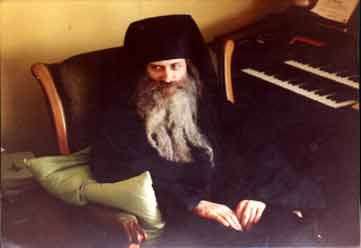
Photo: OrthodoxPhotos.com
Just over a month ago to the day, I received the Father Seraphim Rose Video from the Father Seraphim Rose Foundation.
Yesterday I received the The Teachings of Blessed Hieromonk Seraphim CDs I'd ordered from Hieromonk Lawrence of the Blessed Seraphim Hermitage.
The CDs contain three recordings: "A Word on Fasting During Great Lent," a Molieben for Travelers, and, the longest, "Signs of the Times: An Orthodox Christian Approach" (continued on the second CD). The audio quality is poor to good on the first two tracks. This is in part because the original recordings were analog and the recordings themselves are old; and then analog loses something in being digitized. However the longer and more often one listens to the "poor" spots, the easier it is to discern what's being said. Of course the clearer sections on the first two tracks on CD 1, with the final track on CD 1 and the remainder of the lecture on CD 2, are of quite good quality and make for good listening.
It is, for me, absolutely amazing to hear Blessed Seraphim's voice. I've seen many pictures in his biography (both editions), and online. I've asked his intercessions, but to hear his voice is something else altogether. What a joy.
This was a most blessed and welcome package. But imagine how thrilled I was to discover on opening the parcel that inside were a container of oil from the vigil lamp as well as some soil from Blessed Seraphim's grave! These blessed relics now sit on my icon shelf to aid me in my unworthy prayers.
Glory to God!
December 05, 2004
Father Seraphim Rose Video
On Friday, I finally received from The Father Seraphim Rose Foundation a copy of the video commemorating the twentieth anniversary of his blessed repose. It was $24.95 ($20 for the video and $4.95 S&H;). The picture quality is very good (though some of the editing of parts is a bit choppy). The sound quality is fair, sometimes poor, but not unlistenable.
The video runs just under two hours. On the video you see:
# Trip up the road to the St. Herman of Alaska Monastery
# Sermon by Fr. Thomas Hopko
# Segments from the Divine Liturgy with 12 priests at Fr. Seraphim's grave
# Segments from an English-language Pannikhidas
# Presentation of Fr. Seraphim's vestments to Hieromonk Ambrose (Young)
# Talk by Hieromonk Damascene
# Talk by Hieromonk Ambrose
# Talk by Protopriest Petr Perekrestov of Joy of All Who Sorrow Cathedral, San Francisco
# Reminiscences by Abbot Gerasim and Barbara Murray
# Tour of Fr. Seraphim's Optina cell
# Segments from Slavonic-language Pannikhida at Fr. Seraphim's grave
# Trip down the road
The sermon by Fr. Hopko and the talks by Hieromonk Damascene and Hieromonk Ambrose were printed in the edition of The Orthodox Word which similarly commemorated Father Seraphim's repose.
I very much liked the video tour of Father Seraphim's cell. Amazing to think of him sleeping, praying and working there in the stifling heat of summer and freezing temperatures of winter with nothing but a woodstove for warmth.
But I think the best part of all was the audio excerpts from sermons and talks that Father Seraphim gave which both open and close the video. It moved me to tears. Here was the voice of my patron, whom I ask each day to pray for me, whose books I've read. It was amazing.
For those of you interested in Father Seraphim, I recommend writing the Foundation and obtaining your own copy of the video.
October 13, 2004
Father Seraphim Books
Yesterday, I received in the mail the four books I'd ordered from St. Herman Press, all by my patron, Father Seraphim Rose:
The Soul After Death
The Place of Blessed Augustine in the Orthodox Church
God's Revelation to the Human Heart
Orthodoxy and the Religion of the Future
I've read all these before (see list below), having checked them out from the libraries at the seminary or Loyola, but got some birthday money last month, and had just enough to order these four books and pay for shipping, so I decided to add them to my home collection. (They're also all in newer editions than the ones I've read, so they have extra material I'd like to read, too.)
Although Blessed Seraphim's list of authored books is relatively finite, as can be seen from the list below, his list of translated books is relatively larger. What makes these translated books valuable is not just the translation of previously unavailable texts, but Father Seraphim's godly-wise introductions.
A case in point. I'm currently re-reading the out-of-print Vita Patrum: The Life of the Fathers, a translation of a portion of a work by St. Gregory of Tours (historian of the Franks). (By the way, it is currently in revision and soon to be republished under the title Western Orthodox Roots.) The first one-hundred-fifty pages are a detailed introduction by Father Seraphim on monasticism in fifth and sixth century Gaul, and its relevance to modern Orthodox Christianity. Clearly, Father Seraphim's introductions are important works in their own right.
In any case, I remember reading the books listed above, particularly Orthodoxy and the Religion of the Future and The Soul After Death, and being a bit mystified by them. Keep in mind that this was early on in my intensive investigations into Orthodoxy. On the one hand, much of what they said I could definitely agree with. The dangers of occultism and the lifting up of religious experience over dogma. The necessity of sobriety about one's own death. But there were other teachings of ancient Christianity that struck me as, well, frankly, weird. Prelest, or spiritual delusion, and the necessity to focus on religious struggle. The reality behind the metaphor of the toll-houses.
But recently I reread Father Seraphim's Nihilism, as I commuted on the bus. I also remember my first experience with this book, and coming at it from a philosophical perspective. I thought, "Father Seraphim doesn't understand the philosophers he's criticizing." But now I've got more than a year of Divine Liturgies under my belt, and something like a discipline of daily prayer. I also am more grounded in my academic discipline. So when I came to Nihilism again, I thought, "Man, Blessed Seraphim is dead on."
It was partly as a result of that experience that motivated me to go ahead and purchase these books so I can more receptively take in the godly insights of this saint.
So, although I should have dutifully plowed through "Observing Reason" in Hegel's Phenomenology of Spirit on the commute this morning, instead I pulled out God's Revelation to the Human Heart and read the first section. I was almost in tears. (I'm very emotional of late. What's up with that?) Father Seraphim indeed spoke the truth, a truth he both knew personally and struggled through suffering to know.
Blessed Seraphim, our father in the faith, pray for us.
Works written or translated by, or biographies of, Blessed Seraphim and when I read them:
1. The Soul After Death (November 02 and October 04)
2. God's Revelation to the Human Heart (November 02 and October 04)
3. Heavenly Realm (December 02)
4. [Tr] A Treasury of St. Herman's Spirituality (Little Russian Philokalia v. 3) (December 02)
5. The Place of Blessed Augustine in the Orthodox Church (January 03 and October 04)
6. [Tr] St. Seraphim of Sarov (Little Russian Philokalia v. 1) (January 03)
7. Orthodoxy and the Religion of the Future (February 03 and October 04)
8. [Tr] Vita Patrum: The Life of the Fathers (February 03 and December 04)
9. [Tr] On the Orthodox Veneration of Mary the Birthgiver of God (February 03 and October 04 and October 04)
10. [Bio] Not of This World (October 02-March 03)--Purchased 30 May 03* [Cf. this post here as to why this purchase is significant.]
11. [Tr] The Apocalypse in the Ancient Teachings of Christianity (May 03)
12. Nihilism (July 03 and October 04)
13. [Tr] Orthodox Dogmatic Theology (July 03)
14. [Tr] First-Created Man (July 03)
15. Genesis, Creation and Early Man (August 03)
16. [Tr] Guidance Toward the Spiritual Life (September 03)
17. [Bio] Father Seraphim Rose: His Life and Works (September-December 03 and September-November 04)
18. Letters from Father Seraphim (December 03 and January 05)
19. [Bio] Seraphim Rose: The True Story and Private Letters (March 04 and July 05)**
20. Blessed John the Wonderworker (March 04)
21. [Tr] The Spiritual Life and How to Be Attuned to It (May 04)
22. [Tr] The Path to Salvation (June 04)
23. [Tr] The Northern Thebaid (July 05)
24. [Tr] Abbot Nazarius (Little Russian Philokalia v. 2) (September 05)
*Note: Not of This World is the first edition of Father Seraphim's biography. It was written at a time in the life of the St. Herman Brotherhood in which some problems in leadership in the brotherhood resulted in some regrettable decisions. The end of the book has almost nothing to do with the life of Father Seraphim, and is written to justify some of these questionable decisions. If one is interested in Father Seraphim's life, the second edition of his biography, Father Serpahim Rose: His Life and Works, is a very significant revision and should be considered the authoritative and trustworthy source.
**Note: Cathy Scott is a niece of the late Father Seraphim. Her biography, Seraphim Rose: The True Story and Private Letters was written to counter some of the things written and implied in Not of This World. Unfortunately, Ms. Scott's own biography is marred by her agenda, which includes the revelation early on in the book of Father Seraphim's homosexuality and his homosexual relationship of several years prior to becoming Orthodox, and the contradiction of a handful of points, such as whether and how often Father Seraphim bathed, which seem fairly petty. That Father Seraphim was gay is hardly a matter about which to be concerned; he repented of his behavior upon becoming Orthodox and led a celibate life till his death. But Ms. Scott gives almost no context for Father Seraphim's homosexuality, and seems to imply that Father Seraphim's conversion was an unhealthy one. The book focuses almost exclusively on Father Seraphim's life pre-conversion and on his early years as Orthodox. His life as a monk is given much less coverage. On the one hand, the details learned of Father Seraphim's early life are invaluable in the context of his whole life, especially, given today's obsession with sexuality issues, the revelation of Father Seraphim's life pre-conversion. But if Ms. Scott's book is read by itself, the picture of Father Seraphim one receives is severely distorted. One should read the second edition of Father Seraphim's biography prior to reading Ms. Scott's book.
September 21, 2004
The Ascetical Life of Blessed Seraphim (Rose) of Platina
From The Ascetic Life of Fr. Seraphim Rose, by Father Seraphim's spiritual son, Father Alexey Young:
I had the privilege of knowing him from 1966, around the time of the repose of St. Archbishop John Maximovitch, who was his spiritual father. Fr. Seraphim was a layman at that time--he didn't even have the famous beard of his later years, yet--, and then he became a Reader in the Cathedal shortly after I first met him.I do not know what his Cell Rule was, nor how many prostrations he did. He never spoke of it. He was a very private man. But I and others who were close to him know that he said The Prayer unceasingly and was probably a full hesychast in his last years. I never saw him without a prayer rope moving through his fingers.
He was extremely calm and peaceful at all times. I never saw him angry or agitated about anything (and I saw him in many different situations over the years), and only once ever saw him laugh. Yet he wasn't sour and downcast, either. Just very "still." He wasn't particularly outgoing, but always participated "normally" in situations, although he didn't dominate conversations. His voice was very quiet; you had to really listen in order to hear him, and his singing voice was tenor.
So far as I know, he kept only the usual monastic fast, which included the Fast of the Angels on Mondays. I was present at many, many meals over the years at the monastery. He always ate whatever was on his plate but never reached for seconds. Of course he never ate between meals, and always observed the monastic practice of never having food in his cell. Sometimes, when he was alone at the monastery (which wasn't often), he skipped meals, but this probably had more to do with being an "absent minded professor" than with any ascetic practice. In my home he ate normally, not skimping, but also never having seconds. I once asked him if he had any favorite food, favorite dishes, and he said that he didn't. When I asked the other monks they said they never had any idea of a favorite food, that he never spoke of food at all.
As an ascetic exercise, however, he wore a very heavy scratchy wool neck scarf around his throat, under his cassock, even in very hot weather. I didn't know about this until his last years when, once in a while, it would peek above the level of the neck of his cassock. When I asked the other monks about it they said it was an ascetic practice--like a hair shirt. He felt that unusual or extraordinary ascetic practices were not for our times, however. He said that just to be a good and decent and pious Orthodox Christian was already a huge "ascetic practice"! So he never gave a blessing to any of his spiritual children to do much beyond the normal fasting rules of the Church and the Morning and Evening Prayers in the prayerbook. He allowed me, at that time, to say The Prayer for no more than one half hour a day, and never assigned prostrations (except as appointed during weekday and lenten services) except as a penance. He felt that converts in particular tend to go overboard very easily and then they end up with what he called "spiritual indigestion." Better to go very slowly, he said, and always just "from strength to strength."
Fr. Seraphim took a "sponge bath" at a basin in his cell from time to time, but always took a thorough shower once a year, just before his annual visit to his mother. He never smelled and never looked unclean or dirty. As far as keeping "healthy" in any other ways, I was aware that he took a daily multi-vitamin, only out of obedience, but otherwise he had no interest whatever in health matters. I once asked him if he or the monastery had health insurance. He pointed up with his index finger and said (indicating heaven), "THAT is my 'health insurance'."
I had one or two experiences of his clairvoyance, where he literally read my mind (or rather, read my heart), but this was not a constant or frequent phenomenon in my experience. However, his prayers for someone were very powerful, and after his death I know personally of a very dramatic healing of someone from terminal cancer as a result of his intercession. He clearly is a man for our times. The late Archbishop Anthony of San Francisco said that he was the "first" genuine American "podvizhnik" ("righteous struggler"), and so therefore an example to us all. On the fortieth day after his repose, the late saintly Bishop Nektary--who knew him very well--spontaneously sang a "Magnification" to him as a monk-saint, so this constituted the very first "local veneration" of him. Fr. Seraphim was probably the first authentic patristic scholar in the English language. He would never have said this about himself, of course, but it's true.
August 18, 2004
Fr. Seraphim (Rose) of Platina: On Stability and Christian Striving
“Christianity in practice, and monasticism above all, is a matter of staying in one place and struggling with all one's heart for the Kingdom of Heaven. One may be called to do the work of God elsewhere, or may be moved about by unavoidable circumstances; but without the basic and profound desire to endure everything for God in one place without running away, one will scarcely be able to put down the roots required in order to bring forth spiritual fruits. Unfortunately, with the ease of modern communications one may even sit in one spot and still concern oneself with everything but the one thing needful—with everyone else's business, with all the church gossip, and not with the concentrated labor needed to save one's soul in this evil world.
"In a famous passage of the Institutes, St. Cassian warns the monks of his time to 'flee women and bishops. . . .' Women, of course, tempt by means of the flesh, and bishops by means of ordination to the priesthood and in general by the vainglory of acquaintance with those in high positions. Today this warning remains timely, but for the monks of the twentieth century one can add a further warning: Flee from telephones, traveling, and gossip—for they will cool your ardor and make you, even in your monastic cell, the plaything of worldly desires and influences.”
--Father Seraphim Rose: His Life and Works, p. 459
August 13, 2004
Fr. Seraphim (Rose) of Platina: On the Daily Struggle of Salvation in Christ
[T]he less you think of spiritual life in the abstract and the more you are just struggling in the labors of daily life, praying according to your strength . . . the better for you. Orient yourself towards zealous Orthodoxy, and then just struggle from day to day, and God will give you wisdom.
--Letters from Father Seraphim, p. 133
August 11, 2004
Fr. Seraphim (Rose) of Platina: On the Struggle in the Saving of One's Soul
“We are told by the Holy Fathers,” Eugene [Fr. Seraphim] explained elsewhere, “that we are supposed to see in everything something for our salvation. If you can do this, you can be saved.
“In a pedestrian way, you can look at something like a printing press which does not operate. You are standing around and enjoying yourself, watching nice, clean, good pages come out printed, which gives a very nice sense of satisfaction, and you are dreaming of missionary activity, of spreading more copies around to a lot of different countries. But in a while it begins to torture you, to shoot pages right and left. The pages begin to stick and to tear each other on top. You see that all those extra copies you made are vanishing, destroying each other, and in the end you are so tense that all you can do is sort of stand there and say the Jesus Prayer as you try to make everything come out all right. Although that does not fill one with a sense of satisfaction (as would watching the nice, clean copies come out automatically), spiritually it probably does a great deal more, because it makes you tense and gives you the chance to struggle. But if instead of that you just get so discouraged that you smash the machine, then you have lost the battle. The battle is not how many copies per hour come out: the battle is what your soul is doing. If your soul can be saved while producing words that can save others, all the better; but if you are producing words that can save others and are all the time destroying your own soul, it's not so good.”
--Father Seraphim Rose: His Life and Works, p. 380
March 22, 2004
Fr. Seraphim (Rose) of Platina: On the Mind and Living Faith
When I became a Christian I voluntarily crucified my mind, and all the crosses that I bear have been only a source of joy for me. I have lost nothing and gained everything.
--Father Seraphim Rose (Cathy Scott, Seraphim Rose: The True Story and Private Letters, p. 191)
Orthodoxy is life. If we don't live Orthodoxy, we simply are not Orthodox, no matter what formal beliefs we hold.
--Father Seraphim Rose (Cathy Scott, Seraphim Rose: The True Story and Private Letters, p. 231)
For though we walk in the flesh, we are not waging war according to the flesh. For the weapons of our warfare are not of the flesh but have divine power to destroy strongholds. We destroy arguments and every lofty opinion raised against the knowledge of God, and take every thought captive to obey Christ . . . (2 Cor. 10:3-5 ESV)
March 18, 2004
My Two Encounters with Seraphim Rose at Barnes and Noble
I have had encounters with Father Seraphim on two occasions, now, at the Barnes and Noble in Evantson.
My first encounter was entirely by "accident." It was 30 May last year, and I had gone to see the movie "X2: X-men United" in the early afternoon. After the movie I had had about an hour to kill till Anna left work to pick me up. I had originally decided to just cross the street and head into Borders for some coffee and to do some reading. For some reason, however, I thought I'd head to the library. But while on the way, I decided it would be too far to walk to the library and back, so Barnes and Noble happened to be on the way and I ended up stopping there and browsing. I had no desire to buy any books, nor did I even have any books in mind that I was really wanting to get. But as it happened, while browsing in the Christian section I happened upon the out of print original edition of Father Seraphim Rose's biography, Not of This World. I was stopped in my tracks.
I should at this point tell how St. Benedict came to be my patron. While I was still in Bible college, and only just beginning my journey to historic Christianity, I happened to be on a short trip to one of our sister colleges and seminaries in Lincoln, Illinois. I'd already done some reading about St. Benedict through my then-new interest in monasticism, and had read some snippets from St. Benedict's Rule. While in the college bookstore--a conservative evangelical bookstore, mind you--I happened to notice a copy of the Rule. I bought it without a second thought. It was, at the very least, a serendipitous moment. And although I then had no concept of what a patron saint was, I began to have an affinity of sorts with St. Benedict, his rule, and monasticism.
So, there I was last year in Barnes and Noble having an almost identical encounter, some thirteen years later. Although I had not yet considered Father Seraphim Rose my patron saint--that spot had long been held by St. Benedict--this "chance" encounter was so similar to how St. Benedict "found" me, that I took it as an indication another saint had "picked" me.
Needless to say, I purchased the book and soon thereafter began asking for the intercessions of Father Seraphim along with St. Benedict. The more I learned about Father Seraphim, the more convinced I became of his sanctity.
So, the new biography came out in the fall, and I purchased it. Shortly thereafter, I acquired Nihilism and Genesis, Creation, and Early Man, and of course I had several months before read other of Father Seraphim's writings. Then I picked up a copy of Letters from Father Seraphim. The only remaining book that I had thought I wanted to get was Cathy Scott's biography, Seraphim Rose: The True Story and Private Letters.
Which brings me to yesterday, and my second encounter with Father Seraphim. I had ordered the Cathy Scott book through Barnes and Noble, so this was to be a planned meeting. While I was waiting for the shuttle to take me to Loyola to teach, Barnes and Noble called. My book was in. I hot-footed it to the store, and picked up the book.
I'm not a big fan of Barnes and Noble (they crowded out the local college bookstore at Loyola, earning my continuing disrespect), but since I've encountered Father Seraphim there twice in less than a year, I need to remember and be grateful.
December 17, 2003
Fr. Seraphim (Rose) of Platina and Self-Defense
What an interesting juxtaposition of events today.
First, I've been reading from the book, Letters from Father Seraphim, edited by Hieromonk Ambrose (formerly Fr. Alexey Young). He makes these remarks regarding St. Seraphim's understanding of suffering and the faith:
[H]e believed that when suffering comes as a result of our own immaturity and mistakes, it has value only if we learn from that suffering. To embrace the sorrows and difficulties that result from our own fallen human nature, or those which are sent to us from "outside" by persecution and misunuderstanding, must not entail self-pity, but should soften our hearts hardened by sin and refine our spiritual nature, making us depend more and more on God alone. One must accept these sufferings without complaining or they have no spiritual value. Often Fr. Seraphim spoke of the need to "suffer through" some particular problem or difficulty. By this he meant that one should endure, again without complaining--which is one of the best tools for spiritual growth. (p. 163)
And about a person who had come to the monastery for guidance, Fr. Seraphim writes to Hieromonk Ambrose:
He accepted everything I said, including the necessity to put off his habit of self-justification . . . .
My general impression is this: his habit of self-pampering and self-justification is so deep that humanly his case is almost hopeless. But there is God. We should continue to help and support him--and firmly insist that he change, persistently working on himself. . . .
I think this whole thing is given you by God to give you insight into how deep is sin in man, and how stubborn is human self-will and resistance to amendment of life, even in sincere converts. (p. 194)
Then, because I have no permission to share details I will have to be vague, in a series of email exchanges on a particular group to which I subscribe, I found myself in the position of responding to allegations as to my honesty and integrity. Admittedly, I now see how diametrically opposed are some of my theological beliefs with those of most of the ones in the group. But I little suspected that I would be made to look like some cyber troll or agent provocateur. I'm used to defending my beliefs. I'm not so used to having my motives impugned and maligned. How does one respond to allegations that one has bad motives? I did it the only way I could, by highlighting how my actions demonstrated my integrity.
I doubt it swayed those who were suspicious to begin with.
But all this got me to thinking. Dare I take on the Lenten discipline of not justifying myself in anyway for anything for 40 days during Great Lent? (Gulp.)
Fr. Seraphim (Rose) of Platina and Self-Defense
What an interesting juxtaposition of events today.
First, I've been reading from the book, Letters from Father Seraphim, edited by Hieromonk Ambrose (formerly Fr. Alexey Young). He makes these remarks regarding St. Seraphim's understanding of suffering and the faith:
[H]e believed that when suffering comes as a result of our own immaturity and mistakes, it has value only if we learn from that suffering. To embrace the sorrows and difficulties that result from our own fallen human nature, or those which are sent to us from "outside" by persecution and misunuderstanding, must not entail self-pity, but should soften our hearts hardened by sin and refine our spiritual nature, making us depend more and more on God alone. One must accept these sufferings without complaining or they have no spiritual value. Often Fr. Seraphim spoke of the need to "suffer through" some particular problem or difficulty. By this he meant that one should endure, again without complaining--which is one of the best tools for spiritual growth. (p. 163)
And about a person who had come to the monastery for guidance, Fr. Seraphim writes to Hieromonk Ambrose:
He accepted everything I said, including the necessity to put off his habit of self-justification . . . .
My general impression is this: his habit of self-pampering and self-justification is so deep that humanly his case is almost hopeless. But there is God. We should continue to help and support him--and firmly insist that he change, persistently working on himself. . . .
I think this whole thing is given you by God to give you insight into how deep is sin in man, and how stubborn is human self-will and resistance to amendment of life, even in sincere converts. (p. 194)
Then, because I have no permission to share details I will have to be vague, in a series of email exchanges on a particular group to which I subscribe, I found myself in the position of responding to allegations as to my honesty and integrity. Admittedly, I now see how diametrically opposed are some of my theological beliefs with those of most of the ones in the group. But I little suspected that I would be made to look like some cyber troll or agent provocateur. I'm used to defending my beliefs. I'm not so used to having my motives impugned and maligned. How does one respond to allegations that one has bad motives? I did it the only way I could, by highlighting how my actions demonstrated my integrity.
I doubt it swayed those who were suspicious to begin with.
But all this got me to thinking. Dare I take on the Lenten discipline of not justifying myself in anyway for anything for 40 days during Great Lent? (Gulp.)
Fr. Seraphim (Rose) of Platina: His Turning to Orthodoxy, Pt. II
[Eugene, the future Father Seraphim, briefly commented later in life on his attending his first Orthodox worship service: ] ". . . [W]hen I entered an Orthodox church for the first time (a Russian church in San Francisco) something happened to me that I had not experienced in any Buddhist or other Eastern temple; something in my heart said that this was 'home,' that all my search was over. I didn't really know what this meant, because the service was quite strange to me, and in a foreign language. I began to attend Orthodox services more frequently, gradually learning its language and customs." . . .
After his first experience of an Orthodox service, Eugene attended services in a number of Orthodox churches. Above all he was attracted to the Russian tradition. In San Francisco, three overlapping "jurisdictions" of the Russian Orthodox Church were represented: the Russian Church Abroad, the American Metropolia [N. B.: Later to become the Orthodox Church of America (OCA)], and the Moscow Patriarchate. Eugene went to services in the church of all three.
In 1957 Eugene was profoundly moved while attend the Holy Week and Pascha (Easter) services in the various Russian churches in San Francisco, espeically in the Holy Trinity Cathedral of the American Metropolia. At that time the Metropolia's ruling hierarch in San Francisco was Bishop John Shahovsky. A highly regarded and influential church figure, Bishop John had grown up as a prince in pre-Revolutionary Russia. He was tonsured a monk on Mount Athos, Greece, in 1926, and served as the dean of St. Vladimir's Seminary in New York before being appointed Bishop of San Francisco and Western American in 1950. . . .
Eugene's experience in the Russian Cathedrals--both of Archbishop Tikhon and Bishop John--did not bring about an immediate change in him. A seed had been planted, one that would grow inside of him and later transform him into a new being. Almost three years would pass between his first entrance into an Orthodox Cathedral and the time when he would come to know Him Who was depicted in the Cathedral's icon.
--Father Seraphim Rose: His Life and Works, pp. 83-84, 86
December 16, 2003
Fr. Seraphim (Rose) of Platina: His Turning to Orthodoxy, Pt. I
At Jon's recommendation, Eugene [N.B.: the future Father Seraphim] went first to the Cathedral of the Russion Orthodox Church Abroad in the heart of San Francisco, dedicated to the icon of the Mother of God "Joy of All Who Sorrow." Having formerly been an Episcopal church, the Cathedral had tall stained glass windows in front and along the walls. Its vaulted ceiling had been made from boards taken from old sailing vessels; and indeed, standing beneath its arches one felt as if one were inside some great ark.
Eugene arrived at the Cathedral in time for the Vespers service. Red oil lamps flickered before a gold iconostasis, illumining holy images of Christ and His Mother. From the left side of the Cathedral and from the choir loft came beautiful antiphonal singing in a language foreign to Eugene's ear. On a small platform in the middle of the nave stood a crippled, bent-over old man with a white beard and purple vestments. This was Archbishop Tikohn Troitsky. Totally immersed in the service, he kept his eyes closed in a state of utmost attention. Whenever he would open them, they would be stern and command complete alertness from those who served with him.
The small figure of Archbishop Tikhon made a tremendous impression on Eugene. Perhaps Eugene saw even then that he was not just performing according to a carefully choreographed ritual, but was in a state of deep prayer. What Eugene did not know then was that Archbishop Tikhon had been a man of prayer all his life, having received his spiritual training from the God-illumined Elder Gabriel of Kazan and Pskov in Russia. In his small quarters attached to the Cathedral, Archbishop Tikhon spent more time in prayer than anything else, and would keep vigil whole nights through.
In the Cathedral, the intensity of all that was happening around him touched the soul of Eugene--this seemingly incidental visitor. He witnessed the beauty of the traditional art and music, but, even more, he sensed the fulfillment of his longing to leave this world--since what he beheld was otherwordly.--Father Seraphim Rose: His Life and Works, pp. 81, 82
October 07, 2003
Fr. Seraphim (Rose) of Platina: His Life (Pre-Conversion)
[Note: On 24 September 2003, I received the revised biography of Father Seraphim Rose, one of my patron saints. I am currently reading slowly through the massive, 1100-plus-page volume. I will from time to time post excerpts here that I find relevant, moving or convicting.]
Long before the word "hippie" entered our lexicon, the progressive intellectuals of San Francisco had turned away from the American dream, with its ideals of family and Judeo-Christian religion. They were delving into anything that was different, drawing above all from Eastern religions. In rejecting Western morality and taking only what they wanted from the East, they were free to explore forms of debauchery, degradation, and perversion with what Eugene [N.B.: the future Father Seraphim] would later refer to as "the spirit of lawlessness." . . .
Eugene, too, would follow this philosophy to its logical conclusion. Together with many of his young contemporaries, he entered upon a life of hedonism and sexual immorality. . . .
Compared with what went on in San Francisco bohemian subculture, the acts of nonconformity among Eugene's friends at Pomona [where Eugene earned his undergraduate degree] were quite tame. In some letters to his Pomona friends, Eugene took on the flippant, devil-may-care attitude of a twenty-two-year-old youth experimenting in what before had been barred to him; but this seems to have been just bravado. As he stated in later years, this was the darkest, most miserable period of his life. Forbidden deeds, he said, had disgusted him even at the time he was committing them. They would precipitate long periods of depression afterward. . . .
Many years later, describing the end of his exploration and experimentation outside the will of God, he could only say, "I was in hell. I know what hell is." . . .
This was a hell that Eugene wished on no one. In later life he said that certain sinful realities, which he had known while being in that hell, are best left unmentioned so that they will not be put into the air. . . . [N. B.: It is now known that Eugene was referring, in part, to his homosexual activities and to his alcohol abuse.]
--Father Seraphim Rose: His Life and Works, pp. 55, 57, 59, 61
March 25, 2003
Blessed Seraphim Rose
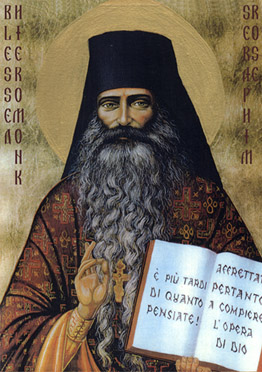
It's later than you think! Hasten therefore to do the work of God.
I've been reading, this past six months, in between homework and papers, the 1000-page biography of Fr. Seraphim (ne Eugene) Rose, Not of This World, a convert to Orthodoxy (in 1962), who became a monk, co-founding the St. Herman of Alaska Brotherhood (whose publishing ministry can be found here). (Note: The biography, in its first edition, is marred by some of the jurisdictional politics that was all too rife in the 70s and 80s. A critique of the first edition, by a close friend of Fr. Seraphim, can be found here. A second edition, Fr. Seraphim Rose, is in process now, and is expected to be published soon.) Fr. Seraphim died in 1982, in his late forties.
I'm impressed by two things about Fr. Seraphim. First, his humility. A brilliant linguist and Sinologist, he turned away from a career in academia (for which he was clearly suited) to go "further up and further in" to the faith and life of the Orthodox Church. This meant for him, in time, monasticism and the priesthood. In this vocation, his strong mind was used for God, and by no means wasted. He both wrote articles in and translated works from Chinese, Greek, Latin, French, Russian, and other languages, both in their modern and more ancient forms. He read and criticized important philosophical and theological works. He was nonetheless deeply engaged in the culture of modern U. S. society, and offered deep reflections and criticisms of important movements. He was among the first to warn of the impending dangers of Jonestown, and of what has come to be known as the New Age movement. But his humility was also evident in his refusal to take part in the ecclesial controversies of his day. He sought the deeper and more genuine expression of Orthodoxy and the Church, and not the shallow, soul-destroying allegiances of church politics.
I am also impressed by his urgent desire to go ever deeper into the faith and life of the Church. Not content to read about the vibrant life of monasticism, he forged ahead, with the blessing of his spiritual father, St. John Maximovitch, founding a monastery and eventually being received into the monastic life. He knew what it was to suffer, and how suffering could play a role in the redemption of one's soul. May I capture even the smallest portion of such a spirit! (Goodness knows, I couldn't take the whole thing!)
May his memory be eternal.